DApps: What Are Decentralized Applications and Why Do They Matter?

Every app on your phone has a landlord. Instagram owns your photos. Uber takes a 25% cut of every ride. Your bank can freeze your account on a Tuesday morning and not tell you why until Friday. We have all agreed to this arrangement because, well, there was not really an alternative.
DApps are the alternative. Short for decentralized applications, these decentralized platforms run on blockchains instead of some company's servers in Virginia. No single owner. No terms of service that change every month. No one harvesting your data while you sleep. Over 21,000 of them exist across 75+ blockchains as of late 2025, and roughly 18.7 million wallets touch them on any given day, per DappRadar.
Is this still a niche thing for crypto nerds? The DeFi sector alone holds $97.6 billion in locked value as of March 2026. That is more than the GDP of most countries. So no, not niche anymore.
How do dapps actually work?
Let me explain this without making your eyes glaze over.
A normal app: you tap a button, your phone talks to a company's server, the server does the thing, sends back the result. Simple. One company runs it all. When their server goes down, the app goes down. When they decide to change the rules, the rules change.
A dapp works differently. Dapps operate on blockchain technology instead of centralized servers. The backend does not live on one server. It lives on a peer-to-peer network of thousands of computers (called nodes) that all run the same code. When you do something on a dapp, here is what happens:
1. You open it through a crypto wallet (MetaMask is the popular one)
2. You click "swap" or "lend" or "buy"
3. Your wallet creates a transaction and broadcasts it to the network
4. Nodes across the planet verify that transaction
5. A smart contract, basically a chunk of self-running code, does the actual work
6. The blockchain records everything. Permanently.
The smart contract part is what makes dapps different from just putting a website on a bunch of servers. Smart contracts are open-source programs that do exactly what they were coded to do. Nobody can tweak them after launch. Nobody can make exceptions. If the code says "swap token A for token B at this ratio," that is exactly what happens. Think of it like a vending machine you cannot hack. Put in the money, get the snack. No cashier needed.
What you actually see and click on, the frontend, is usually just a normal website. The difference is all in the backend and who controls it.
| Part | Normal app | Dapp |
|---|---|---|
| Backend | Corporate server | Blockchain network |
| Rules | Set by the company | Written in smart contracts (open-source) |
| Login | Email, password, phone number | Crypto wallet (no personal data) |
| Data | Stored on centralized servers | On a distributed ledger |
| Who's in charge | The company | The code + token holders who vote |
| If servers crash | App dies | Network keeps running on thousands of nodes |
Where do dapps live? The blockchain landscape
Here is something that surprised me when I first got into this. Not all blockchains do the same thing well. Some are fast. Some are cheap. Some have the deepest pools of money and developers. The landscape in 2026 looks like this:
BNB Chain has the most dapps by raw count: 5,836. It passed Ethereum (5,096) in mid-2025, mostly because it is cheap to deploy on. Polygon runs 2,473 dapps, Arbitrum has 762, and Base, backed by Coinbase, is the fastest growing at 740.
But if you follow the money, Ethereum still dominates. It holds about 68% of all DeFi value. The biggest dapps launched there first. Solana is the interesting challenger with $9.2 billion in DeFi TVL and transaction speeds that make Ethereum feel like dial-up.
| Chain | Dapp count | Why people use it | DeFi TVL |
|---|---|---|---|
| BNB Chain | 5,836 | Cheap, fast, works with Ethereum tools | ~$5B |
| Ethereum | 5,096 | Biggest ecosystem, most money, deepest talent | ~$66B |
| Polygon | 2,473 | Low fees, Ethereum sidechain | ~$1B |
| Solana | 1,000+ | Blazing fast, growing DeFi scene | ~$9.2B |
| Arbitrum | 762 | Ethereum L2 with lower gas | ~$3B |
| Base | 740 | Coinbase-backed, growing fast | ~$3B |
What kinds of dapps exist?
More than you would guess. This is not just "swap coins on a website."
DeFi: the money layer
DeFi. Decentralized finance. The biggest category by far, and the one that scares traditional financial services the most. Lending, borrowing, swapping tokens on decentralized exchanges, farming yield. All without relying on a bank, a credit score, or an intermediary asking for your passport.
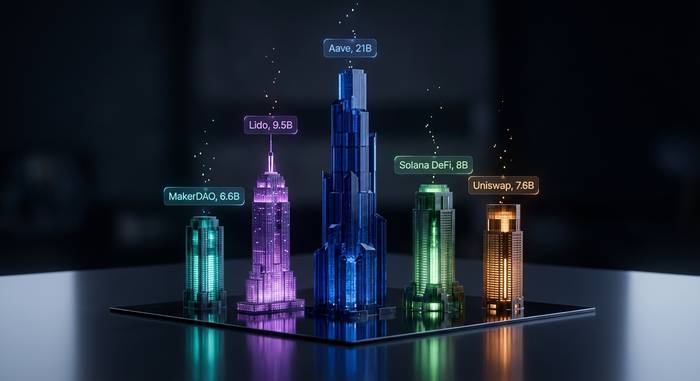
Aave has $54.98 billion locked in it. You throw in some ETH, other people borrow it, and you get paid interest. Smart contracts handle the matchmaking. What I find wild is that Aave has never been hacked. That matters when the only thing standing between your money and theft is a few thousand lines of code.
Uniswap moves more than half the volume on decentralized exchanges on any given week. There is no order book. Instead, people drop tokens into liquidity pools, and traders swap against those pools. I have personally used Uniswap hundreds of times. It takes about 15 seconds and the only person involved is me.
Lido has $25.85 billion in it and does liquid staking. You give it your ETH, it gives you stETH tokens. Your original ETH earns staking rewards. Your stETH goes to work in other DeFi protocols. Double dipping on the same capital. Try asking your bank if you can do that.
Gaming and NFTs
Web3 gaming hit $33.42 billion in 2026 and pulls in 4.66 million daily wallets, more than DeFi and NFTs combined by daily user count.
The story everyone should know is Axie Infinity. At its peak in 2021, 2.8 million people played every day. In the Philippines, whole families were earning a living from it. Then the in-game token SLP crashed 99%, from $0.40 to $0.004. Player count dropped to 225,000. The Ronin chain Axie runs on has since recovered (419,000 daily wallets in Q3 2025) but Axie itself never did. If you need one example of why "play-to-earn" is not a job, this is it.
OpenSea let people buy and sell NFTs across blockchains during the 2021-2022 frenzy. Bitcoin NFTs (Ordinals) also blew up in 2023. OpenSea is still around, though volumes are a fraction of what they were.
Decentralized social media
Lens Protocol and Farcaster let you own your social graph. Your posts, your followers, your connections, all on the blockchain. If one app treats you badly, you take your audience to another one built on the same protocol. That alone makes it fundamentally different from Twitter or Instagram, where leaving means starting from zero.
Daily users dropped from 3.8 million to 1.57 million in Q3 2025, per DappRadar. Still early. Very early.
Supply chain management and real-world stuff
Less sexy, possibly more important long-term. Some dapps verify that products are what they claim to be. Is that "organic" coffee actually organic? Are those "conflict-free" diamonds actually conflict-free? Blockchain makes that trackable from the mine or the farm to the shelf. Other dapps handle voting, healthcare records, and peer-to-peer energy trading.
Why would anyone use dapps over normal apps?
Honestly? Because normal apps get away with a lot of stuff we have just gotten used to.
Money. Swap tokens on Uniswap and you pay a gas fee. Done. No $7 commission. No hidden spread. Nobody skimming a percentage from page 47 of a terms of service document you never read.
Privacy. You connect one of your cryptocurrency wallets. The dapp does not know your name, your email, your birthday, where you live. There is nothing for advertisers to buy because there is nothing to sell. Compare that to Gmail reading your emails to sell you shoes.
Uptime and censorship resistance. AWS went down in 2024 and half the internet broke for hours. A blockchain runs on thousands of nodes in dozens of countries. There is no CEO who can flip a switch and shut it off. I have had DeFi positions earning yield through three separate exchange outages. My Aave deposits did not care.
Openness. You can read every line of code in a dapp. You can see every transaction on the ledger. Try asking Meta to show you how their algorithm decides what you see in your feed. You will get a PR statement and a link to their transparency report, which tells you nothing.
The problems nobody should ignore
Look, I am a fan of this technology, but I am not going to pretend it is smooth sailing.
Scalability is a bottleneck. Ethereum does 15-30 transactions per second on a good day. Visa does 65,000. L2 chains like Arbitrum and Base cut costs and add speed, but they do not magically make blockchain as fast as a credit card tap.
Fees are unpredictable. I have paid $3 for a swap on a quiet Tuesday and $87 for the exact same swap on a Saturday when everyone was minting something. Solana and BNB Chain are cheaper but sacrifice some degree of decentralization for that speed.
Smart contract bugs do not get patched. This is not your iPhone updating overnight. Once a contract is live, it is live. A flaw in the code becomes a target. In 2024, hackers stole $2.2 billion from crypto projects across 303 incidents. In 2025, $3.4 billion, per Chainalysis. The Bybit attack in February 2025 drained $1.5 billion because North Korean hackers got into one developer's laptop. One laptop.
Using dapps is still confusing. Setting up MetaMask, writing down seed phrases, guessing gas fees, clicking "approve" on transactions you half-understand. My friend who works in traditional finance tried Uniswap last month and gave up after 20 minutes. Account abstraction will eventually fix this, but we are years away from dapps feeling like Venmo.
Nobody knows the rules yet. MiCA gives Europe some framework. The US is still arguing. Building a product on legal quicksand is not something most developers signed up for.
| Problem | What it means for you | What is being done |
|---|---|---|
| Slow speeds | Waiting for transactions to confirm | L2 chains (Arbitrum, Base, Optimism) |
| Gas fee spikes | Expensive to use during busy times | Alt chains (Solana, BNB), rollups |
| Smart contract exploits | Funds can be drained if code has bugs | Audits, bug bounties, formal verification |
| Confusing UX | Hard to onboard new users | Account abstraction, social logins |
| Legal gray area | Rules keep changing | MiCA (EU), US crypto policy in progress |
How to actually start using dapps
Alright, if I have not scared you off, here is the practical stuff.
Step one: get a wallet. MetaMask for Ethereum stuff, Phantom for Solana. Free browser extensions or mobile apps. When it spits out 12 or 24 random words, write those on paper. Physical paper. Not your Notes app, not a screenshot, not a Google Doc. Tape it inside a book you never lend out. That seed phrase is the only way back in if your phone ends up in a lake.
Step two: buy a small amount of crypto. ETH for Ethereum dapps, SOL for Solana. Use Coinbase or Kraken. Send it to your wallet. I am talking $50 here. You are learning, not investing.
Step three: pick one well-known dapp and actually use it. Uniswap for a simple token swap. Aave if you want to try lending. Connect your wallet, make one small move, and pay attention to everything. How long does the transaction take? What does the gas fee feel like? How does it compare to sending money on PayPal?
Step four: before you connect to some random site, ask yourself a few things. Did an audit firm review the smart contracts? Can you read the code? How long has it been live? How much money is in it? If a DeFi protocol you have never heard of promises 10,000% returns and went live last Thursday, close the tab.
Step five: once you move past pocket change, get a hardware wallet. Ledger. Trezor. Keep the bulk of your holdings offline. Hot wallet stays for dapp money you are okay losing.
What is next for dapps?
The dapp market was around $30 billion in 2024. Analysts at Virtue Market Research project $70 billion by 2030. Precedence Research thinks DeFi alone could hit $954 billion by 2035. I am skeptical of any number that far out, but the direction is pretty obvious.
What actually needs to happen? The UX has to stop punishing users. Passkey logins, gas sponsoring, and account abstraction are chipping away at the friction, but slowly. L2 chains need to get cheap enough that a $5 swap does not cost $4 in fees. And the big one: real-world assets like bonds, real estate, and equities are starting to show up on-chain. When your mortgage lives on Ethereum and your stock trades settle through a smart contract, the line between "app" and "dapp" stops meaning anything.
Here is my take on how this plays out. Most people will never care about decentralization the way crypto people do. They will not run nodes or read smart contract code. But they will notice when an app does not ask for their social security number, does not crash at 2 AM, and does not skim 3% off every transaction. That is the win. Not the ideology. The experience.