S&P 500 Price Prediction 2026-2050

The S&P 500 index remains the most widely used benchmark for evaluating the performance of the U.S. stock market. As a market-capitalization-weighted index representing 500 companies across key sectors, it reflects the health of financial markets, corporate earnings, and long-term economic growth. This article delivers a comprehensive analysis focused on forecasting the S&P 500 beyond the near-term cycle, emphasizing a detailed price prediction for 2026 and extended long-term forecasts through 2030, 2035, 2040, and even 2050.
The purpose of this research is not investment advice, but an analytical framework that helps an investor understand how analysts make predictions, how market trends evolve, and why the index could grow—or decline—under different scenarios.
Historical Context and Market Structure
Understanding the history of the S&P 500 is essential when predicting the S&P 500. Since its formal expansion to 500 companies in 1957, the index has survived recessions, wars, inflation shocks, and multiple drawdown phases while still producing long-term gains.
The value of the S&P 500 has historically increased in line with GDP growth, productivity improvements, and innovation cycles. Based on historical data from 2023 and 2024, the index fluctuated significantly, reflecting inflation fears, monetary tightening, and later recovery supported by improving corporate earnings.
As a market-capitalization-weighted index, larger companies exert more influence on index price movements, meaning concentration risk remains a critical valuation metric.
Current Price and Market Position
The current price of the index sits near a recent all-time high, reflecting optimism across the broader market. The latest S&P 500 readings suggest the index has already hit a new all-time high, reinforcing bullish sentiment among long-term investors.
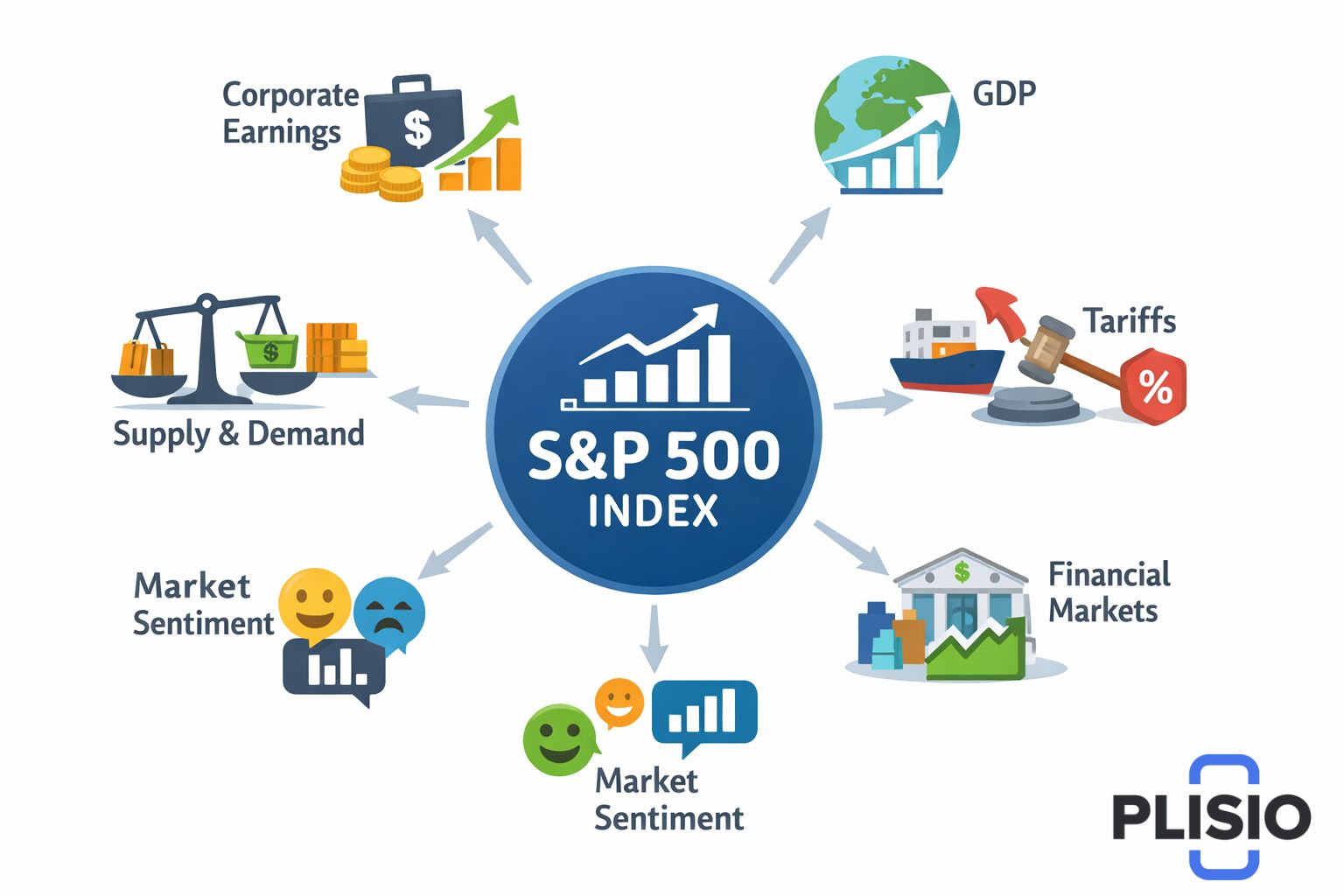
Despite strong momentum, valuation remains elevated by historical standards, raising questions about the lowest price the index could revisit during a correction. Market sentiment, supply and demand dynamics, and expectations for earnings growth all play a role in shaping the S&P 500’s short- and medium-term trajectory.
S&P 500 Price Forecast for 2026
The central focus of most institutional models is the forecast for 2026. The consensus index forecast suggests moderate but sustained growth driven by earnings expansion and productivity gains.
SPX Price Forecast for 2026 (Scenarios)
|
Scenario |
Estimated Index Price |
Key Assumptions |
|
Bullish |
7,800–8,700 |
Strong earnings, AI-driven efficiency, stable inflation |
|
Base Case |
7,200–7,800 |
Normalized growth, balanced valuation |
|
Bearish |
6,500–6,900 |
Valuation compression, macro uncertainty |
This 500 price forecast for 2026 shows that while upside remains possible, downside risks cannot be ignored. The forecast suggests volatility, particularly in the second half of the year.
The price prediction for 2026 assumes no systemic financial shock and steady global growth. According to multiple analyst models, the index is expected to grow gradually rather than surge aggressively.
Technical Analysis and Indicators
Technical analysis plays a supporting role in short-term trading decisions. Common technical indicators include RSI, MACD, and moving averages, which help identify overbought or oversold conditions.
When RSI remains elevated for prolonged periods, the index could experience a pullback. MACD crossovers often precede trend changes, while long-term moving averages define structural support levels. These tools do not make predictions on their own but complement fundamental valuation analysis.
Long-Term Forecasts: 2028 to 2030 and Beyond
Long-term forecasts rely on assumptions about productivity, demographic trends, and technological change.
|
Year |
Projected Range |
Key Drivers |
|
2028 |
8,000–9,200 |
Earnings growth, market stability |
|
2029 |
8,500–10,000 |
Capital investment, margin expansion |
|
End of 2029 |
Upper range scenario |
Sustained bullish momentum |
|
2030 |
9,000–11,700 |
AI adoption, efficiency gains |
By 2030, the index will reach levels that depend heavily on valuation discipline and earnings quality. Artificial intelligence is increasingly cited by strategist teams as a structural growth catalyst rather than a short-term narrative.
Extended Outlook: 2035, 2040, and 2050
Looking further ahead introduces uncertainty, but long-term forecasts remain broadly optimistic. By 2035, the index to grow past previous valuation ceilings depends on productivity gains and global capital flows.
For 2040, models diverge significantly, reflecting different assumptions about inflation, demographics, and geopolitical stability. By 2050, projections become illustrative rather than precise, highlighting how financial markets reward long-term participation despite cyclical setbacks.
Bullish and Bearish Perspectives
A balanced S&P 500 price prediction must include both sides.
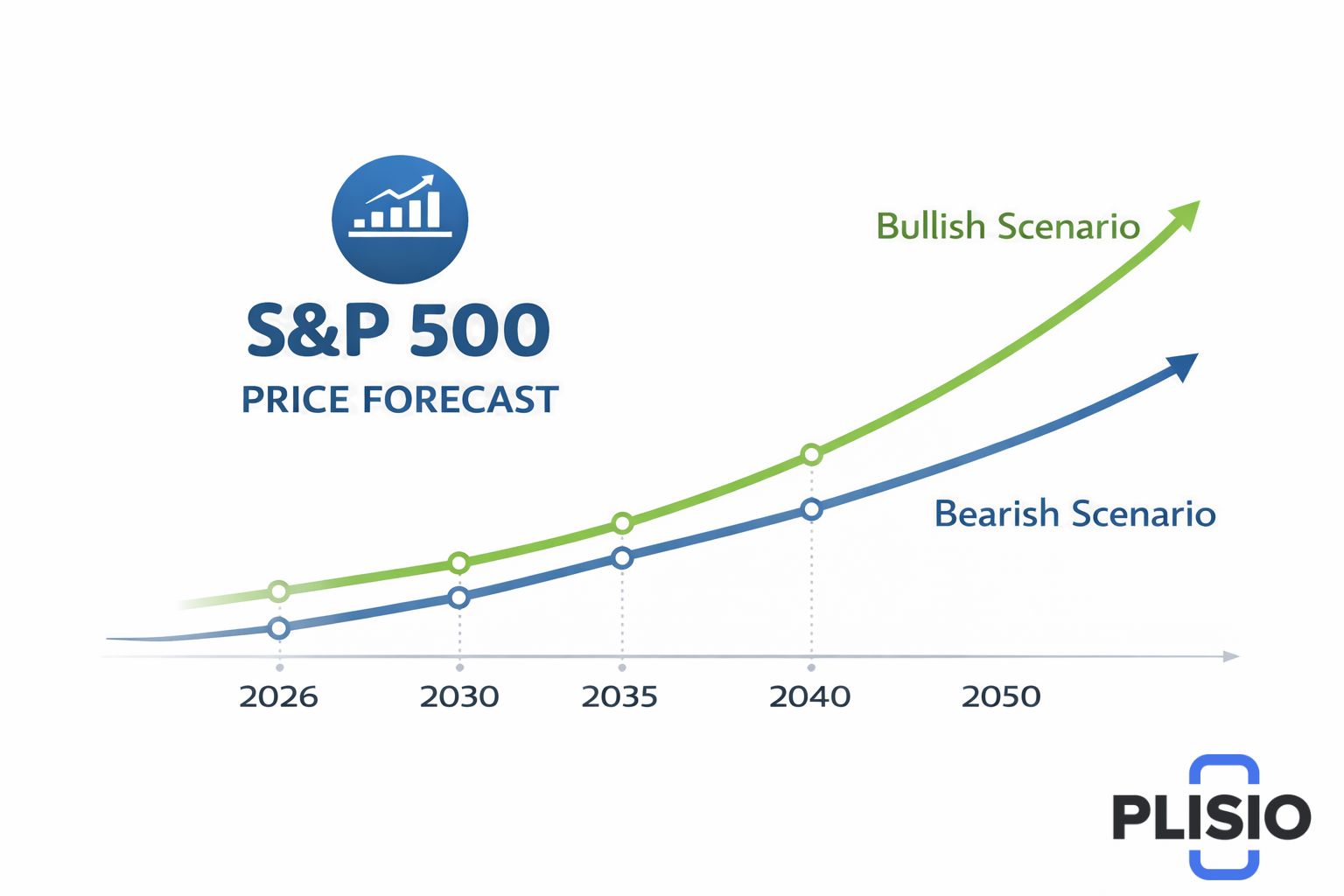
Bullish arguments emphasize earnings growth, innovation, and strong balance sheets. Bearish views focus on elevated valuation, potential drawdown risk, and sensitivity to tariff changes or policy errors.
Understanding both perspectives helps investors avoid emotional buy or sell decisions driven by short-term noise.
Factors That Influence the Index
Key factors that influence the S&P 500 forecast include corporate earnings, GDP growth, interest rates, tariff policy, and investor psychology. Market sentiment often amplifies price movements beyond fundamentals, especially during periods of uncertainty.
The broader market context matters as well, since sector rotation can distort index-level signals even when individual stocks diverge.
Investment Considerations
This analysis is not personalized investment advice. A financial advisor can help align investment decisions with an individual investment horizon and risk tolerance. For many investors, exposure through an ETF remains the simplest way to track index price performance.
Long-term participation, diversification, and disciplined valuation awareness remain core principles for navigating the stock market.
Conclusion
The S&P 500 price forecast points toward continued growth over the long run, with the price prediction shaped by earnings, valuation, and macroeconomic stability. While forecasting always carries uncertainty, historical resilience suggests the index will remain a central pillar of global financial markets.
Investors should view the S&P 500’s evolution as a dynamic process—one where patience, data-driven analysis, and risk management matter more than precise point predictions.