Oasis Network (ROSE): Blockchain, Cryptocurrency, and Market Overview

Cryptocurrencies are no longer just a topic for tech enthusiasts. Over the past few years, the cryptocurrency market has moved closer to everyday life, driven by rapid adoption, media attention, and shifting crypto trends. While bitcoin and ether dominate headlines, many altcoins and blockchain projects develop more quietly, focusing on specific use cases.
• Blockchain: Oasis Network blockchain (Layer‑1)
• Native token: ROSE (rose coin)
• Consensus: Proof‑of‑Stake with validators
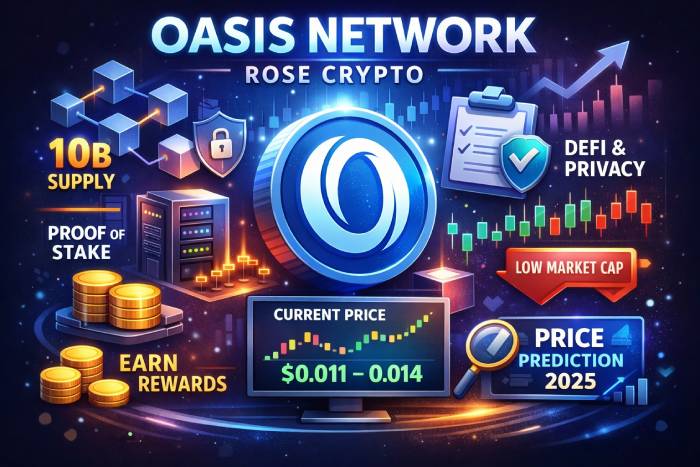
• Max supply: 10 billion ROSE tokens
• Circulating supply: ~7.4-7.5 billion ROSE
• Focus: Privacy‑focused smart contracts, DeFi, Web3, responsible data
• Key layers: Consensus Layer and ParaTime Layer
Oasis Network is one such project. Oasis Network is a privacy-focused, scalable blockchain designed for Web3 and open finance. It supports smart contract development and decentralized applications (dApps), with an emphasis on responsible data use. This makes Oasis Network crypto part of a broader effort to bring blockchain technology beyond traders and early adopters to a mass market.
Below, we explain how the Oasis blockchain works, what the ROSE token is used for, and how the network fits into the wider digital asset ecosystem.
Oasis Network Crypto Explained: Blockchain That Aims for Scalability and DeFi
Oasis Network is a layer-one, proof-of-stake blockchain that aims to support decentralized finance (DeFi), data tokenization, NFTs, DAOs, and other Web3 applications. Because it enables smart contracts and on-chain logic, it is often compared to Ethereum and other smart contract platforms.
At the same time, Oasis Network’s architecture is designed differently. The blockchain that aims to balance scalability, privacy, and low transaction fees separates consensus and execution, allowing the network to remain scalable as usage grows.
Despite similarities with Ethereum, Oasis Network differs in several key areas:
Scalability - The network works more efficiently as more validator nodes join. This design helps Oasis remain scalable while maintaining fast transaction speeds.
Security - Oasis Network relies on a decentralized set of validators and Byzantine Fault Tolerance to support secure validation of transactions.
Transaction fees - Compared with many blockchains, transaction fees on Oasis Network are relatively low, even during periods of higher network activity.
Decentralize - The network’s performance improves as more nodes participate, strengthening decentralization over time.
Privacy - Oasis Network supports the creation of private smart contracts, helping users maintain ownership of their data.
These features make the Oasis Network ecosystem attractive for developers building privacy-focused dApps and DeFi products.
Oasis Network and Oasis Labs: Team, Blockchain Vision, and Ecosystem
Oasis Network was created by a team with strong academic and industry backgrounds. The project was founded by Dawn Song, a professor at the University of California, Berkeley, and a leading expert in computer security. The broader team includes engineers and researchers with experience from major technology companies and universities.
Oasis Labs acts as the main technical contributor, helping guide development and support the growth of the Oasis Network’s ecosystem.
How the Oasis Network Works: Consensus, Validators, and ParaTime Layer
Oasis Network operates using a proof‑of‑stake consensus model secured by a decentralized set of validator nodes. Validators stake ROSE tokens to participate in the validation of transactions and to help secure the blockchain. This design allows the network to remain energy‑efficient while supporting decentralization.
At a technical level, Oasis Network separates consensus and execution into two layers. The Consensus Layer is responsible for validator coordination, Byzantine Fault Tolerance, finality, staking, and overall network security. Transaction ordering and validation of transactions happen here.
Execution takes place on what is called the ParaTime Layer. This architectural split allows the network to scale more effectively. While the consensus layer focuses on security, the ParaTime Layer handles computation, enabling fast transaction speeds and relatively low transaction fees even as usage grows.
In practice, this structure allows Oasis Network to process transactions in parallel. As more validator nodes and ParaTimes are added, the network works more efficiently, improving scalability without sacrificing security.
ROSE Token Explained: Staking, Consensus, and 10 Billion ROSE Supply
ROSE is the native token of the Oasis Network. The ROSE token is used for transaction fees, staking, and delegating within the network. In other words, the rose token is used to keep the network secure and operational.
There is a capped supply of 10 billion ROSE tokens. This capped supply, often referred to as 10 billion tokens or 10 billion ROSE, introduces scarcity into the system. A portion of the billion ROSE tokens is released over time, while others are distributed as staking rewards.
ROSE is used for staking and delegating. Validators and users can stake ROSE to earn rewards for staking and to help secure the blockchain. By staking it with applications or validators, participants earn rewards while supporting the network’s consensus.
Where to Buy Oasis Network: ROSE Crypto Exchange and Trading Price
Those interested in buying ROSE can do so through a crypto exchange that supports the Oasis Network crypto. The option to buy Oasis Network varies by region and exchange, and trading price depends on current market conditions.
When purchasing ROSE, users should consider transaction fees, custody options, and whether they plan to hold, trade, or stake the asset.
Staking ROSE and Managing Your Token: Earn Rewards Within the Network
ROSE can be stored on supported crypto exchange wallets or transferred to a personal wallet. Some users choose self-custody to maintain direct control over their digital asset, while others prefer exchange-based wallets for convenience.
Oasis Network Ecosystem: DeFi, Smart Contracts, NFTs, and Data Tokenization
Privacy in practice: how Oasis Network is used
Oasis Network’s privacy features are applied across multiple real‑world use cases. In DeFi, private smart contracts can reduce risks such as front‑running by keeping sensitive transaction data confidential. For NFTs, users can interact with marketplaces while limiting the public exposure of wallet activity.
In data tokenization and DAOs, Oasis Network enables on‑chain coordination and governance while protecting sensitive information. This approach supports a responsible data economy, where users retain ownership of their data and decide how it is shared.
The Oasis Network ecosystem supports a wide range of applications. Beyond DeFi, the network is used for NFTs, including NFTs ROSE crypto projects, data tokenization, DAOs, and metaverse-related use cases.
A key goal of the network is responsible data. By allowing users to retain ownership of their data, Oasis Network supports open finance models that extend beyond traders and early adopters to a mass market.
Oasis Network Team and Ecosystem Support: Oasis Labs and Open Finance
Oasis Network has deep roots in academic research. Alongside Oasis Labs, the project has attracted industry backing and launched a large ecosystem fund to support developers building within the network.
This fund supports projects across DeFi, privacy-focused applications, data tokenization, and Web3 infrastructure, strengthening the overall ecosystem.
Oasis Network Market Data: ROSE Price, Market Cap, and Billion ROSE Tokens
ROSE has a maximum supply of 10 billion ROSE tokens. The current circulating supply is measured in billion ROSE, contributing to the network’s market capitalization.
Market data such as rose price, rose crypto price, actual price, and trading price can change rapidly based on the overall crypto market. Investors often track market cap, market capitalization, and current market trends to understand relative value.
Oasis Network Price History: Bearish Trends and Crypto Prices
Like most cryptocurrencies, ROSE has experienced notable volatility. During bearish phases of the crypto market, the rose crypto price has declined alongside broader crypto prices. In 2025, Oasis Network remains a low market cap digital asset compared to larger blockchain networks.
Short‑term price movements often reflect overall market sentiment, while long‑term performance depends on adoption, ecosystem growth, validator participation, and continued development.
Like most cryptocurrencies, ROSE has shown volatility. In bearish periods, the rose price has declined alongside broader crypto prices. At times, Oasis Network has had a low market cap relative to larger projects.
Short-term price movements often reflect the overall market, while long-term performance depends on adoption, ecosystem growth, and network development.
ROSE Coin Price Prediction: Crypto Trends and Prediction 2025
Any rose price prediction should be treated cautiously. Crypto prices are influenced by market cycles, macroeconomic conditions, and adoption trends across the broader cryptocurrency market.
Instead of focusing on fixed targets, many observers monitor network usage, staking ROSE participation, validator growth, and ecosystem expansion. These factors may influence long‑term value, while short‑term price movements can remain volatile.
Whether ROSE is a good investment depends on individual goals and risk tolerance. Some view the project’s focus on privacy, scalability, and data tokenization as long-term strengths. Others remain cautious due to volatility and bearish market conditions.
Any price prediction, including oasis network price prediction or prediction 2025 or December 2025 estimates, remains speculative. Crypto prices can change quickly, and rose is expected to follow broader cryptocurrency market cycles.
Does Oasis Network Have a Future? Scalability, Validators, and Adoption
Oasis Network continues to develop as a blockchain that aims to balance scalability, privacy, and decentralization. Improvements to the ParaTime Layer, growth in staking activity, and an expanding validator set contribute to network stability.
Whether Oasis Network reaches adoption beyond early adopters to a mass market will depend on real‑world use cases, developer engagement, and demand for privacy‑focused Web3 infrastructure.
Oasis Network continues to develop its ecosystem, expand staking options, and support new use cases. With proof-of-stake security, a growing validator set, and ongoing development, the network remains active.
Whether Oasis Network reaches mass adoption will depend on how well it can deliver scalable, privacy-focused solutions within the network.
Oasis Network Summary: Blockchain, Token, and Cryptocurrency Market
Oasis Network is a scalable, privacy‑enabled blockchain designed for Web3, DeFi, and open finance. By separating the consensus layer from the ParaTime layer, the network enables fast transaction speeds, low fees, and flexible smart contract execution.
The ROSE token is the native token of the network and is used for transaction fees, staking, and securing the blockchain. Users who stake ROSE can earn rewards while helping maintain network security.
For developers, Oasis Network provides a privacy‑focused environment for building decentralized applications. For users and investors, it represents a digital asset with a capped supply of 10 billion ROSE tokens. As with all cryptocurrencies, its future depends on adoption, market conditions, and ongoing innovation.
Oasis Network is a scalable, privacy-enabled blockchain built for Web3 and open finance. By separating the consensus layer from the ParaTime layer, the network supports fast transaction speeds, low fees, and flexible development.
The ROSE coin powers this system as the native token, used for staking, transaction fees, and securing the network. As part of a growing ecosystem, Oasis Network’s future will depend on adoption, market conditions, and continued innovation.