What Is an MPC Wallet? A Crypto Wallet Built on Multi-Party Computation
An MPC wallet is a type of crypto wallet built on secure multi-party computation, a specialized field of cryptography. Instead of relying on a single private key, the wallet creates multiple encrypted key shares and distributes them across different locations and systems. These key shares are held by multiple parties and are used together to authorize transactions, without ever reconstructing the full private key in one place.
As crypto adoption grows, wallet security has become a critical concern. In 2025, institutional investors, funds, and enterprises manage hundreds of billions of dollars in digital assets. According to industry estimates, the global digital asset custody market exceeds $700 billion in assets under management, driven largely by demand for stronger security models and regulatory‑ready infrastructure. This shift has pushed MPC wallets into the mainstream.
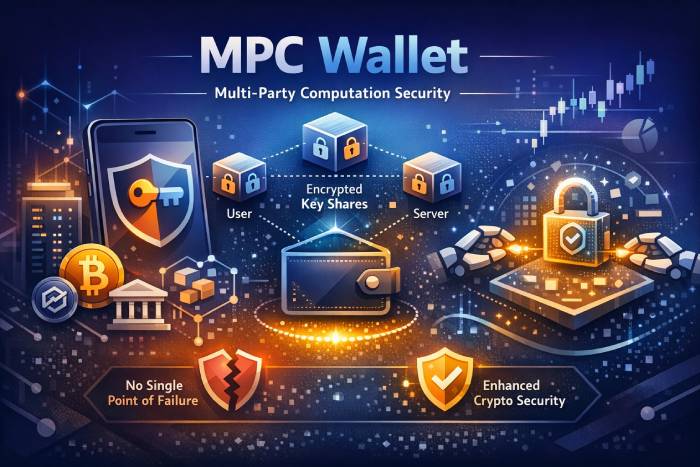
This design directly addresses one of the biggest weaknesses of traditional wallets: the single point of failure. In single‑key wallets, anyone who gains access to the private key can fully control the wallet. MPC wallets eliminate this risk by ensuring that no single party ever has complete control over the key.
Multi-Party Computation Explained: How MPC Protects the Private Key
Multi-party computation (MPC) is a cryptographic technique that allows multiple parties to work together on a computation without revealing their private inputs to each other. Each participant keeps their data secret, yet the group can still produce a valid result. In crypto systems, this result is typically a valid transaction signature.
When applied to a digital asset wallet, MPC enables multiple parties to collectively sign transactions without exposing the underlying private key. Each participant only holds a key share, and the MPC protocol ensures the signature can be generated securely and correctly. This approach enhances security and privacy at the same time, making MPC particularly well suited for protecting high‑value crypto assets.
MPC in Crypto: A New Security Model for Digital Asset Wallets
In the crypto ecosystem, the private key is the most sensitive element of wallet security. Control of the private key means control of the digital asset, whether that asset is Bitcoin or another cryptocurrency. MPC technology protects private keys by splitting them into independent shares that are distributed across a secure wallet infrastructure.
Because the full key never exists in one place, MPC wallets provide strong security guarantees even if one device, server, or administrator is compromised. This security model is particularly important for institutions managing large volumes of crypto assets. In 2025, industry data shows that a majority of top‑tier custodians and exchanges rely on MPC‑based wallet infrastructure as their default security layer.
From Single-Key Wallets to MPC: The Evolution of Crypto Wallet Security
Early crypto wallets were built around a single private key, often stored on a local device or in a hardware security module. While simple, this model created clear risks. Multisig wallets later introduced multiple private keys and required several signatures to approve a transaction, improving security but adding operational complexity and higher transaction costs.
MPC wallets represent the next stage of this evolution. Instead of managing multiple independent keys like a multisig wallet, MPC wallets rely on one logical key that is never assembled. Signing happens off‑chain, without smart contracts, and works across different blockchains. This makes MPC wallets more flexible and often more cost‑efficient than multisig alternatives.
How MPC Wallets Work: Using MPC to Secure Crypto Assets
At a high level, MPC wallets work by ensuring that no single entity ever controls the full private key. One key share might be stored on a user’s mobile device, while another is held by a wallet provider or secure cloud environment. When a transaction is initiated, the key shares briefly interact to produce a valid signature.
A useful analogy is a safe that requires multiple code fragments to open. Each fragment is meaningless on its own, but together they unlock access. In the same way, MPC wallets rely on cooperation between multiple parties to authorize transactions, while keeping each key share protected.
Real‑World Example: MPC Wallets in Practice
Consider a crypto investment fund managing assets on behalf of clients. The fund may require approvals from both a portfolio manager and a compliance officer before funds can be moved. With an MPC wallet, each approver controls a key share. A transaction can only be signed when the required parties approve it, without exposing the private key or slowing down daily operations. This model reduces internal risk while maintaining operational speed.
MPC Wallet Technology: Secure Multi-Party Computation in Practice
MPC wallets rely on advanced cryptographic techniques such as Distributed Key Generation (DKG) and threshold signatures. With DKG, the private key is never generated as a whole. Each party creates its own key share from the start, eliminating the risk of key exposure during setup.
Threshold signatures allow transactions to be approved once a required subset of key shares participates, such as two out of three. Some MPC implementations also use zero‑knowledge proofs, which allow participants to prove they hold a valid key share without revealing it. Together, these tools enable secure MPC while preserving usability.
Why MPC Wallets Are More Secure Than Traditional Crypto Wallets
Traditional wallets, including many hot wallets and hardware wallets, rely on a single private key stored in one location. Even when protected by strong hardware security, this model still creates a single point of failure. Industry reports consistently show that private key compromise remains one of the leading causes of crypto losses.
Because key shares are distributed across different systems and often different administrative domains, compromising one component is not enough to steal assets. This makes MPC wallets more secure than many conventional crypto wallet types, especially for institutional crypto custody.
Benefits of MPC Wallets for Crypto and Digital Asset Security
MPC wallets offer a unique balance between security and usability. They provide security without relying on physical isolation, as cold wallets do, and without requiring complex on‑chain logic, as smart contract wallets offer. Policies can be updated, approvals can be automated, and wallets remain non‑custodial.
Key benefits of MPC wallets include stronger protection against key theft, flexible approval models involving multiple parties, improved privacy with no special on‑chain signatures, and compatibility across different blockchains and wallet uses.
Limitations of MPC Wallets and MPC Technology
Despite their advantages, MPC wallets are not without trade‑offs. MPC is a complex technology, and wallets rely heavily on correct implementation of cryptographic protocols. Users and institutions must trust their MPC wallet providers and ensure the technology has been independently audited.
Operational risks such as service downtime, device loss, or poor user security practices can still affect access. MPC wallets enhance security, but they do not eliminate the need for good operational hygiene.
When MPC Wallets Make Sense - and When They Don’t
MPC wallets are ideal for institutions, DAOs, and active users who require strong security combined with frequent transactions and flexible approvals. They are particularly effective where multiple stakeholders are involved.
For long‑term storage with minimal access, traditional cold wallets or hardware wallets may still be appropriate. MPC is not a universal solution, but rather a powerful tool when accessibility and security must coexist.
MPC vs Other Wallet Types: Hardware Wallets, Multisig, and Traditional Wallets
Compared to a multisig wallet, MPC wallets usually operate off‑chain and avoid smart contract fees. Compared to custodial wallets, MPC wallets give users full control over their assets. Compared to hardware wallets, MPC wallets remove the need to protect a single physical device.
This makes MPC wallets a strong wallet solution for both institutions and advanced individual users who want to manage digital assets securely without sacrificing convenience.
Institutional MPC Wallet Uses: Crypto Custody and Digital Asset Security
Institutional MPC wallets are widely used by custodians, exchanges, funds, and payment platforms. They enable organizations to enforce approval policies, separate duties, and protect crypto assets at scale. By 2025, MPC has become the dominant security model for institutional crypto custody.
Beyond institutions, MPC wallets are increasingly used in consumer applications, DAO treasury management, and DeFi protocols. As MPC technology matures, it is becoming accessible to a broader audience.
The Future of MPC Wallets
Looking ahead, MPC wallets are expected to play a central role in regulated crypto markets. As compliance requirements grow stricter, MPC provides a foundation for secure, auditable, and flexible wallet infrastructure. The convergence of MPC with smart contract wallets and on‑chain policy engines is likely to define the next generation of wallet security.
In summary, an MPC wallet is a modern cryptocurrency wallet that uses secure multi‑party computation to protect private keys and digital assets. By removing the single point of failure found in traditional wallets, MPC wallets provide advanced security, strong privacy, and flexible control for managing digital assets in 2025 and beyond.