What is Hyperledger Fabric in Blockchain?

Hyperledger Fabric is an open-source blockchain framework designed specifically for enterprise use. Originally created by IBM and later contributed to the Hyperledger project hosted by the Linux Foundation, it operates as a permissioned blockchain where all participants in the network are known, verified, and accountable.
At its core, Hyperledger Fabric is a distributed ledger platform built on a modular architecture. This approach allows organizations to assemble a blockchain network from various components instead of adopting a rigid, one-size-fits-all system. As a result, Fabric delivers a strong balance of privacy, scalability, and performance, which is essential for real-world business environments.
From supply chain management and finance to insurance and healthcare, Hyperledger Fabric has become one of the most widely adopted enterprise blockchain platforms in the modern blockchain space.
In this article, we explain how Hyperledger Fabric works, outline its key features and benefits, and explore practical enterprise use cases, while keeping the technical details clear and accessible.
Hyperledger Project Background and Enterprise Blockchain Origins
The Hyperledger project was launched by the Linux Foundation in December 2015 to support the development of enterprise-grade blockchain technology and distributed ledger solutions. Unlike public blockchain platforms such as Ethereum, Hyperledger initiatives focus on permissioned networks built for collaboration between known organizations.
Hyperledger Fabric was initially developed by IBM and Digital Asset and later evolved into a cross-industry effort supported by the Linux Foundation. In March 2017, Fabric became the first Hyperledger blockchain to move from incubation to active status, a milestone that signaled production readiness.
Modular Architecture of Hyperledger Fabric
When Hyperledger Fabric is described as modular, it means organizations can customize how the blockchain network is built and operated. Instead of locking every user into the same design, Fabric allows different consensus mechanisms, identity systems, and transaction processing models to be combined as needed.
This modular architecture supports plug-and-play integration of various components. Enterprises can reuse existing capabilities, add new ones over time, and adapt their Fabric networks as business requirements change. This flexibility is especially important in enterprise environments, where systems must evolve without frequent redesigns.
Benefits of Hyperledger Fabric for Enterprise Blockchain
Hyperledger Fabric is an open-source blockchain framework hosted by the Linux Foundation and supported by a large, active developer community. Its open nature promotes transparency, long-term stability, and continuous improvement.
One of the main benefits of Hyperledger Fabric is its permissioned blockchain design. Every participant in the network has a verified identity, enabling fine-grained access control and a high degree of security. Sensitive transactions can be shared only with authorized parties, reducing data leakage and compliance risks.
Fabric is also designed for scalability and performance. Different peer nodes handle different responsibilities, allowing transaction processing to run in parallel. In practice, this can lead to faster settlement times, lower reconciliation costs, and clearer audit trails compared to many public blockchain systems.
For enterprise developers, Fabric offers flexibility without sacrificing control. Encryption, identity management, and consensus settings can be tailored to meet regulatory, operational, and business requirements.
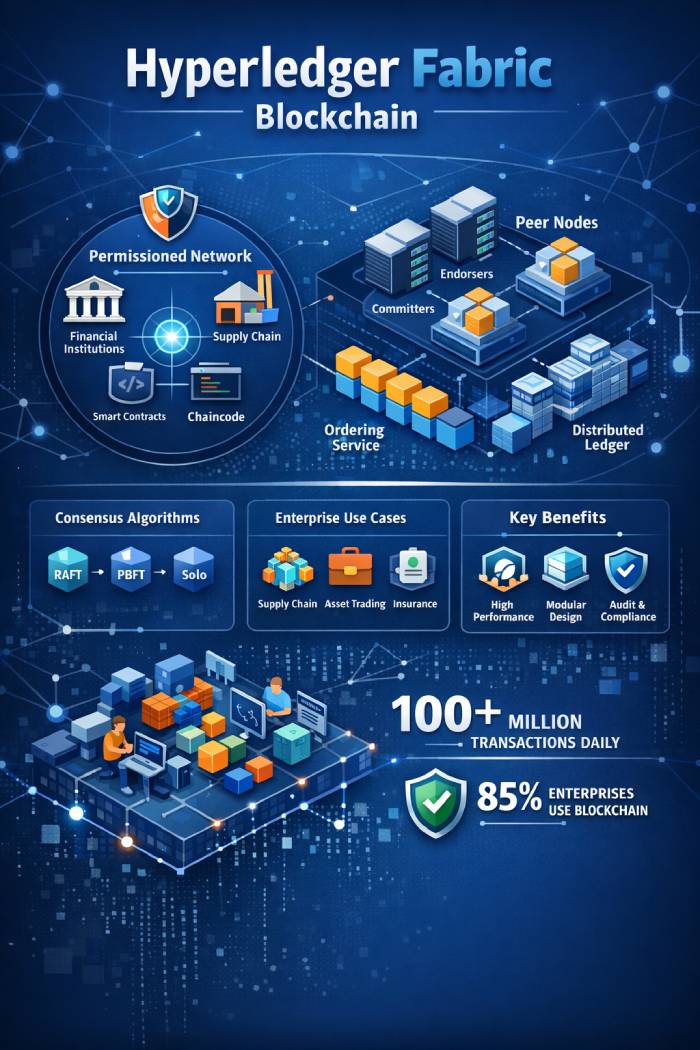
Permissioned Network, Peer Access, and Enterprise Oversight
Hyperledger Fabric is built for environments where trust and accountability are critical. Access to the blockchain network is managed through digital identities issued by a Fabric Certificate Authority. Only approved organizations, peer nodes, and applications can participate in the network.
This permissioned network model is particularly valuable in regulated industries such as banking, logistics, healthcare, and insurance, where auditability and governance are mandatory rather than optional.
Open Source Hyperledger Fabric Hosted by the Linux Foundation
As part of the Hyperledger project hosted by the Linux Foundation, Hyperledger Fabric is fully open source. Organizations can inspect the source code, modify it, and build custom blockchain applications without vendor lock-in.
Modular and Configurable Design in Hyperledger Fabric Networks
Fabric’s design allows nearly every layer of the system to be configured. Consensus mechanisms, endorsement policies, membership services, and security rules can all be adjusted to match specific enterprise use cases. This configurability is a key reason Fabric is widely used across different industries.
Transaction Processing and Endorsement in Hyperledger Fabric
Hyperledger Fabric uses an execute-order-commit model for transaction processing. First, a transaction proposal is executed by endorser peers. After sufficient endorsement, the transaction is ordered into blocks and then committed to the distributed ledger by peer nodes. This model improves scalability and performance compared to many public blockchain platforms.
How Hyperledger Fabric Works in a Permissioned Blockchain Network
Hyperledger Fabric is a distributed ledger platform designed for known participants operating within a permissioned blockchain network. Organizations such as banks, manufacturers, and logistics providers can collaborate while maintaining strict control over data visibility.
Unlike public blockchain networks, where every node sees every transaction, Fabric allows data to be shared selectively. This makes it possible to build enterprise blockchain solutions without exposing sensitive business information to all participants.
Hyperledger Fabric in Blockchain: Technical Overview
Hyperledger Fabric is one of the most widely used blockchain frameworks within the Hyperledger blockchain ecosystem. Its architecture separates responsibilities across different node types to improve scalability and performance.
Peer nodes execute smart contract logic, validate transactions, and maintain the ledger. Orderer nodes establish transaction order and create blocks. This separation allows Fabric networks to scale efficiently as transaction volume grows.
Channels add another layer of isolation. Each channel functions as a separate chain network with its own ledger, policies, and participants. A single Hyperledger Fabric network can therefore support multiple independent blockchain networks at the same time.
Hyperledger Fabric Architecture: Peer Nodes and Core Components
A Hyperledger Fabric network consists of multiple organizations, also known as members. Each organization manages its identities using a Fabric Certificate Authority and operates one or more peer nodes.
Assets in the Hyperledger Fabric Blockchain Network
Assets represent items of value within the blockchain network. They may be physical goods, digital records, or financial instruments. In Hyperledger Fabric, assets are stored as key-value pairs, typically in JSON format, and every update is recorded as a ledger transaction.
Chaincode and Smart Contract Business Logic
Chaincode is Hyperledger Fabric’s implementation of smart contract functionality. It defines the business logic that governs how assets are created, updated, and transferred. Chaincode is executed by peer nodes and must be endorsed before changes are written to the ledger.
Distributed Ledger in Hyperledger Fabric
The ledger is the shared, tamper-resistant record of all transactions in the network. It is append-only and designed for audit and compliance purposes. Fabric maintains both a full transaction history and the current world state.
Identity, Certificate Authority, and Network Security
Hyperledger Fabric relies on Public Key Infrastructure and Membership Service Providers to manage identities. Every node, developer, and application must authenticate before participating in the network. This identity layer enables precise access control at both the network and channel levels.
Privacy and Data Isolation in Fabric Networks
Privacy is a core feature of Hyperledger Fabric. Channels isolate transactions between selected participants, while private data collections allow sensitive information to be shared only among approved peers, with cryptographic hashes stored on the ledger.
Consensus Mechanism in Hyperledger Fabric
Hyperledger Fabric does not depend on a single global consensus mechanism. Instead, it separates transaction execution, ordering, and validation. Modern Fabric networks typically use Raft for ordering, while more advanced deployments may integrate Byzantine fault tolerant options.
Consensus in Fabric includes endorsement, ordering, and commitment. Endorser peers execute chaincode, orderer nodes sequence transactions, and committing peers update the ledger.
Developer Programming Model for Enterprise Blockchain Applications
Hyperledger Fabric is designed with enterprise developers in mind. Smart contracts can be written in Go, JavaScript, or Java, without learning a specialized language such as Solidity. Applications interact with the blockchain network through SDKs and well-defined APIs.
Smart Contract Functionality Using Chaincode
Smart contracts in Hyperledger Fabric, known as chaincode, can run as long-lived services or execute on demand. Deployment involves installing the chaincode on selected peer nodes and approving its definition through network governance.
Enterprise Use Case Scenarios for Hyperledger Fabric
Hyperledger Fabric is widely used in supply chain networks to improve traceability of transactions across complex, multi-party environments. It is also adopted in finance, healthcare, and insurance, where privacy, compliance, and data integrity are essential.
In insurance, Fabric supports multi-party subrogation claims and automated settlement using smart contracts. In trading and asset transfer, it enables paperless workflows between organizations that do not fully trust one another.
Key Features of Hyperledger Fabric Enterprise Blockchain
Key features of Hyperledger Fabric include modular design, permissioned networks, strong identity management, scalable transaction processing, and flexible consensus options. Together, these capabilities make Fabric a leading enterprise-grade blockchain framework.
Limitations of Hyperledger Fabric in Enterprise Blockchain
Despite its strengths, Hyperledger Fabric has limitations. Network setup and governance can be complex, interoperability with other blockchain platforms is limited, and operational costs must be considered. Fabric is best suited for enterprise environments rather than open public blockchain use cases.
Practical Enterprise Blockchain Network Example
Consider a manufacturer selling products at different prices across regions. Using Hyperledger Fabric, pricing data can be shared only with relevant participants in the network, preserving confidentiality while maintaining a shared ledger of record.
Hyperledger Fabric vs Hyperledger Sawtooth Blockchain Platforms
Both Fabric and Sawtooth are Hyperledger blockchain frameworks, but they differ in approach. Fabric focuses on permissioned enterprise networks with chaincode-based smart contracts, while Sawtooth offers alternative consensus models and transaction families.
Hyperledger Fabric in the Enterprise Blockchain Space
After the cryptocurrency hype cycle, enterprise blockchain platforms were evaluated more critically. Hyperledger Fabric has demonstrated its value not through speculation, but by enabling controlled, cross-industry collaboration using blockchain technology.