WHAT IS A STOCK MARKET INDEX?

A stock market index is a standardized way to measure how a specific group of stocks, bonds, or other securities perform over time. Instead of tracking every individual stock, an index provides a clear benchmark that reflects overall market direction and sentiment.
When financial news reports that “the market is up,” they are referring to a market index such as the S&P 500 Index or the Dow Jones Industrial Average. These indexes serve as reference tools that summarize the movement of hundreds of companies and translate them into a single figure showing whether markets are advancing or declining.
HOW INDEXES WORK & WHY THEY MATTER
Indexes help investors understand the bigger picture without analyzing each company individually. By grouping securities by shared characteristics -like market size, sector, region, or asset class -indexes offer:
- a benchmark for portfolio comparison
- a snapshot of market performance
- an objective measure of economic movement
- a standardized tool for tracking trends
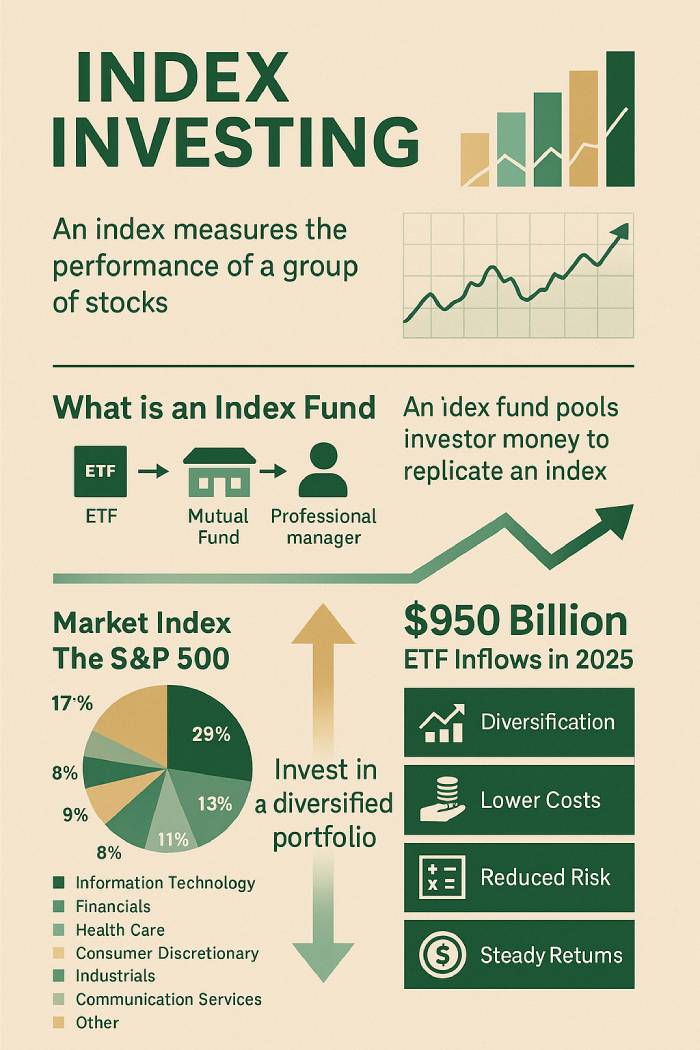
Investors cannot invest directly in an index. Instead, they invest through index funds and ETFs that replicate the index’s composition and track its performance.
BENCHMARK INDEXES: S&P 500 & DOW JONES INDUSTRIAL AVERAGE
The two most widely used U.S. benchmarks are:
S&P 500 Index
- tracks 500 of the largest publicly traded U.S. companies
- market‑cap weighted
- represents roughly half of U.S. stock market value
- widely considered the clearest indicator of U.S. equity health
Dow Jones Industrial Average (DJIA)
- tracks 30 large U.S. corporations
- price‑weighted
- higher‑priced stocks exert more influence on index value
The S&P 500 provides broad market exposure, while the Dow offers a narrower look at blue‑chip strength.
HOW INDEX COMPOSITION SHAPES MARKET EXPOSURE
Indexes select companies based on rules determined by the index provider. Criteria often include:
- market capitalization
- liquidity
- sector representation
- financial stability
This ensures the index reflects a specific market segment accurately.
Weighting methods impact how an index responds to price changes:
- market‑cap weighted (S&P 500)
- price‑weighted (Dow Jones)
- equal‑weighted (each company carries equal influence)
WHAT AN INDEX FUND IS
An index fund is a mutual fund or ETF that mirrors a benchmark index rather than attempting to outperform it. Because one fund instantly provides exposure to hundreds of companies, it offers diversification at a lower cost than purchasing individual stocks.
Index investing benefits include:
- broad market diversification
- lower fees vs active funds
- reduced turnover and tax impact
- less reliance on human judgment
POPULAR INDEXES & WHAT THEY MEASURE
- S&P 500: large‑cap U.S. stocks
- Russell 2000: small‑cap U.S. companies
- Nasdaq‑100: technology‑heavy leaders
- MSCI ACWI ex‑U.S.: global equities beyond the U.S.
- Bloomberg U.S. Aggregate Bond Index: U.S. bond market performance
Together, these indexes provide multi‑dimensional views of the market.
HOW INDEXES MEASURE MARKET PERFORMANCE
An index turns thousands of daily price movements into a single data point. The value reflects:
- economic activity
- corporate earnings
- capital flows
- investor sentiment
Index levels matter less than direction:
- rising → expansion
- falling → contraction
- flat → consolidation
INDEX FUNDS & ETFs: HOW THEY TRACK THE MARKET
Index ETFs and index mutual funds replicate benchmark composition and weightings. When the index changes -a merger, delisting, sector shift -the fund adjusts as well.
Unlike active managers, index funds aim for precision, not outperformance.
INDEXES IN PORTFOLIO STRATEGY
Indexes underpin both active and passive strategies:
- Active investing: index used as benchmark for outperformance
- Passive investing: index replicated to match market returns
Most retirement portfolios use index funds because they efficiently capture broad market exposure without constant trading.
S&P 500 vs DOW vs NASDAQ
S&P 500
- 500 leading U.S. companies
- market‑cap weighted: largest firms have greatest influence
- represents broad U.S. equity performance across all sectors
- best used as a benchmark for total market exposure
Dow Jones Industrial Average (DJIA)
- 30 blue‑chip firms
- price‑weighted: high‑priced stocks move the index most
- narrower than S&P 500 but extremely media‑visible
- long‑term barometer of legacy corporate strength
Nasdaq‑100
- 100 largest Nasdaq‑listed non‑financial companies
- technology‑heavy: includes Apple, Microsoft, NVIDIA, Alphabet, Meta
- reflects innovation, growth, and high‑beta market cycles
- more volatile but also more responsive to tech and digital trends
INDEX MYTHS VS REALITY
Myth 1: Indexes reflect every stock in the market.
Reality: Each index covers a specific segment. Even the S&P 500 is not the entire market.
Myth 2: If the S&P 500 rises, every company inside it must be rising.
Reality: Index weighting means a handful of mega‑caps can move the total value.
Myth 3: Index funds guarantee safety.
Reality: They reduce single‑stock risk but remain exposed to market downturns.
Myth 4: Indexes never change.
Reality: Reconstitutions happen regularly -firms enter, exit, merge, split, and delist.
Myth 5: Passive = no management.
Reality: Index ETFs and funds rebalance constantly to mirror index methodology.
CRYPTO INDEXES: A MODERN EXTENSION
Traditional market benchmarks now coexist with digital‑asset indices:
CMC Crypto 200 Index
- tracks 200 leading crypto assets by market capitalization
- provides a structured benchmark for the otherwise fragmented digital‑asset market
FTSE Crypto Index Series (LSEG)
- constructed by London Stock Exchange Group
- focuses on regulatory‑aligned digital benchmarks
- enables institutional measurement of crypto market performance
Crypto indices function similarly to equity and bond benchmarks, offering:
- standardized market measurement
- visibility into digital‑asset segments
- broader exposure without selecting individual tokens
ETF FLOWS & MARKET POSITIONING (2025)
Global ETF inflows reached historic levels in 2025:
- approximately $1.6 trillion in net new ETF inflows
- over 70% directed into index ETFs
- most traded: S&P 500 (SPY, IVV, VOO), Nasdaq-100 (QQQ), Total Market ETFs (VTI, SCHB)
Passive ownership of U.S. equities surpassed active management for the first time, reshaping how capital allocates and how benchmarks move.
RISK LITERACY: WHAT INDEXES CAN AND CANNOT PROTECT FROM
Indexes reduce single-company risk but not systemic shocks:
- recessions
- tightening cycles
- liquidity crunches
- geopolitical volatility
Diversification lowers concentration risk but does not remove market-wide drawdowns.