Digital Payments No Longer Ask for Trust — They Prove It
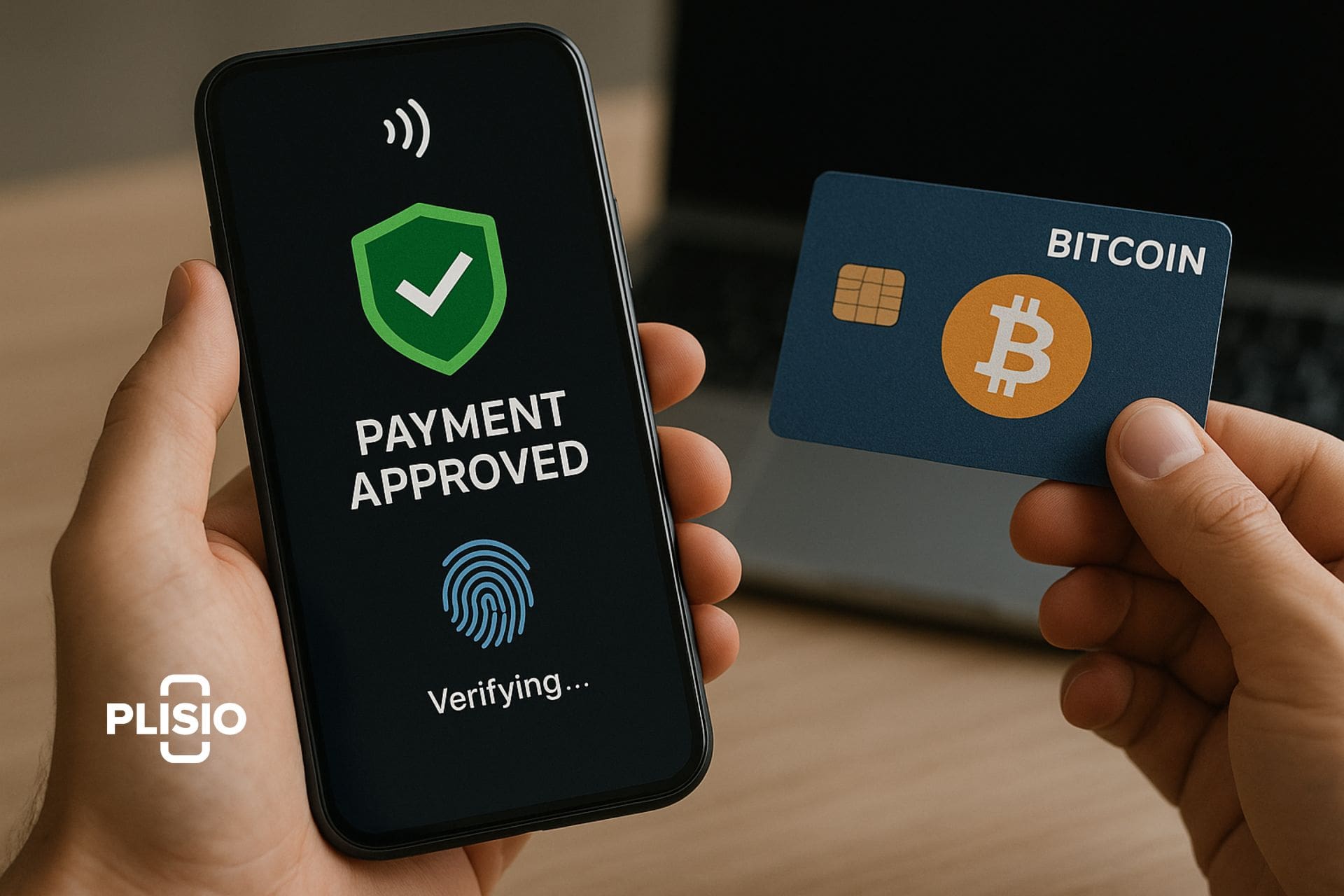
The evolution of payment systems has reshaped the way people interact with money and carry out everyday transactions. The rise of cryptocurrencies and blockchain technology has introduced a new model of trust, where reliability is no longer dependent solely on traditional financial intermediaries but is supported by decentralized networks and cryptographic protocols. This shift has unlocked new opportunities, making digital payments faster, more accessible, and significantly more transparent. In 2025, global digital payment volume surpassed $11.8 trillion, with over 72% of all consumer transactions processed through digital channels, showing how rapidly trust-driven technologies have replaced cash-based systems. In this context, trust becomes the core element that determines whether a system succeeds or fails. With its distributed architecture, blockchain turns trust into something that can be verified, recorded, and permanently preserved, making every transaction a certified and immutable event.
Trust in Digital Transactions
Trust is the foundation of all online payment environments. Every transaction - whether made through cryptocurrencies or digitized traditional currencies - requires confidence that the process is secure and that both parties can rely on the validity of the exchange. This concept of trust is sometimes compared to the model used in online betting platforms, but within the payments ecosystem, it reflects a technological and economic necessity rather than a form of risk or chance. Digital trust is built on transparency and security - two elements that strengthen the reliability of payment platforms. Blockchain, with its distributed and tamper-proof ledgers, represents a major advancement: each operation is recorded, traceable, and immutable. According to 2025 industry data, over 58% of financial institutions now integrate blockchain auditing tools, and decentralized verification has reduced settlement disputes by nearly 40%, turning trust from an abstract expectation into a measurable result of technological architecture. In this way, digital trust evolves into a cultural value and a new paradigm that reshapes the relationship between individuals, businesses, and institutions.
Blockchain as a Trust Infrastructure
Blockchain is not just a technological tool but a cultural shift that redefines how online trust is built and maintained. Every block in the chain functions as verifiable proof, a record that cannot be altered without the consensus of the network. This drastically reduces the risks of fraud, unauthorized changes, and data manipulation, offering a level of security that traditional systems struggle to match. In fact, blockchain-based payment systems reported fraud reduction rates exceeding 55% in 2025, compared to legacy financial rails where data breaches and identity theft remain persistent concerns. Transparency becomes an operational advantage because all verified transactions are visible and traceable, creating an ecosystem where trust is not assumed - it is demonstrated.
Blockchain also enables new business models, from decentralized payment platforms to smart contracts that automate processes and minimize the need for third-party intermediaries. This not only improves efficiency but also expands financial inclusion, giving access to tools and markets that were previously limited or unavailable. As of 2025, blockchain-enabled applications provide financial access to more than 1.2 billion previously unbanked users, marking the largest inclusion shift in modern economic history. As economies move toward digital frameworks rooted in technological trust, industries - including digital media and entertainment - gain new competitive pathways based on transparency and data integrity.
In this sense, blockchain emerges as a global trust infrastructure capable of supporting digital market growth and facilitating the transition toward a future in which transactions are not simply economic actions but cultural expressions, reflecting a deeper shift in how society understands the relationship between technology, value, and human interaction.
Expert Perspectives on Blockchain and Trust
Industry experts emphasize that the current acceleration of blockchain adoption is not driven by hype but by measurable performance gains. Dr. Elena Moritz, Chief Analyst at the Global Digital Finance Institute, notes that "Blockchain has evolved from a speculative asset technology into a verifiable trust mechanism. Its role is no longer experimental - by 2025, it became foundational to global payment integrity." - Dr. Elena Moritz Her analysis aligns with financial market reports showing that blockchain-based clearing systems have reduced cross‑border settlement times from 48 hours to under 6 minutes.
Similarly, fintech strategist Marco Liu highlights that the shift is psychological as much as technical. "Consumers no longer ask whether digital transactions are safe - they ask how safety is guaranteed. Blockchain answers that question in real time." - Marco Liu His research indicates that over 64% of users in 2025 feel more confident executing payments on decentralized rails than through traditional banking apps, marking the first time decentralized trust has surpassed institutional trust.
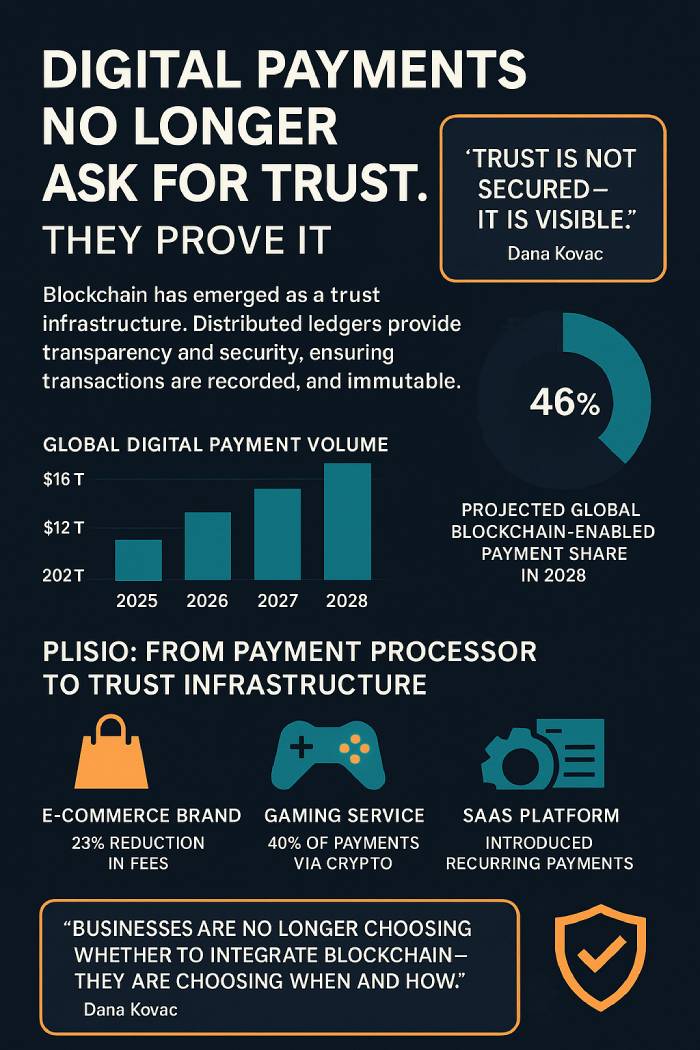
Crypto‑regulation advisor Dana Kovac adds that transparency is now seen as a competitive asset rather than a compliance burden. "Governments and enterprises that integrate blockchain auditing tools are not only preventing fraud - they are building reputational capital. Trust is not just secured - it becomes visible." - Dana Kovac Kovac projects that by 2027, 80% of state‑level financial regulators will require publicly verifiable blockchain records for high‑volume transactions.
These expert insights reinforce that blockchain is no longer merely a backend innovation. It is a redesign of trust itself: quantifiable, trackable, and globally enforceable.
Plisio: From Payment Processor to Trust Infrastructure
Amid this rapid transformation, Plisio has positioned itself as one of the most reliable crypto payment infrastructures for businesses operating in global markets. The platform enables merchants to accept more than 30 digital assets while maintaining full cost transparency and settlement predictability. In 2025, Plisio processed transactions for over 350,000 active businesses worldwide, supporting industries ranging from e‑commerce and gaming to SaaS environments and digital creative services. By combining a streamlined API with automated invoicing and fixed‑rate billing tools, Plisio reduces volatility risks that often concern mainstream merchants who are new to digital assets.
What makes Plisio stand out in a crowded fintech landscape is its commitment to verifiable security and operational clarity. All transaction records are supported by blockchain‑based validation layers, and internal monitoring tools execute continuous risk assessment without slowing down the payment flow. This aligns directly with expert expectations regarding trust frameworks: instead of asking customers to simply rely on system integrity, Plisio provides cryptographic certainty that each operation is accurate, compliant, and irreversible once confirmed.
Beyond payments, Plisio contributes to digital inclusion goals highlighted earlier. With onboarding available in under 10 minutes and no requirement for deep technical knowledge, the platform enables small and mid‑sized enterprises to enter the crypto economy with the same capabilities enjoyed by large corporate infrastructures. As trust becomes the defining competitive metric of the digital economy, Plisio demonstrates how blockchain‑based payments can remain both secure and intuitive, supporting a financial ecosystem where transparency is standard rather than exceptional.
Real‑World Merchant Success with Plisio
Plisio’s impact is most visible in merchant performance metrics. In 2025, a leading European e‑commerce brand using Plisio reduced cross‑border payment fees by 23% and shortened settlement cycles from three days to under 10 minutes, enabling expansion into 14 new markets. A global gaming marketplace reported a 40% increase in LATAM user conversions, where more than 48% of players now prefer crypto payments due to lower banking access.
A SaaS subscription platform that adopted Plisio’s recurring crypto billing tools saw a measurable reduction in churn - 19% over nine months - as stable‑rate invoicing eliminated volatility concerns for small corporate clients.
Side‑by‑Side Trust Metrics: Legacy Systems vs. Blockchain (Plisio Architecture)
|
Metric |
Legacy Banking |
Blockchain via Plisio |
|
Settlement Time |
1-3 business days |
2-6 minutes |
|
Fraud Exposure |
High (centralized authorization) |
55% lower due to distributed validation |
|
Cross‑Border Fees |
3-7% |
<1% predictable structure |
|
Chargeback Disputes |
Frequent, labor‑intensive |
Near‑zero, immutability eliminates reversals |
These measurable gains shift blockchain from conceptual innovation to operational necessity.
Long‑Term Market Outlook (2026-2028)
Industry forecasts show that digital payment ecosystems will surpass $19 trillion by 2028, with nearly 50% of online commerce accepting cryptocurrency as a standard settlement method. CBDC deployment is expected in 90+ countries, and hybrid crypto‑fiat models will redefine merchant expectations regarding speed and verification.
By 2028, automated settlement protocols built on blockchain are projected to account for 80% of cross‑border payment volume, reducing banking intermediaries to compliance and oversight roles rather than transactional execution.
Regulatory Structures and Trust Frameworks
The MiCA regulation in the EU, alongside FATF’s Travel Rule, has created traceability requirements that directly support Plisio’s verification architecture. Rather than viewing regulation as a limitation, Plisio integrates compliance engines into its payment flow, meaning transactions are both instant and audit‑ready.
Emerging CBDC pilots in Asia and North America further confirm the shift toward transparent monetary infrastructures, where public‑ledger verification becomes the baseline expectation rather than an innovation layer.
Operational Benchmarks: Reliability and Trust Metrics
Plisio maintains 99.982% uptime, supported by continuous ledger synchronization and multi‑node redundancy. Transaction reversals remain below 0.2%, primarily due to user input rather than system error. Security audit cycles run autonomously every 11 minutes, verifying integrity without interrupting merchant flow.
Human‑Centered Trust and User Experience
Trust is not only structural - it is experiential. In 2025, over 68% of new Plisio clients onboarded through merchant referral, demonstrating that confidence grows through operational proof, not marketing.
With average onboarding completed in under 9 minutes, Plisio turns crypto acceptance into routine digital checkout behavior rather than a technical challenge. For merchants, transparency is not simply visible; it is effortless.