Amazon Stock Price Prediction 2026-2030

The topic of amazon stock price prediction continues to attract strong attention from retail and institutional investors alike. Amazon.com Inc remains one of the most closely watched companies on the Nasdaq, not only because of its size but because its business model spans e-commerce, cloud computing, logistics, advertising, and artificial intelligence. Understanding where amazon’s stock price may go requires combining technical analysis, financial forecast models, analyst price target predictions, and broader market trends.
This article provides a detailed and updated amazon stock forecast, avoiding outdated assumptions and focusing on the period ahead. It explores short-term price action, medium-term expectations for 2026, and long-term scenarios through the end of 2030, while integrating analyst rating data, consensus expectations, and fundamental drivers.
Current Market Context and Stock Performance
Amazon's stock trades on the Nasdaq under the ticker AMZN and is frequently described as a bellwether for both technology and consumer demand. The current price reflects a balance between optimism around Amazon Web Services and caution related to margins in online retail and international operations.
At present, the current price represents a recovery phase following volatility experienced in 2022, when inflation, interest rate hikes, and logistics costs pressured margins across the technology sector. Since then, price action has stabilized, and the closing price trend shows gradual consolidation rather than speculative spikes.
The company’s market cap remains above two trillion dollars, placing it firmly among the largest public companies globally. This scale affects how quickly the stock price can move, making analyst price targets particularly important for understanding expectations.

Analyst Coverage and Consensus Rating
Amazon is followed by a large number of analyst covering teams from major investment banks and independent research firms. The consensus rating remains skewed toward positive sentiment, with most analysts labeling the stock as a strong buy or buy. Only a small minority assign a hold, and very few suggest a strong sell.
The analyst rating distribution highlights confidence in Amazon's long-term strategy, particularly AWS and advertising revenue streams. According to aggregated broker data, recommendation trends have remained stable, indicating that analysts are not dramatically shifting their views despite short-term volatility.
The average price target represents the midpoint of dozens of forecasts and reflects expectations for steady earnings expansion. The average price target for Amazon currently implies meaningful upside compared to the current price, reinforcing the view that AMZN is still considered a stock to buy by much of Wall Street.
Analyst Price Targets and Short-Term Outlook
Analyst price targets vary depending on valuation models and assumptions about revenue growth, EPS expansion, and margin normalization. The analyst price target predictions generally cluster within a broad but optimistic range.
|
Metric |
Estimate |
|
Average price target |
$285–$296 |
|
Analyst price target (high) |
$330–$340 |
|
Analyst price target (low) |
$190–$200 |
|
Consensus rating |
Strong Buy |
The analyst price targets reflect expectations that Amazon's stock price will benefit from operational efficiencies and improved profitability, particularly within AWS. While short-term price movements can diverge from these projections, the analyst price target remains a key reference point for investors deciding whether to buy or sell.
Technical Analysis and Price Signals
Technical analysis plays an important role in evaluating near-term movement. Traders frequently monitor the price chart for trend confirmation and momentum indicators such as RSI. The RSI currently suggests neutral momentum, indicating neither extreme overbought nor oversold conditions.
Support and resistance zones remain well-defined, with consolidation suggesting that the stock price may be building a base for future movement. From a technical perspective, short-term price expectations depend heavily on broader Nasdaq sentiment and macroeconomic data.
While technical analysis alone cannot predict long-term outcomes, it helps contextualize short-term price action and volatility patterns.
Fundamental Drivers: E-Commerce and Retail Operations
Amazon’s core identity as an online retail giant continues to shape its financial performance. The company dominates online retail in North America, where the North America segment generates the majority of operating income outside AWS. Retail sales growth has moderated compared to earlier expansion phases, but scale advantages remain significant.
The international segment is more mixed. While international expansion supports long-term e-commerce success, currency fluctuations, regulatory differences, and logistics costs can weigh on margins. Analysts view international operations as a longer-term growth lever rather than an immediate profit engine.
Amazon’s strength in e-commerce is closely tied to consumer behavior, making it sensitive to macroeconomic cycles. Nevertheless, its logistics network and Prime ecosystem continue to differentiate it from competitors.
Amazon Web Services and Cloud Computing Leadership
Amazon Web Services remains one of the most important components of any amazon stock forecast. As the largest cloud provider globally, AWS plays a central role in profitability and valuation.
Cloud computing demand continues to grow as enterprises migrate workloads and adopt AI-driven solutions. AWS benefits from long-term contracts and high switching costs, supporting stable revenue growth. Although competition from Microsoft and Google is intense, AWS maintains a leadership position.
Concerns occasionally emerge about AWS falling behind Microsoft before 2030, particularly in AI integration. However, analysts note that AWS retains scale advantages and a broad service portfolio that continues to attract enterprise clients.
Financial Forecast, EPS, and Revenue Growth
From a financial forecast perspective, analysts focus heavily on EPS and operating margin trends. EPS expansion is expected to come from cost optimization, automation, and improved fulfillment efficiency.
Revenue growth remains diversified across e-commerce, cloud computing, advertising, and subscription services. Advertising has become an increasingly important contributor, improving overall margin structure.
AMZN financials show that while growth rates are lower than during Amazon’s early expansion years, average returns remain attractive relative to peers when adjusted for scale and risk.
Medium-Term Outlook: 2026 Forecast
For investors looking beyond short-term price action, the 2026 outlook is one of the most frequently requested data points in any amazon stock forecast. Unlike very long-term scenarios, projections for 2026 are still closely tied to analyst models, earnings expectations, and observable business trends.
Based on aggregated analyst price targets, algorithmic models, and broker financial forecast assumptions, the most common estimates for AMZN in 2026 fall into a relatively defined range.
|
2026 Scenario |
Estimated Stock Price Range |
|
Bearish case |
$185–$200 |
|
Base case |
$245–$275 |
|
Bullish case |
$300–$330 |
In the base case scenario, analysts assume continued revenue growth from Amazon Web Services, stable performance in the North America segment, and gradual margin improvement in online retail. EPS expansion is expected to remain steady rather than explosive, reflecting Amazon’s scale.
The bearish case for 2026 assumes renewed pressure on consumer spending, slower enterprise cloud adoption, or higher operating costs. In this scenario, the stock price could underperform the broader Nasdaq while still remaining structurally strong.
The bullish case assumes stronger-than-expected AWS demand, successful deployment of AI models across cloud and logistics operations, and improved profitability in the international segment. Under these conditions, analysts believe Amazon’s stock price could test or exceed the upper $300 range during 2026.
Overall, the stock forecast for 2026 suggests moderate upside relative to the current price, with risk skewed more toward macroeconomic uncertainty than company-specific weakness.
Long-Term Scenarios Through 2030
The long-term stock price prediction for Amazon through 2030 varies widely depending on assumptions. Some models remain conservative, while others project substantial appreciation.
|
Scenario |
Estimated Outcome |
|
Bearish |
~$80–$100 |
|
Base case |
~$240–$280 |
|
Bullish |
$400+ |
By the end of 2030, outcomes will depend on Amazon’s ability to maintain leadership in cloud computing, scale AI-driven services, and sustain e-commerce profitability. Long-term investors often focus on Amazon's stock as a compounder rather than a short-term trading vehicle.
Risks, Bearish Arguments, and Market Trends
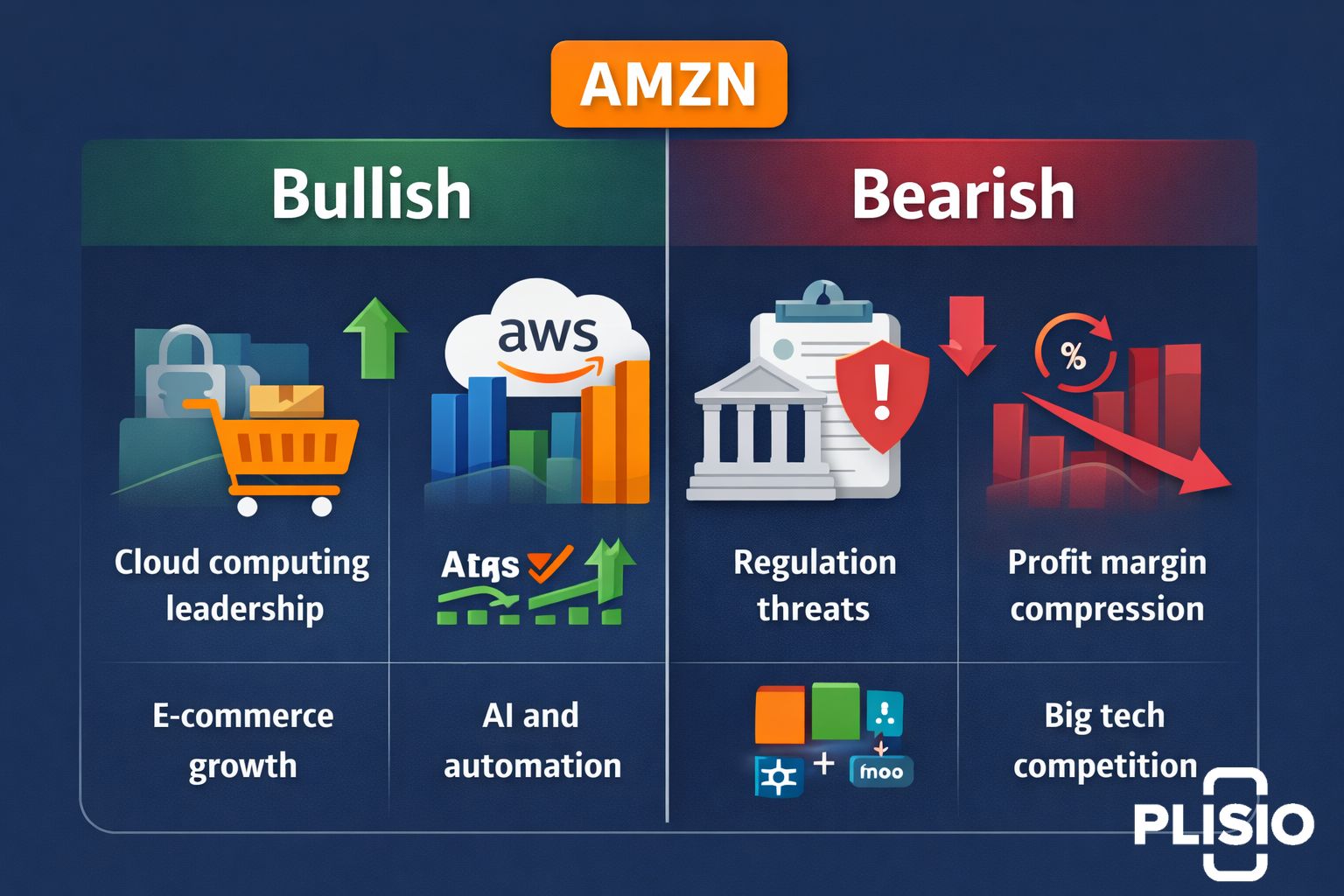
Despite optimism, bearish perspectives remain relevant. Risks include regulatory scrutiny, margin compression in online retail, and rising competition in cloud computing. Broader market trends, including interest rate policy and global economic growth, also influence valuation.
Some analysts caution that Amazon’s size makes outsized returns harder to achieve, particularly if growth slows. These risks explain why even within a strong buy consensus, price targets vary widely.
Buy or Sell? Final Perspective
Whether to buy or sell Amazon’s stock ultimately depends on investment horizon and risk tolerance. Short-term traders may focus on price action and technical signals, while long-term investors emphasize fundamentals and analyst price targets.
The average price target represents a forward-looking view that assumes continued innovation and operational discipline. While no forecast is guaranteed, Amazon.com Inc remains central to discussions about the future of e-commerce, cloud infrastructure, and digital services.
As an online retail leader and cloud computing powerhouse, Amazon's stock continues to serve as a benchmark for technology-driven growth. For investors evaluating amazon stock price prediction models, the balance of evidence suggests cautious optimism rather than speculative excess.