CapEx vs OpEx: Key Differences, From Mining Rigs Up
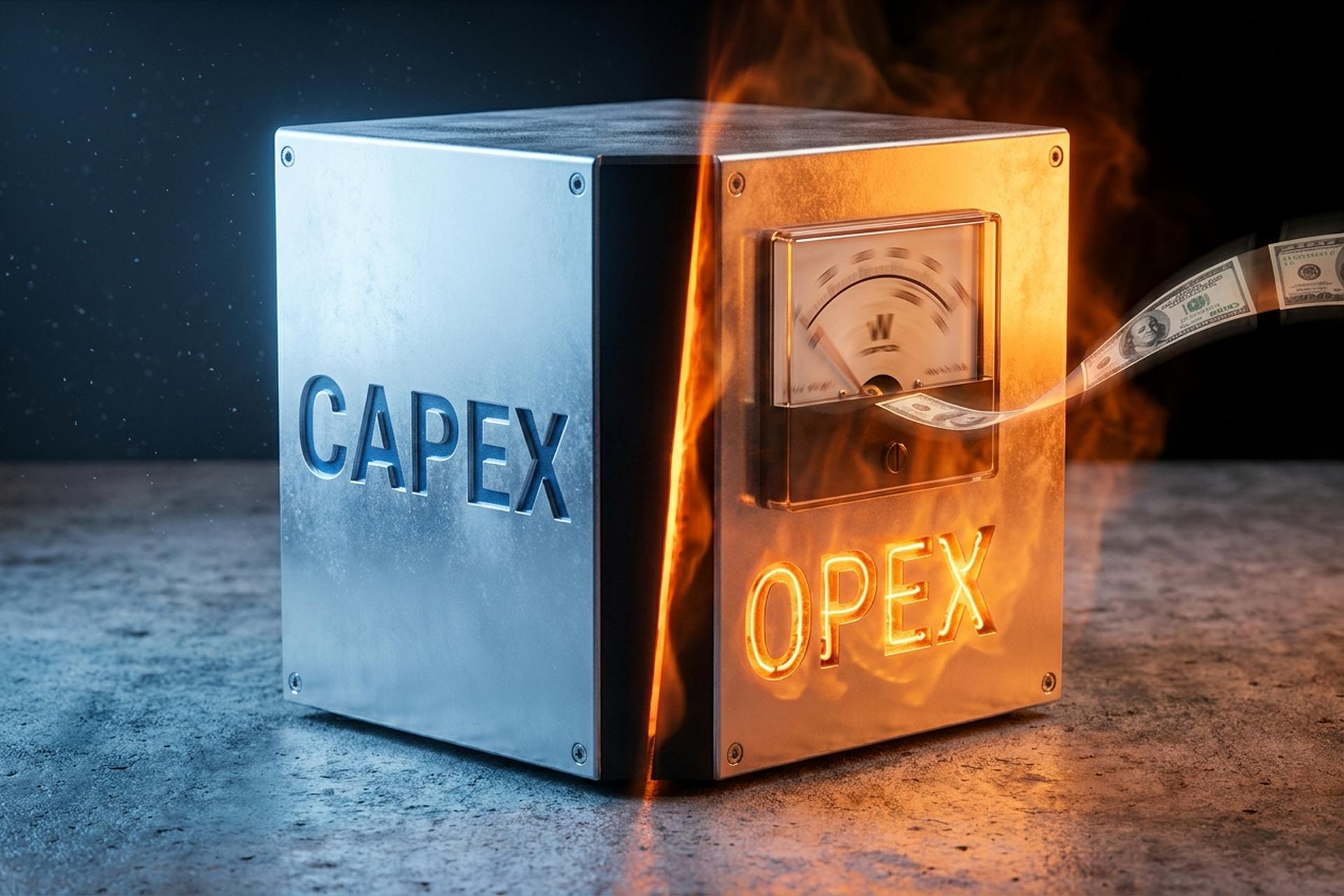
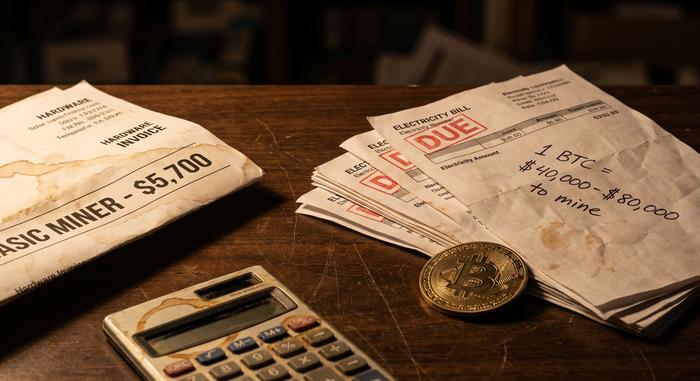
Buy one bitcoin miner and you feel the whole idea of CapEx and OpEx in a single afternoon. You hand over roughly $5,700 for an ASIC machine once, bolt it to a rack, and that money is gone in one swing. Then the second bill starts, and it never stops: electricity, every second the machine runs. One payment bought you an asset. The other keeps the asset alive. That split between capital expenditure and operating expense runs through every business on earth, from a corner coffee shop to a hyperscale data center. This guide walks through what each one is, how accountants and tax authorities treat them differently, the formulas, and how to decide which side of the line your next purchase belongs on.
What capital expenditure (CapEx) actually means
CapEx is not just a fancy word for expensive. A capital expenditure is money you spend to buy or upgrade an asset you will use for years, not something you burn through this month. Because the thing keeps working long after you pay for it, accounting refuses to let you write off the whole cost at once. Instead the purchase lands on your balance sheet as a fixed asset, and you depreciate it gradually across its useful life.
Think machinery, vehicles, and fixed assets like buildings and the land under them. Crypto makes this concrete in a hurry. A modern ASIC rig runs anywhere from $4,000 to $12,000 per unit, with a mid-tier S21-class machine around $5,700 in mid-2026. Buy a hundred of them, add the cooling, the racks, the electrical buildout, and the warehouse lease, and you have a textbook pile of capital expenditure before a single coin is mined.
CapEx is not always something you can touch. Intangible assets count too: purchased software licenses, patents, and capitalized research and development all sit in the same bucket. The common thread is simple. You are making one of those long-term investments today that you expect to benefit the company for several years, so the cost gets spread out rather than booked in one hit. That is the line that separates CapEx from OpEx, and it decides how each purchase moves through your financial statements.
What operating expense (OpEx) covers daily
If CapEx buys the machine, OpEx keeps the lights on, literally. That single contrast is the clearest way to picture the CapEx vs OpEx split. OpEx, sometimes written as operational expenditure, is the cost of running your day-to-day operations: the recurring costs that keep the business switched on right now. Stop paying it and you do not slowly lose value over five years. You stop today.
The usual suspects are payroll, salaries and rent, every utility bill, insurance, and the growing stack of software subscriptions most companies now run on. These are business expenses classified as OpEx that you incur and use up inside the same accounting period, so they get expensed immediately. They show up on the income statement, not the balance sheet, and they are generally fully deductible in the year you pay them.
Back to mining for a clean example. Once the rigs are bolted in, electricity becomes the dominant operating cost, eating an estimated 75 to 85 percent of a miner's ongoing OpEx as of mid-2026. Add pool fees, bandwidth, facility maintenance, and the staff watching the dashboards, and you have a recurring monthly bill that has nothing to do with the one-time cost of the hardware. CapEx was the down payment. OpEx is the meter that never stops spinning.
CapEx vs OpEx: the key differences that matter
Strip away the jargon and the whole CapEx vs OpEx question comes down to one thing accounting asks about every dollar: does this purchase keep paying you back after this year, or not? If yes, it is capital expenditure and gets capitalized. If no, it is an operating expense and gets written off now. Everything else, the tax timing, the cash flow impact, the flexibility, follows from that one fork.
Here are the key differences side by side.
| Dimension | CapEx | OpEx |
|---|---|---|
| What it buys | Long-term assets (rigs, servers, buildings) | Day-to-day running costs |
| Where it is recorded | Balance sheet, then depreciated | Income statement, expensed now |
| Cash impact | Large upfront | Recurring, predictable |
| Tax timing | Deducted over useful life | Fully deducted same year |
| Flexibility | Locked in, hard to reverse | Scale up or down monthly |
| Ownership | You own the asset | You rent the capability |
Where each lands on your financial statements
CapEx shows up first as an asset on the balance sheet, then bleeds onto the income statement a slice at a time as depreciation. OpEx skips the balance sheet entirely and hits the income statement, also called the profit and loss statement, in full. On the cash flow statement the two sit in different rooms: CapEx under investing activities, OpEx under operating activities. Same dollars out the door, very different lines on the company's financial statements.
Tax: depreciation vs an instant deduction
This is where the difference between CapEx and OpEx gets real money attached, because the accounting treatment for tax purposes splits sharply. OpEx is 100 percent deductible the year you incur it. CapEx you depreciate, spreading the deduction across the asset's useful life under a schedule like the US MACRS five-year class for mining and computing hardware. There is a twist worth knowing in 2026: recent US tax law restored 100 percent bonus depreciation, letting businesses expense qualifying hardware in year one. That hands a CapEx purchase OpEx-style tax timing, which matters enormously to anyone buying rigs by the pallet.
How to calculate each
The formulas are less scary than they look. CapEx for a period equals current property, plant and equipment minus the prior period's figure, plus depreciation. OpEx is roughly the cost of goods sold plus operating expenses pulled straight off the income statement. For a small miner, CapEx is the invoice for the rigs; OpEx is twelve months of power bills.
Crypto mining: CapEx and OpEx in real numbers
Bitcoin mining might be the purest CapEx and OpEx machine ever built. You can almost watch capital turn into operating cost in real time: a fixed asset humming in a rack, steadily converting electricity into hashes and, you hope, coins. Most businesses blur the two. Mining separates them with brutal clarity.
The rigs and buildout are CapEx
Everything you buy once is capital expenditure. The ASIC miners at $4,000 to $12,000 each, the immersion-cooling tanks, the transformers, the racks, and the building itself. This is the front-loaded part, and it can run into millions before the operation earns a cent. As noted, US miners in 2026 can often expense that hardware in the first year under restored bonus depreciation, which softens the cash sting but does not change what the spending is: an investment in long-term assets you own.
Electricity and hosting are OpEx
Now the meter. Power is the dominant operating expense in mining, 75 to 85 percent of ongoing costs, which is why miners obsess over their electricity rate more than their hardware. The math is unforgiving. Industrial operations need roughly $0.07 to $0.08 per kilowatt-hour to stay profitable, and anything north of about $0.12 per kilowatt-hour pushes most rigs underwater. All in, mining a single bitcoin cost an estimated $40,000 to $80,000 for industrial operators in mid-2026. After the 2024 halving cut the block reward to 3.125 BTC, those operating costs decide who survives and who unplugs.
Cloud mining vs hosted: moving the mix
Here is where the CapEx or OpEx choice gets strategic. Cloud mining converts the entire operation into OpEx: you rent hashrate, own nothing, and pay a recurring fee. Clean on paper, but I have rarely seen that premium leave any real margin at current prices. Hosted mining is the popular middle path: you buy the rig, which is CapEx plus the tax benefit of owning it, but outsource the power and facility to a host, which is OpEx. The table below shows how the three models split the same activity.
| Model | Hardware | Upfront cost | Ongoing cost | You own the rig? |
|---|---|---|---|---|
| Self-mining | Your CapEx | High | Power and maintenance (OpEx) | Yes |
| Hosted mining | Your CapEx | High | Hosting fee covers power (OpEx) | Yes |
| Cloud mining | Provider's | Low | Subscription or contract (OpEx) | No |
Nodes, validators, and crypto business operations
Mining gets the spotlight, but the same split runs through the rest of crypto's business operations. Run a blockchain node or a staking validator and you face the identical fork. Buy your own server and host it at home or in a rack, and the machine is CapEx while the bandwidth and electricity are OpEx, the operational costs of keeping it online. Rent a virtual server from a cloud provider instead, and the whole thing collapses into a single recurring OpEx line, with no hardware to own or depreciate.
The pattern repeats for any company that touches crypto. A merchant who wants to accept bitcoin can build a payment stack in-house, a capital project with servers, security, and developers, or simply plug in a hosted crypto payment gateway and pay a small recurring fee per transaction. One route is CapEx-heavy and yours forever; the other is pure OpEx that scales with sales and disappears the day you stop — the same CapEx vs OpEx trade-off, just wearing a different industry's clothes. Neither is automatically smarter. They just put the cost in different columns and hand you a different set of trade-offs.
The cloud shift from CapEx to operating expenditure
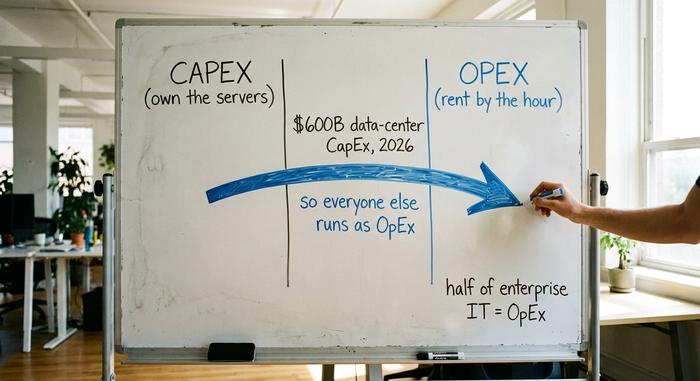
Zoom out and you can see the whole tech economy quietly migrating spend from the CapEx column to the operating expenditure column. The cloud is the engine. The biggest reason a startup can run global infrastructure without buying a single server is that someone else already bought it.
The numbers are staggering. The largest cloud providers are set to pour more than $600 billion of CapEx into data centers in 2026, up around 36 percent year over year, with Amazon alone near $200 billion. Gartner pegs worldwide data-center systems spending above $788 billion for 2026. All of that capital exists so that everyone else can rent computing as an operating expense by the hour. Analysts estimate well over half of enterprise IT spending is now structured as OpEx rather than CapEx.
Software told the same story first. The move from perpetual licenses you bought outright (CapEx) to SaaS subscriptions you rent monthly (OpEx) carried an entire industry's spending across the line. Crypto's cloud-mining boom is just one more corner of the same trade: pay as you go, own nothing, stay flexible.
CapEx or OpEx: which is better for your budget
There is no universally better answer, and anyone who tells you otherwise is selling something. CapEx or OpEx is a trade between owning the upside and keeping your cash flow flexible, and the right call shifts with your scale, your tax position, and how sure you are about the future.
CapEx wins when you want long-term value and control. You own the asset, you capture the depreciation tax benefit, and over a long enough horizon owning is usually cheaper than renting. The catch is cash: you commit a large sum upfront and you are stuck with the thing if the market turns. OpEx wins on flexibility. You preserve cash, you scale up or down month to month, and your costs stay predictable, which is gold for early-stage budgeting and effective financial planning. The catch is that renting forever often costs more in total, and you never build an asset.
Most companies set a capitalization threshold, often a few hundred to a few thousand dollars, below which everything is just expensed to keep the books simple. Above it, the CapEx-or-OpEx debate kicks in, and managing CapEx well becomes a real skill. The crypto version is sharp: own your rigs where power is cheap and you can host them, or use cloud mining when you cannot, and accept the thinner margin as the price of flexibility.
| Lean CapEx if... | Lean OpEx if... |
|---|---|
| You have cash and want to own the asset | Cash flow is tight or unpredictable |
| Power or usage is cheap and stable long term | You need to scale up or down fast |
| The tax depreciation benefit matters to you | You want predictable monthly costs |
| You will use the asset for many years | The technology changes quickly |
The bottom line on CapEx vs OpEx
CapEx and OpEx are not accounting trivia for the finance team to argue about. They decide something real: whether a purchase becomes an asset you own and depreciate, or a bill you keep paying until you stop. Bitcoin mining shows both at once, the rig and the power meter sitting side by side, which is exactly why it is such a clean teacher. The next time you face a big spend, a server, a software platform, a rack of miners, ask the only question that matters here. Which column does this belong in, and what does that do to my tax bill and my cash flow? Get that right and the budget mostly takes care of itself.