Token maker explained: how to create your own cryptocurrency with no coding
Over 11.6 million tokens were launched through launchpad platforms in 2025, more than doubling the prior year according to Messari. Solana alone sees 500,000 new tokens every month. Every day, 20,000 to 30,000 tokens pop up, most created by people who never wrote a line of code. The tool behind this explosion is the token maker, a web app that lets anyone deploy a cryptocurrency token on a real blockchain in a few minutes. No Solidity. No auditors. Just a wallet and a few clicks.
Five years ago, launching a token meant hiring a developer, writing a smart contract from scratch, getting it audited, and spending thousands of dollars. Today, platforms like CreateMyToken, Bitbond Token Tool, and 20lab handle all of that for the cost of a gas fee. Some of them are free. This article breaks down what a token maker is, what types of tokens you can create, which platforms are worth your time in 2026, how much it actually costs, and what mistakes can burn you before your token even hits a DEX.
What is a token maker and how does it work?
Picture a web form. You type in a name, pick a symbol, set the supply, and check a few boxes for features. Maybe you upload a token logo image and design a custom landing page too. Hit deploy, confirm in your wallet, pay a gas fee. Two minutes later, a smart contract sits on a real blockchain with your token in it. That is what a token maker does. The platform writes the code, compiles it, and pushes it live. You download the contract details, share the address, and you are off.
Why does this work? Because most tokens follow a standard. On Ethereum, that standard is ERC-20. It spells out how balances are tracked, how transfers happen, and how wallets and DEXs interact with the token. Since ERC-20 is the same every time, a token maker can rely on pre-written, pre-audited contract templates. It plugs in your custom parameters and deploys. Same story for BEP-20 on BNB Chain, SPL tokens on Solana, and native standards on Polygon, Arbitrum, Base, and Avalanche.
What comes out the other end is real. Not a testnet toy. Anyone with a wallet can hold your token, send it, or trade it. The contract gets verified on Etherscan or whatever block explorer your chain uses, so people can check the code for themselves.
Here is the part nobody says loud enough: deploying the token is the easy part. Building something worth owning is the hard part. Community, utility, liquidity, marketing. No token maker on earth handles that for you.
Types of tokens you can create with a token maker
Not every token does the same thing. What you create depends on what problem you are trying to solve. Or, honestly, whether you are trying to solve a problem at all.
Utility tokens give holders access to a product or service. Think arcade tokens: you need them to play. Lots of DeFi protocols hand out utility tokens so users can pay fees or unlock parts of the product. If you are building an app that needs its own currency, a token maker spits out a custom utility token in minutes.
Governance tokens hand out voting power. DAOs run on them. Compound's COMP and Uniswap's UNI let holders weigh in on proposals. You can make a governance token with any major token maker. The catch is that the voting mechanism itself usually lives in a separate contract or runs through tools like Snapshot, so the token alone is not enough.
Meme tokens need no explanation at this point. Dogecoin started it. Shiba Inu ran with it. In 2024 and 2025, meme coins exploded on Solana. Pump.fun alone generated over 13 million tokens and pulled in $1.08 billion in cumulative revenue by March 2026. CoinGecko reported 1.7 million new meme tokens launched in January 2025 alone. The flip side: 98.6% of Pump.fun tokens collapse according to Solidus Labs, and only 0.89% ever graduate beyond their initial bonding curve.
Stablecoins are supposed to hold a steady price, pegged to USD usually. Can you spin one up with a token maker? Sure. Call it MUSD, set the supply, deploy. Done. But a real stablecoin needs a reserve of actual dollars (or treasuries, or crypto collateral), an oracle feeding price data, and in most places, a regulatory framework. The contract is the easy part. The economics behind it are what make or break a stablecoin.
Security tokens are the serious end of the spectrum. They represent ownership in a real thing: shares in a company, a slice of a building, a bond. Regulators care about these a lot. The RWA tokenization market grew 308% over three years to roughly $24-$30 billion as of 2025, per CoinDesk. McKinsey thinks it hits $2 trillion by 2030. Bitbond's Token Tool handles ERC-1400, the security token standard. If you are doing anything that touches real assets and real money, you need more than a basic ERC-20 generator.
| Token type | Purpose | Example | Can a basic token maker create it? |
|---|---|---|---|
| Utility | Access to a service or platform | BNB, LINK | Yes |
| Governance | Voting on protocol decisions | UNI, COMP | Yes (basic), voting mechanism separate |
| Meme | Community, speculation | DOGE, PEPE | Yes |
| Stablecoin | Price stability, pegged to fiat | USDT, USDC | Contract only, economics separate |
| Security | Ownership of real assets | Tokenized equity | Needs ERC-1400, limited platform support |
| NFT | Unique digital assets | Art, collectibles | Separate standard (ERC-721/ERC-1155) |
How to create your own token step by step
I tried five different platforms. The flow is basically the same on all of them.
Start by picking your blockchain. People rush past this step. Do not do that. Ethereum has the credibility and the ecosystem, but deploying costs $125. BNB Chain is cheap, under $1 in gas most days, and PancakeSwap gives you instant DEX access. Base is Coinbase's L2, and gas is almost free there. Solana is where the meme coin crowd lives. Whatever you pick determines your wallet compatibility, which DEXs you can list on, and what kind of community you can reach.
Next, connect your wallet. MetaMask for EVM chains. Phantom for Solana. Have enough native currency to cover the gas. If you are on Ethereum and your wallet has $50 in ETH, that might not be enough during busy hours.
Now the fun part: naming your token. You need four things at minimum. A name ("My Project Token"), a symbol (MPT), total supply (say 1 billion), and decimals (18 is standard on EVM chains, matching ETH itself).
After the basics, you pick features. This is where token makers earn their keep. A bare-bones platform gives you a fixed supply ERC-20 and calls it a day. Better ones let you toggle minting so you can create more tokens later. Burning so tokens can be removed from circulation forever. Pausing so you can freeze transfers if something goes wrong. Taxes that skim a percentage off every buy or sell. Anti-whale caps that limit how much one wallet can hold. Blacklist and whitelist controls for blocking or approving specific addresses.
Last step: review and deploy. The site shows everything you picked. Double-check it. Once you confirm in your wallet and the transaction goes through, it is done. No undo button on blockchain. Your token contract address appears, and your entire supply lands in the deployer wallet.
Now the real work starts. You need to add liquidity on a DEX or nobody can trade it. You need to verify the contract on the block explorer so it does not look sketchy. You probably need a website, a Telegram group, and a Twitter account. These platforms create tokens. What you do with them after that is entirely on you.
Best token maker platforms in 2026
I counted over 20 token maker platforms that are still active in 2026. Honestly, most do the same core thing. What separates them: chain support, feature depth, price, and whether their contracts have been through a real audit.
| Platform | Chains supported | Token types | Cost | Notable features | Tokens created |
|---|---|---|---|---|---|
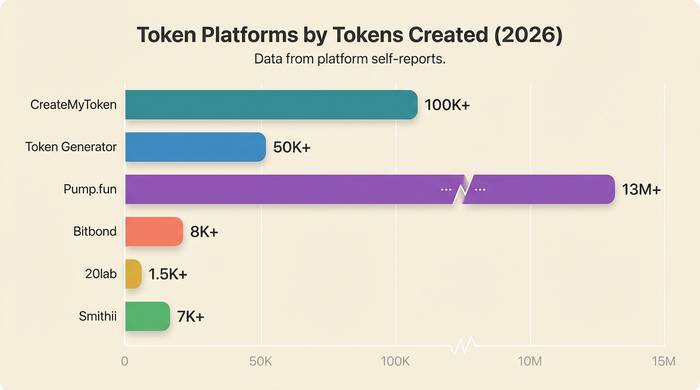
| CreateMyToken | 15+ (Ethereum, Solana, Base, BNB, Polygon, Arbitrum, more) | ERC-20, SPL | Free + gas | Taxes, dividends, deflationary, role-based access | 100,000+ |
| Token Generator (ERC20 Generator) | 14 EVM chains | ERC-20 | Free + gas | Anti-whale, reflection, taxable, liquidity auto-create | 50,000+ |
| Bitbond Token Tool | Ethereum, Polygon, BNB, Base, Avalanche, Arbitrum, Solana, Stellar | ERC-20, ERC-721, ERC-1400, SPL | Pay-per-use + gas | Security tokens, NFTs, token sales, vesting, API | 8,000+ |
| 20lab | 20+ (EVM, Solana, Sui) | ERC-20, SPL, Sui | Varies + gas | Most chains, gas-optimized (saves ~40%), owner dashboard | 1,500+ |
| Smithii | Solana, Sui, EVM chains | SPL, ERC-20 | Low fee + gas | Meme coin focus, presale tools, launchpad | N/A |
| TokenMaker.org | Ethereum, Polygon, BNB, Base, Arbitrum | ERC-20 | 0.03 ETH (Ethereum) | OpenZeppelin contracts, instant trading | N/A |
| CoinFactory | Ethereum, BNB | ERC-20, BEP-20 | Gas only | Simple, mintable and burnable | N/A |
CreateMyToken has the numbers. Over 100,000 tokens deployed since 2019. Their site claims $500 million in total token value generated across all those launches. The interface is about as minimal as it gets: pick a chain, fill in the blanks, connect wallet, deploy. You pay gas and nothing else.
Bitbond is where you go if this is a real business. Their Token Tool is the only major platform handling security tokens through ERC-1400. That matters for asset tokenization under MiCA or SEC guidelines. CertiK audited their contracts. They also do token sales, vesting, and have an API for companies that need to build token issuance into their own product. 8,000+ tokens created so far.
Token Generator by vittominacori has been running since 2018, which makes it ancient in crypto years. Open-source. Contracts auto-verify on Etherscan. Feature-wise it goes deeper than most free tools: anti-whale caps, reflection tokens that redistribute fees to all holders, deflationary burns per transaction, and ERC-1363 callback support.
20lab wins on chain coverage. Over 20 networks including Solana, Sui, and every EVM chain you can name. They claim their gas optimization cuts deployment costs by about 40%. If your project needs a chain nobody else supports, check 20lab first.
For Solana meme coins, Pump.fun took over. 13 million tokens launched, $1 billion in platform revenue. Smithii handles the Solana users who want more control than Pump.fun offers. Both are fast, both are cheap, and both produce tokens that mostly die within hours. That is the meme coin lifecycle.
How much does it cost to create a token?
People assume token creation is expensive. It used to be. In 2026, the cost depends almost entirely on which chain you deploy to. Some token makers charge nothing beyond gas. Others take a flat fee or a cut. Here is what I found comparing real costs.
| Chain | Deployment cost (gas + contract) | Platform fee (varies) | Total estimate |
|---|---|---|---|
| Polygon | ~$4 | $0-$30 | $4-$34 |
| Solana | ~$18 (0.1 SOL) | $0-$20 | $18-$38 |
| Base (L2) | ~$25 | $0-$30 | $25-$55 |
| BNB Chain (BSC) | $25-$140 | $0-$30 | $25-$170 |
| Ethereum mainnet | ~$125 | $0-$50 | $125-$175 |
| TRON | ~$197 | $0-$30 | $197-$227 |
These numbers come from Panda Academy's 2025 cost comparison and shift with gas prices and native token values. Polygon is the cheapest chain for deployment at roughly $4. Ethereum is the most expensive but gives you the largest ecosystem. If you are just experimenting, Base or Polygon cost nearly nothing.
But here is what catches people off guard: the token itself is the cheap part. Adding liquidity is where real money goes. Want your token tradeable on Uniswap? You need to pair it with ETH or USDC and lock actual dollars into a pool. Most projects that get any traction start with $5,000 to $10,000 in liquidity. Skip that and your token sits on-chain looking like a ghost town.
Platform pricing breaks down simply. CreateMyToken and Token Generator cost zero beyond gas. TokenMaker.org charges 0.03 ETH on Ethereum. Bitbond does pay-per-use. Some platforms sell advanced features like taxes and anti-whale as premium add-ons on top of the base deployment.
Risks and scams to watch when using a token maker
The same tools that let a startup launch a token in five minutes also let a scammer do the same thing. That is the trade-off of no-code creation. Knowing how scams work keeps you from being on the wrong end of one.
Rug pulls are the biggest danger. Someone creates a token, hypes it on social media, adds liquidity so people can buy it, then yanks all the liquidity and disappears with the money. Token makers with tax features make this even easier, since a 99% sell tax can trap buyers. Chainalysis estimated total crypto fraud losses at $14-$17 billion in 2025. According to CoinLaw, 62% of meme coins get flagged as potential rug pulls within 30 days of launch. On BNB Chain specifically, 12% of all BEP-20 tokens are designed as rug pulls from the start.
Hidden fees catch people off guard. Token makers let creators set buy and sell taxes. A 1% tax on trades sounds harmless. But what happens when the creator bumps it to 50% next Tuesday? If the contract lets the owner change the tax rate after deployment, buyers are trapped. I have seen it happen dozens of times. Always check whether the tax is hardcoded or modifiable.
Watch out for fake token maker sites. Some look exactly like real generators but are phishing traps. You connect your wallet to "create a token" and your ETH vanishes. Stick to platforms with real track records, open-source code, and users who vouch for them.
Audit status matters less than people think. Yes, the templates are audited. But the moment you toggle on custom features or stack parameters in weird ways, the audit no longer covers your specific contract. If real money is going into your project, pay for an independent audit regardless.
Then there is the legal angle. In most countries, selling tokens to the public looks a lot like selling securities. If your token promises profits or represents ownership in anything, regulators may come knocking. The SEC has already gone after token issuers who skipped registration. A token maker deploys code. It does not make you compliant. KYC, securities filing, tax reporting: all your problem.