What is Celo blockchain? The mobile-first Ethereum L2 for real-world payments
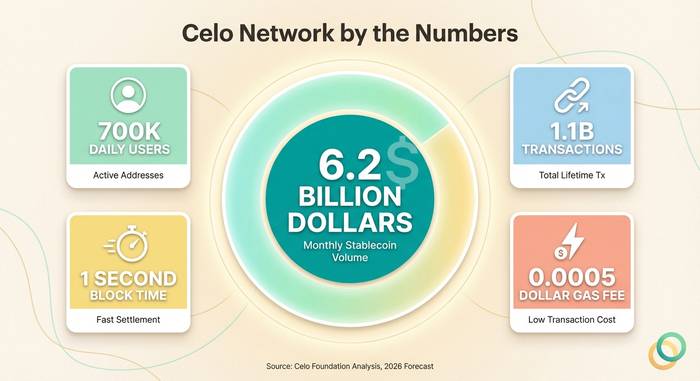
Seven hundred thousand people use the Celo network every day. Not to trade meme coins. Not to flip NFTs. To send money. To pay for groceries. To receive wages. Celo has processed 1.1 billion transactions and moves $6.2 billion in stablecoin volume monthly. In a crypto industry obsessed with speculation, Celo built something that actually gets used for what money is supposed to do.
Celo started as an independent Layer 1 blockchain in 2020 and has since migrated to become an Ethereum Layer 2 built on the OP Stack. The Celo platform was designed from day one for mobile phones, not desktop trading terminals. Gas fees average $0.0005. Block time is one second. You can pay fees in stablecoins like cUSD or USDT instead of needing to hold the native token. And the whole thing works on a cheap Android phone over a spotty cell connection.
This guide explains how Celo works, why it migrated to become an Ethereum L2, what the Celo ecosystem looks like in 2026, and whether the CELO token is worth paying attention to.
How does the Celo blockchain work?
Celo sits on top of Ethereum. It is a Layer 2 built on the OP Stack, the same framework behind Optimism and Base. Security comes from Ethereum mainnet. But the technical stack has some pieces you will not find on other L2s.
EigenDA v2 handles data availability at 100 megabytes per second. That keeps gas dirt cheap even under load. The proof system uses zkEVM through Succinct SP1, verifying transactions with zero-knowledge proofs. And here is what actually matters to regular people: you can pay gas in stablecoins. USDT, USDC, cUSD. No ETH required. No native token required. A woman in Nairobi sending $5 to her sister does not need to understand gas tokens. She just sends the money.
The consensus mechanism is proof-of-stake. Validators stake CELO tokens to secure the network, and anyone holding CELO can delegate to a validator and earn staking rewards. The Celo network achieves one-second block times with up to 1,400 transactions per second.
The phone number mapping is one of Celo's oldest tricks. Through an on-chain public key infrastructure, you can link your phone number to your wallet address. That means you can send crypto to a contact by their phone number, even if they have not set up a wallet yet. The funds sit in a smart contract until the recipient claims them. For bringing crypto to people who have never touched a blockchain, this matters more than any speed benchmark.
Celo's migration from L1 to Ethereum L2
Celo launched as an independent Layer 1 in April 2020. The mainnet had its own validator set, its own consensus, and its own security guarantees. It worked. But the team made a bet that being part of Ethereum would be worth more than being independent.
Why give up being your own chain? Three problems kept coming up.
Money was stuck. Every independent L1 has its own isolated liquidity. Bridging was risky and cost money people did not want to spend. As an Ethereum L2, Celo plugs straight into Ethereum's pools, bridges, and DeFi. A cUSD holder on Celo can tap into Ethereum mainnet without trusting some random bridge contract.
Developers were hard to attract. Ethereum has the most builders in crypto. Period. By joining the OP Stack, Celo made it so any Ethereum developer can ship on the Celo blockchain without learning anything new. The Celo community gets to ride on everything Ethereum builds.
Security was expensive. Running an independent validator set costs money and requires convincing enough independent operators to participate. Ethereum has over $100 billion staked. No L1 with a $400 million market cap can match that. Celo decided to borrow Ethereum's security instead of trying to build its own.
The downside? Less independence. Upgrades now have to fit the OP Stack framework. The team weighed it and decided the trade was worth it.
The Celo ecosystem in 2026
The Celo ecosystem is not built for traders. It is built for people who need payments to work.
Stablecoins on Celo
Stablecoins are the core of everything on Celo. The network supports cUSD (pegged to the US dollar), cEUR (pegged to the euro), cREAL (pegged to the Brazilian real), plus USDT and USDC. The monthly stablecoin volume is $6.2 billion. For context, many Layer 1 blockchains with higher market caps do not move that much stable value.
cUSD is the native Celo stablecoin, backed by a diversified reserve of crypto assets including CELO, BTC, ETH, and DAI. The Celo Foundation manages this reserve and targets overcollateralization, meaning the reserve holds more value than the outstanding cUSD supply.
| Stablecoin | Peg | How it works |
|---|---|---|
| cUSD | US Dollar | Overcollateralized crypto reserve (CELO, BTC, ETH, DAI) |
| cEUR | Euro | Same reserve mechanism as cUSD |
| cREAL | Brazilian Real | Same reserve mechanism |
| USDT | US Dollar | Tether's standard USDT, bridged to Celo |
| USDC | US Dollar | Circle's USDC, available natively |
MiniPay and mobile payments
MiniPay is a wallet built into Opera's mobile browser, focused on African markets. It strips away all the crypto complexity. No seed phrases shown upfront. No gas token confusion. You send stablecoins to phone contacts. That is it. Opera has hundreds of millions of mobile users in Africa, and MiniPay gives them a one-tap path into Celo-based payments.
This is where Celo's numbers come from. Those 700,000 daily active users are not DeFi degens. They are regular people making real payments. Vitalik Buterin himself praised Celo for building "worldwide access to basic payments and finance."
DeFi on Celo
The DeFi ecosystem on Celo is smaller than Ethereum or Solana but focused. Key protocols:
| Protocol | Type | What it does |
|---|---|---|
| Ubeswap | DEX | Automated market maker, the main swap venue on Celo |
| Moola Market | Lending | Borrow and lend cUSD, CELO, and other assets |
| Mento | Stability | Protocol behind cUSD, cEUR, cREAL. Manages the reserve and peg |
| GoodDollar | UBI | Universal basic income distribution using blockchain |
| Toucan Protocol | Carbon credits | Tokenized carbon credits for the voluntary carbon market |
ReFi (Regenerative Finance)
Celo has carved out a niche in ReFi that no other blockchain occupies at this scale. The network is carbon-negative, with 20% of transaction fees going to climate offset initiatives. Over 3,845 tons of carbon have been offset through the protocol. Toucan Protocol and Flowcarbon tokenize real-world carbon credits on Celo, creating a liquid market for climate offsets.
This is not greenwashing. The Celo Foundation has backed real projects: reforestation programs, renewable energy, biodiversity preservation. Whether ReFi becomes a major crypto category or stays niche depends on carbon markets, but Celo is the only blockchain where it is a core part of the identity.
The CELO token
CELO is the native token of the Celo network. It has three jobs: paying gas fees (though you can also pay in stablecoins), staking to secure the network, and governance voting on protocol proposals.
The token launched with the mainnet in April 2020. Total supply is capped at around 1 billion tokens. The Celo Foundation, cLabs (the primary development company), and early investors hold significant portions.
The founding team includes Rene Reinsberg and Marek Olszewski, both with backgrounds in fintech and mobile payments. The project raised funding from a16z Crypto, Polychain Capital, and other major crypto VCs. The Celo Foundation operates as a non-profit supporting ecosystem growth.
| CELO token snapshot | Value |
|---|---|
| Total value secured | ~$400 million |
| Block time | 1 second |
| Max TPS | ~1,400 |
| Average gas fee | ~$0.0005 |
| Total transactions (all-time) | 1.1 billion |
| Daily active users | ~700,000 |
| Monthly stablecoin volume | $6.2 billion |
| Carbon offset | 3,845 tons |
| Network type | Ethereum L2 (OP Stack) |
The honest view on CELO as a token: the protocol has real usage. 700K daily users and $6.2B in monthly stablecoin volume are not numbers you can fake. But the token price has struggled because the value flows through stablecoins, not through CELO itself. People use Celo to send cUSD. They do not need to hold CELO to do it. That creates a disconnect between network usage and token demand that the team has not fully solved.
Risks and things to watch
The L2 migration is mostly done but still evolving. Any bugs in the OP Stack or EigenDA integration could affect Celo. Being part of the Optimism Superchain ecosystem helps, but it also means Celo's roadmap is partly tied to decisions made by Optimism's governance.
The token problem is real. Celo has 700K daily users and they all use stablecoins. Nobody needs to buy CELO to send cUSD. Governance and staking create some demand, but not nearly enough to match the network's usage. This gap between product success and token performance is Celo's defining tension.
Tron moves more stablecoin volume than almost anyone. Stellar targets the same remittance market. Solana processes billions in stable transfers. Celo's advantage is the mobile-first experience and MiniPay's distribution through Opera, but holding that lead requires relentless growth in Africa, Southeast Asia, and Latin America.
And then there is reserve risk. cUSD is backed by crypto: CELO, BTC, ETH, DAI. If everything crashes 50% in a week, the reserve could drop below the outstanding cUSD supply. The Celo Foundation watches this and adjusts, but the risk is baked into the design.