What is a Physical Bitcoin, and What Is Its Real Value?
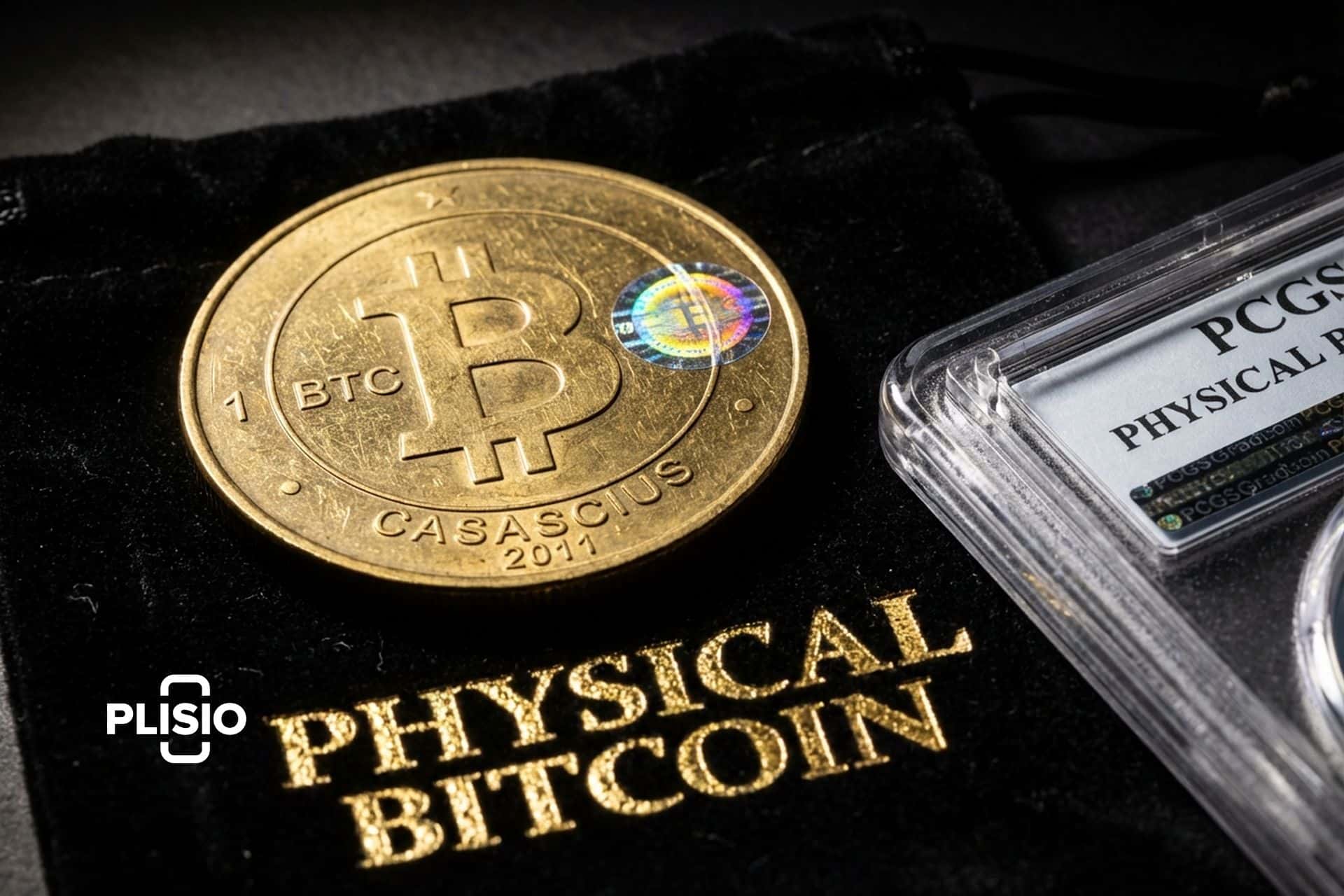
I love the irony of this. Somebody invents a currency that exists only as code on a decentralized network, no physical form, completely digital by design. And the first thing collectors do? Stamp it onto a brass coin and lock the private key under a holographic sticker. Humans, man.
But here's the thing: these coins are worth real money. Serious money. One sold for $1.69 million at auction. Heritage Auctions moved 250 of them in a single November 2023 sale for nearly $7.2 million. Stack's Bowers put $2.7 million worth of physical bitcoin on the block in August 2024. This isn't a novelty. It's a market.
A physical bitcoin is a metal coin or bar with an actual BTC private key sealed inside under a tamper-evident hologram. Not a decorative token with a logo on it (those are $10 on Amazon and contain zero cryptocurrency). I'm talking about objects that function like bearer instruments. If the hologram is intact, the BTC is presumably still at the address. Whoever holds the coin controls the crypto.
The most famous maker, Casascius, stopped minting in 2013. Those coins are now frozen-in-time artifacts from Bitcoin's earliest days, and collectors treat them accordingly. Let me walk you through how all this works.
How physical bitcoin coins work
Simpler than it sounds. Someone mints a coin. They generate a fresh Bitcoin private key, write it on a tiny piece of paper or etch it into metal, and seal it inside the coin under a holographic sticker. On the outside, the first few characters of the public address are visible. That lets you plug it into a blockchain explorer and check the balance without breaking the seal.
The private key is everything. If you have it, you can sweep that BTC into any wallet on earth. The hologram's job is to prove nobody has seen the key yet. Intact hologram? Key is presumably safe. That's why collectors call unpeeled coins "loaded" and pay massive premiums for them. Once someone peels the hologram and moves the bitcoin, the coin becomes a hollow shell. Still collectible, still worth something, but a fraction of what a loaded one fetches.
I think of it like those sealed packs of vintage baseball cards. The pack itself has value. But if there might be a rookie card inside, the sealed pack is worth ten times more than the opened one. Same psychology.
One thing people misunderstand: the coin doesn't "contain" bitcoin the way a USB drive contains a file. The BTC sits on the blockchain. The coin just holds the key to reach it. Lose the coin, the bitcoin still exists. You just can't get to it anymore.
Casascius: the coins that started it all
Mike Caldwell was a guy in Utah who liked Bitcoin back when nobody liked Bitcoin. In 2011, with BTC trading somewhere between $5 and $30, he started minting brass coins with actual bitcoin sealed inside. He called them Casascius coins. The denominations ran from 0.5 BTC all the way up to a 1,000 BTC gold bar that would be worth over $70 million at today's prices.
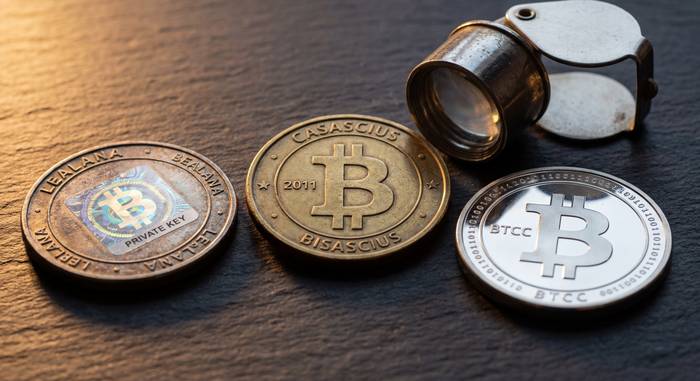
Every coin got a holographic sticker over the private key. You could see the public address on the outside and verify the balance on the blockchain without opening it. The 1 BTC brass coins became the stock photo version of "what does a Bitcoin look like" and showed up in basically every news article about crypto for years. If you've ever seen a gold-ish coin with a B on it, that's probably a Casascius.
Then the government showed up. In November 2013, FinCEN told Caldwell he was running a money transmitter business. Federal registration, state licensing, the whole regulatory package. He shut down loaded coin sales that same month. Never reopened.
Which turned out to be the best thing that could've happened for collectors. Finite supply. No more coming. And the BTC inside kept getting more expensive. A graded MS68 brass 1 BTC coin sold for $43,200 at Heritage Auctions on a day when bitcoin itself was worth $34,800. That's a 24% premium the buyer paid just because the coin is cool and rare.
The biggest sale? A 2011 25 BTC Casascius went for $1,698,750 at GreatCollections in November 2021. Over 200 people bid on it. The bitcoin inside was worth about $1.5M at the time. The extra $200K was pure "I want to own a piece of crypto history" money.
| Denomination | Metal | Years minted | Notable auction price |
|---|---|---|---|
| 0.5 BTC | Brass | 2013 | $5,000-15,000+ |
| 1 BTC | Brass | 2011-2013 | $43,200 (MS68, Heritage) |
| 10 BTC | Silver | 2012-2013 | $200,000+ |
| 25 BTC | Gold-plated | 2011 | $1,698,750 (GreatCollections) |
| 100 BTC | Gold bar | 2011-2012 | Rarely traded publicly |
| 1,000 BTC | Gold bar | 2011 | Extremely rare |
Other physical bitcoin makers
Caldwell wasn't the only one who had this idea. A handful of other companies gave it a shot, and each brought something different to the table.
Lealana showed up in 2013 with gold and silver coins. Higher quality metal than Caldwell's brass, built to last longer. They did 0.1 BTC denominations and even minted physical Litecoin tokens. Produced in smaller batches than Casascius, which makes them harder to find today on the secondary market.
Titan went heavy on security. Anti-counterfeit features, unique QR codes on every coin, and you could literally call a phone number to verify how much BTC was loaded. They made 0.5 and 1 BTC coins before going quiet.
Denarium was a Finnish operation aiming for the budget end of the market. Brass coins you could buy empty or pre-loaded with tiny amounts, 0.01 or 0.1 BTC. They tried laser-etching private keys instead of using holographic stickers. Interesting approach, never really broke through.
BTCC Mint came from Bobby Lee, who co-founded the BTCC exchange. Polished silver, gold plating, fancy boxes, certificates of authenticity. Looked premium. They stopped when the exchange shut down in 2018.
Every single one of these ran into the same wall as Caldwell: in the U.S., selling coins loaded with crypto makes you a money transmitter in the eyes of FinCEN. That's what killed the industry. Not demand. Regulation.
Physical bitcoin as a collectible
This is where numismatics and crypto crash into each other, and I find it genuinely fascinating.
A loaded physical bitcoin has two price components stacked on top of each other. First: whatever the BTC at that address is worth. For a 1 BTC Casascius in March 2026, that's about $71,000. Second: the collector premium. How rare is this coin? What condition? What denomination? What series year? Collectors routinely pay 20-50% above the bitcoin value. For rare pieces, way more.
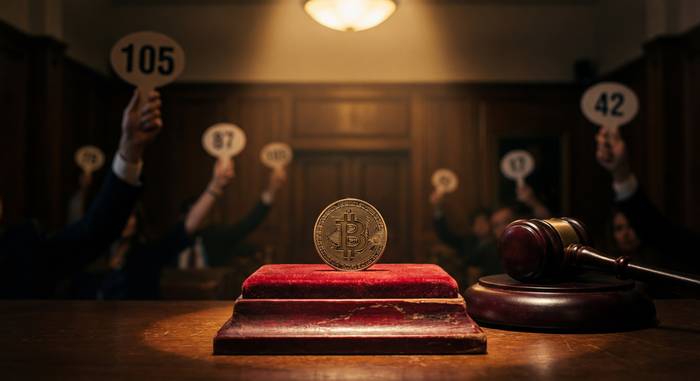
Stack's Bowers sold a single 1 BTC brass Casascius in June 2025 for $117,000. Bitcoin was around $80K that week. The buyer voluntarily paid an extra $37,000, roughly 46%, just to own the physical object. That's not investment logic. That's collector behavior. And it's growing.
Once a coin gets peeled, the premium collapses. A peeled Casascius is basically a brass disc with a cool story. Still goes for $500-2,000 depending on series and condition, but nothing like a loaded one. The magic dies when the hologram breaks.
The coin grading world noticed. PCGS and NGC, the same companies that authenticate old Morgan dollars and gold eagles, now grade physical bitcoins. A Casascius in a PCGS MS68 slab commands a serious premium over a raw ungraded coin. Heritage Auctions and Stack's Bowers both run dedicated cryptocurrency coin sections in their regular sales now. This niche has gone mainstream within the coin collecting world.
Novelty coins vs loaded coins
Let me clear something up because I see this confusion constantly. Those gold-looking coins on Amazon for $8-15? Novelty tokens. Gold-plated zinc with a Bitcoin logo. Zero cryptocurrency inside. No private key. No hologram that means anything. Desk decorations. Conversation starters. Not bitcoin.
A loaded Casascius coin, the real deal, starts at roughly $40,000 for a 1 BTC denomination in 2026. Completely different universe. I've seen people on Reddit bragging about buying "a physical bitcoin" and posting a photo of a $12 Amazon token. It's like buying a plastic crown and claiming you're royalty.
If you're shopping for the real thing, here's the checklist: known mint (Casascius, Lealana, Titan, BTCC, Denarium), hologram visibly intact with no signs of tampering, and always verify the address balance on a blockchain explorer before you hand over money. Fakes are out there. They're getting better. Be careful.
Do physical bitcoins make sense in 2026?
Honestly? As a way to store bitcoin, no. Hardware wallets like Ledger and Trezor do the same job better, cheaper, and with the ability to hold multiple coins and tokens. A physical bitcoin is one coin, one denomination, sealed shut. You can't spend part of it. You can't add to it. Once you peel the hologram, the collectible premium evaporates.
But as a collectible? Absolutely. Casascius coins are genuinely rare historical artifacts from the earliest days of crypto. They're the coin collecting equivalent of first-edition books. The market for them is real, growing, and backed by major auction houses. If you treat them as numismatic pieces rather than a practical storage method, the value proposition makes sense.
And there's something poetic about it. Bitcoin was invented to be purely digital. No physical form, no central authority, no geographic home. And the very first thing humans did was stamp it onto a brass coin and put it in a safe. We really can't help ourselves.