BEP-20: what is the BNB Smart Chain token standard and how does it compare to ERC-20
Somebody sends you USDT. You paste your wallet address, hit confirm, and wait. Nothing arrives. You check the transaction hash. The tokens left the sender's wallet. They traveled across the BNB Smart Chain. Your wallet is on Ethereum. The USDT is gone. Stuck between two networks because nobody told you that USDT exists as both an ERC-20 token on Ethereum and a BEP-20 token on BSC, and the two are not interchangeable without a bridge.
This mistake costs people real money every week. And it happens because most beginners do not understand that the same token can live on different blockchains using different standards. BEP-20 is one of those standards. It powers everything on BNB Smart Chain the same way ERC-20 powers everything on Ethereum. Same concept, different network, different gas token, different rules for moving assets around.
If you use MetaMask, Trust Wallet, or any DeFi protocol on BSC, you are already interacting with BEP-20 tokens whether you realize it or not. This article explains what the BEP-20 standard actually is, how it compares to ERC-20 and BEP-2, which tokens use it, and the practical things you need to know to avoid sending your crypto into the void.
What BEP-20 means and why it exists
BEP stands for BNB Evolution Proposal. Twenty is just the proposal number, same naming convention that gave us ERC-20 on Ethereum. The standard tells developers: "here is how tokens on BNB Smart Chain should behave."
Here is the backstory. Binance already had a blockchain called Binance Chain (now BNB Beacon Chain) since April 2019. It was fast for basic token transfers but dumb in the useful sense. Could not run smart contracts. Could not do DeFi. Could not host an NFT marketplace. Basically a one-trick pony for the Binance DEX.
So in September 2020, Binance launched a second chain alongside it: BNB Smart Chain. This one ran the Ethereum Virtual Machine. Copy-paste your Solidity code from Ethereum, deploy it on BSC, it works. PancakeSwap was essentially a Uniswap fork that went live in days because the EVM compatibility made porting trivial.
BEP-20 came with BSC as the token standard. And it is not "inspired by" ERC-20. It is ERC-20 wearing different clothes. Same six functions. Same two events. A developer who shipped an ERC-20 contract on Ethereum can redeploy the exact same code on BSC and call it a BEP-20 token. The difference is not in the code. It is in the network running underneath.
The key difference: gas. On Ethereum, a simple token transfer might cost $1-15 depending on network congestion. On BSC, the same transfer costs a few cents. You pay gas in BNB instead of ETH. Block time on BSC is about 3 seconds compared to Ethereum's 12 seconds. Faster and cheaper. The tradeoff is decentralization: BSC runs on 21 active validators selected through a Proof of Staked Authority (PoSA) consensus mechanism. Ethereum has over a million validators. That validator count difference is the core criticism of BSC.
| Parameter | BEP-20 (BSC) | ERC-20 (Ethereum) |
|---|---|---|
| Network | BNB Smart Chain | Ethereum |
| Gas token | BNB | ETH |
| Block time | ~3 seconds | ~12 seconds |
| Avg gas cost (token transfer) | $0.01-0.05 | $1-15 |
| EVM compatible | Yes | Native |
| Validators | 21 active (PoSA) | 1M+ (PoS) |
| Smart contract language | Solidity | Solidity |
| Address format | 0x... | 0x... |
One practical detail that trips people up: BEP-20 and ERC-20 addresses look identical. Both start with 0x followed by 40 hex characters. Your MetaMask address is the same string on both networks. But the tokens on each network are separate. Sending BEP-20 USDT to an Ethereum address without using a bridge means the tokens end up on BSC at that address. If the recipient only checks Ethereum, they see nothing. The tokens exist, just on the wrong chain.
BEP-20 vs BEP-2: the two Binance token standards
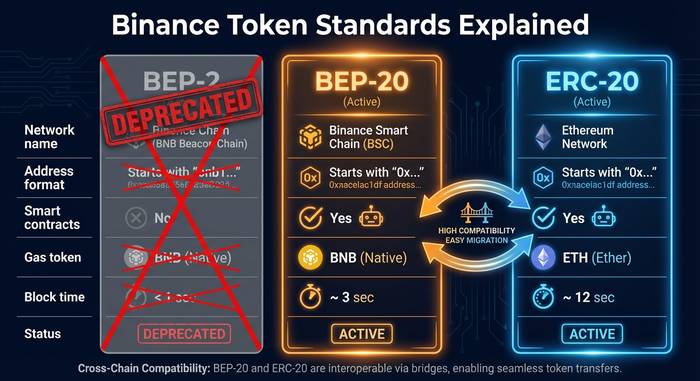
I cannot count the number of times someone in a Discord server has asked "what is the difference between BEP-2 and BEP-20?" The answer used to be complicated. Now it is simple: BEP-2 is dead.
Let me explain. Binance ran two blockchains at the same time for four years. BNB Beacon Chain (the old one, April 2019) used BEP-2 tokens. It could do fast transfers and run the Binance DEX but nothing else. No smart contracts. No DeFi. BEP-2 addresses looked like bnb1qzm84k... and required a MEMO field that everybody forgot and then spent three days in support chat trying to recover their funds.
BNB Smart Chain (September 2020) was the smart one. EVM compatible. Smart contracts. DeFi. NFTs. BEP-20 tokens with 0x... addresses. No MEMO nonsense.
Almost immediately, everyone moved to BSC. The Beacon Chain became a ghost town. In June 2024, Binance pulled the plug. Beacon Chain stopped producing blocks. BEP-2 is officially deprecated. If you have BEP-2 tokens in some ancient Trust Wallet backup from 2020, they need to be converted to BEP-20 or they are stranded on a chain that no longer exists.
| Standard | Network | Address format | Smart contracts | Status (2026) |
|---|---|---|---|---|
| BEP-2 | BNB Beacon Chain | bnb1... (+ MEMO) | No | Shut down (June 2024) |
| BEP-20 | BNB Smart Chain | 0x... | Yes | Active, primary standard |
| ERC-20 | Ethereum | 0x... | Yes | Active |
BEP-20 and ERC-20: what is the same and what is different
People ask me all the time: "so BEP-20 is just ERC-20 on a different chain?" Basically, yes. And that is the whole point. Binance did not reinvent the wheel. They copied Ethereum's homework, made a few tweaks, and ran it on a faster, cheaper, more centralized chain.
The tooling carries over too. I use MetaMask for BSC the same way I use it for Ethereum. Same Remix IDE for deploying contracts. Same Hardhat for testing. Same OpenZeppelin libraries. If you are a Solidity developer, BSC is a free lunch. Zero new skills required.
BEP-20 does add a couple things ERC-20 does not require. The getOwner() function is mandatory on BEP-20 but optional on Ethereum. The decimals field must be explicitly declared. And BEP-20 bakes in optional parameters for blacklisting addresses, minting, burning, and pausing transfers. On Ethereum you would add these through OpenZeppelin extensions. On BSC they are part of the standard template that most developers start from.
The real differences are at the network level, not the token level:
Gas costs make BSC attractive for small transactions. Swapping $50 of tokens on PancakeSwap costs pennies. The same swap on Uniswap costs dollars in gas. For retail DeFi users in Asia, Africa, and Latin America where $5 in gas is meaningful, BSC was the affordable alternative to Ethereum.
Speed matters too. 3-second blocks mean transactions confirm faster. DeFi protocols feel snappier. Liquidations happen quicker. For trading bots and arbitrageurs, the faster block time provides an edge.
Decentralization is where BSC loses the argument. Twenty-one validators, all selected through staked authority, most of them closely affiliated with Binance. Ethereum runs on over a million independent validators spread across the world. If decentralization matters to you, BSC is a harder sell. If cheap and fast matters more, BSC wins.
Top BEP-20 tokens on BNB Smart Chain
BNB itself is technically a native token, not a BEP-20 token (similar to how ETH is native to Ethereum). But Wrapped BNB (WBNB) is a BEP-20 wrapper that DeFi protocols use.
The biggest BEP-20 tokens by activity and market cap:
| Token | Type | What it does |
|---|---|---|
| USDT (BSC) | Stablecoin | Tether on BNB Smart Chain, billions in circulation |
| USDC (BSC) | Stablecoin | Circle's stablecoin on BSC |
| BUSD | Stablecoin (deprecated) | Was the main BSC stablecoin until Paxos stopped minting in Feb 2023 |
| CAKE | Governance/utility | PancakeSwap's native token, largest BSC DEX |
| XVS | Governance | Venus Protocol, largest BSC lending platform |
| BAKE | Governance | BakerySwap DEX token |
| BSC-USD | Stablecoin | Binance-pegged USD |
| ALPACA | DeFi | Alpaca Finance, leveraged yield farming |
The BUSD story deserves a note. Binance USD was the native stablecoin of BSC for years. In February 2023, the SEC ordered Paxos (the issuer) to stop minting BUSD. The stablecoin went into redemption-only mode. Billions drained out over the following months. BSC lost its native stablecoin and the ecosystem shifted to USDT and FDUSD. It was a regulatory blow that weakened BSC's DeFi competitiveness.
PancakeSwap remains the dominant DEX. It is BSC's equivalent of Uniswap. CAKE token holders govern the protocol and earn staking rewards. Venus Protocol handles lending and borrowing. These two protocols account for a large share of BSC's total DeFi TVL.
How to use BEP-20 tokens: the practical stuff
Two minutes to set up. Seriously. Open MetaMask. Networks tab. Add BNB Smart Chain. Chain ID 56. RPC: bsc-dataseed.binance.org. Symbol: BNB. Block explorer: bscscan.com. Done. Or just use the built-in network list and skip the manual entry.
Next: gas money. Buy a few dollars of BNB on Binance or Coinbase. Withdraw to your MetaMask on BSC. That small amount covers hundreds of transactions because BSC gas runs pennies per TX.
From there it is the same as Ethereum. PancakeSwap for swaps. Venus for lending. Pools for yield farming. Your MetaMask works identically on both networks. Same buttons, same flow, different chain running in the background.
Trust Wallet skips the setup entirely because Binance owns it. BSC works out of the box. Ledger and Trezor users connect through MetaMask as usual.
One thing I drill into every beginner I talk to: CHECK THE NETWORK BEFORE YOU SEND. BSC and Ethereum addresses look the same. 0x followed by the same hex characters. Your wallet address is literally identical on both chains because they derive from the same private key. But the tokens on each chain are separate universes. I have seen people send $10,000 in BEP-20 USDT to someone expecting ERC-20 USDT on Ethereum. The tokens land at that address but on BSC. The recipient opens Ethereum and sees nothing. Panic ensues. The fix is simple if you know what happened: add BSC to the recipient's wallet, same private key controls both chains, tokens are right there. But most people do not know that and assume the money is gone.
BNB Smart Chain in 2026: where the ecosystem stands
2021 was BSC's moment. Ethereum gas hit $50-100 per swap. Regular people could not afford to use Uniswap. BSC offered the same experience for pennies. Billions of dollars migrated overnight. PancakeSwap went from nothing to rivaling Uniswap in daily volume within months. Every yield farm you could think of popped up on BSC. So did every rug pull. The Wild West period was real and it was messy.
Then Ethereum L2s showed up. Arbitrum, Optimism, Base. Gas under $0.10 but with Ethereum's security model. BSC's main selling point, "we are cheaper than Ethereum," lost its punch when L2s offered the same thing without the centralization tradeoff.
Binance punched back with opBNB, their own L2 on top of BSC. Gas below $0.001. Aimed at gaming and microtransaction apps where even L2 fees on Ethereum feel heavy. BNB Greenfield handles decentralized storage. The ecosystem is expanding, not retreating.
DeFi TVL on BSC runs $4-5 billion in 2026. Third or fourth largest DeFi ecosystem depending on whether Arbitrum is having a good week or not. Millions of users, mostly in Southeast Asia and South America, use it daily. Not flashy. Not dead. Quietly doing what it was always built to do: be cheap enough that the next billion crypto users can afford to participate.
The BEP-20 standard will not change. It does what it was built to do. The real question is whether BSC itself stays relevant. My take: BSC will not die. It has too much institutional backing from Binance and too many users in emerging markets where even L2 fees feel expensive compared to BSC's fractions of a cent. But the days of BSC rivaling Ethereum for DeFi dominance are probably over. It has settled into its niche: cheap, fast, good enough for the majority of users who care more about saving $5 per transaction than about having a million validators secure their swap.