How to Anonymously Send Money: 10 Methods That Actually Work in 2026
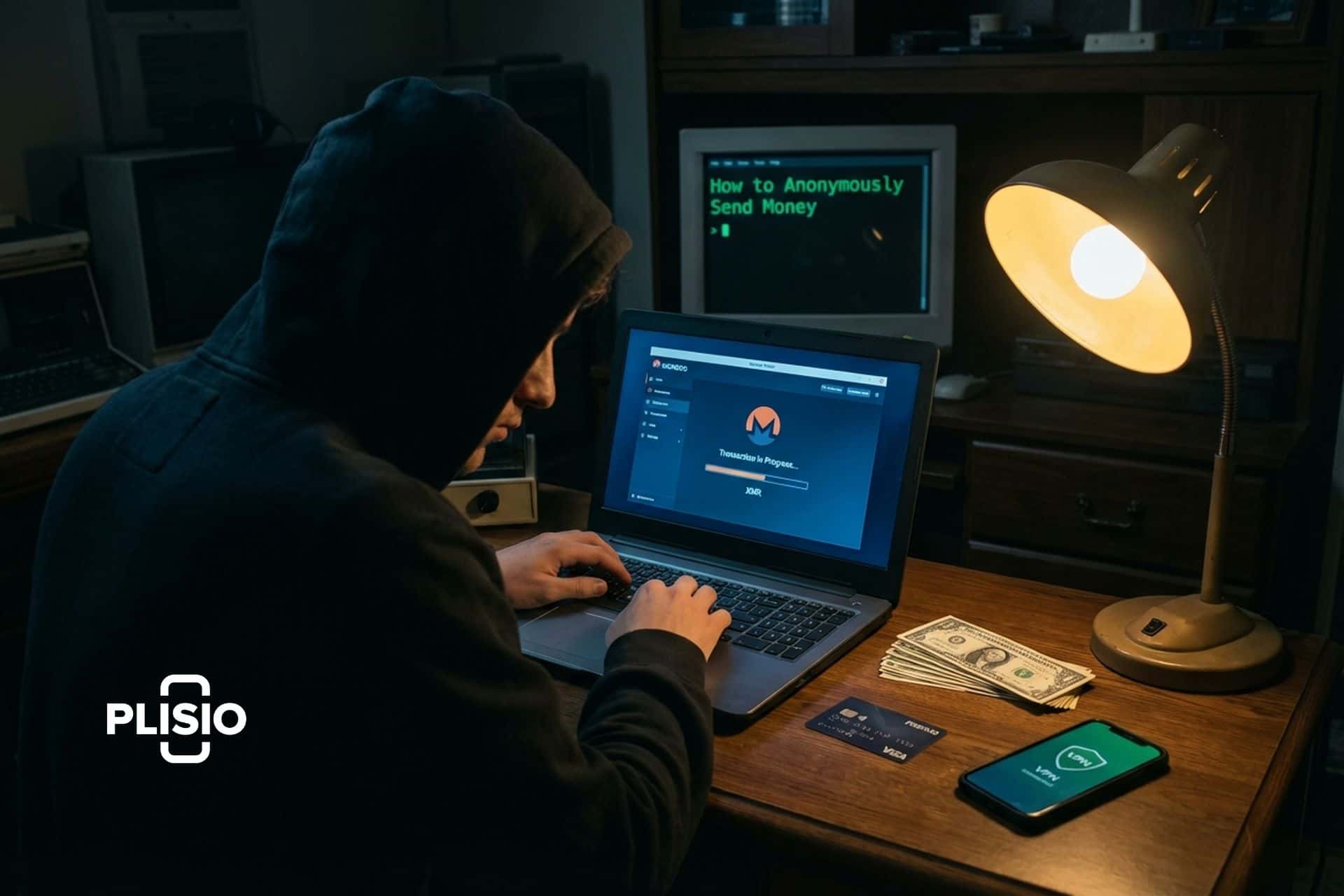
Your bank knows where you eat lunch. Visa knows your subscription list. PayPal ties your name to every $12 transfer. Financial privacy barely exists anymore unless you actively build it.
There are legitimate reasons to want anonymity when sending money. Donating to a political cause without your employer finding out. Helping someone without the awkwardness of them knowing who sent it. Protecting yourself from corporate data harvesting. Paying for a service without handing over your personal information to yet another company that might get breached next quarter.
This guide covers 10 ways to send money anonymously in 2026, from privacy coins to prepaid cards, with honest assessments of what works, what does not, and what could get you in legal trouble if you use it wrong.
The privacy vs anonymity distinction (read this first)
Two words that sound identical and mean completely different things.
Privacy: the coffee shop charges your card. They see the amount. Visa sees the amount. Your bank sees the amount. But your neighbor does not. The transaction happened, people in the chain know about it, and it stops there.
Anonymity: you drop a $20 bill into a street performer's guitar case. Nobody knows. No receipt. No record. The performer does not know your name.
Bitcoin sits in a weird middle ground. No name on your wallet address, sure. But Chainalysis and similar firms trace bitcoin back to real people maybe 60-70% of the time when KYC records exist somewhere upstream. Every BTC transaction gets carved into a public ledger that anyone can read. Permanently.
Monero is built for the guitar case scenario, except digital. Stealth addresses, ring signatures, RingCT. Sender hidden. Receiver hidden. Amount hidden. That is why regulators hate it and exchanges keep removing it.
Before picking a method, ask: do you want privacy (hidden from merchants and the public) or anonymity (hidden from everyone, including the platform)?
Method 1: privacy coins (Monero, Zcash)
The digital equivalent of handing someone an envelope of cash. Except it works over the internet.
Monero (XMR) hides everything. Sender. Receiver. Amount. All baked into the protocol through ring signatures, stealth addresses, and RingCT. You cannot opt out of privacy on Monero the way you can on most blockchains. The IRS posted a $625,000 bounty for anyone who could reliably crack Monero's privacy. As of 2026, nobody has publicly collected.
Zcash (ZEC) takes a different approach. Privacy is optional. "Shielded" transactions use zero-knowledge proofs to verify a payment without exposing details. Problem: most people skip the shielded part because it is slower and some exchanges reject shielded withdrawals. So in practice, a lot of Zcash transactions are fully transparent.
Access keeps getting harder. Monero survived 73 exchange delistings in 2025 alone, including Binance (February 2024), OKX, and Huobi. And yet the price sat at $447 with an $8.2 billion market cap as of early 2026. The coin refuses to die. Zcash had an even wilder year, gaining roughly 800% through 2025. Privacy tokens as a category rose 288%.
Buying XMR in 2026 means Haveno (decentralized), a no-KYC swap, or a shrinking list of centralized exchanges. Legal in most places. Convenient? Less every year. The EU's MiCA framework is adding pressure from the regulatory side.
| Feature | Monero (XMR) | Zcash (ZEC) |
|---|---|---|
| Privacy by default | Yes | No (optional) |
| Hides sender/receiver/amount | Yes | Only in shielded txs |
| Exchange availability | Shrinking (delistings) | Better than Monero |
| Chain analysis resistance | Highest | Moderate |
| Regulatory risk | High | Medium |
Method 2: Bitcoin with CoinJoin and Lightning
Bitcoin by itself is about as anonymous as writing your name in invisible ink. Technically hidden, until someone shines a UV light.
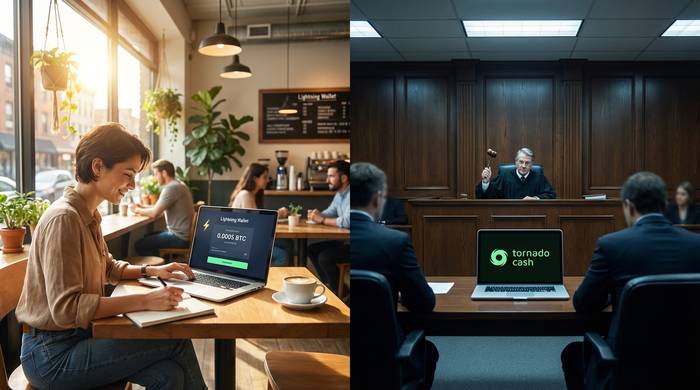
CoinJoin fixes part of the problem. Your transaction mixes with other people's transactions inside the same block, so blockchain watchers cannot easily tell which input matches which output. Wasabi Wallet used to make this dead simple. Click a button, pay a small fee, done. Then the Tornado Cash arrests happened. Wasabi shut down its CoinJoin coordinator in 2024. JoinMarket still runs, but now you need to operate your own coordinator. The user-friendly version of Bitcoin privacy basically evaporated overnight.
Lightning Network is the other option. Bitcoin moves through off-chain payment channels. Faster, cheaper, and the transactions do not all land on the public blockchain. Routing nodes see fragments of the payment path but not the full picture. Not perfect, but a genuine step up from raw on-chain BTC.
Neither one makes Bitcoin as anonymous as Monero. They make tracing harder. For everyday privacy, that is often enough. For serious anonymity, it is not.
Method 3: prepaid debit cards
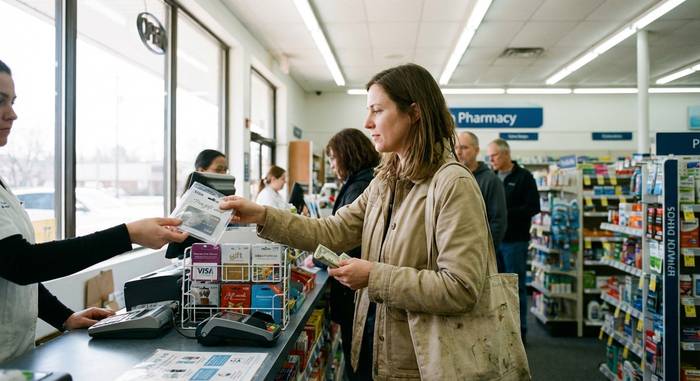
Walk into a pharmacy or grocery store. Buy a prepaid Visa or Mastercard with cash. Load it. Use it online or anywhere cards are accepted. No name attached, no bank account linked, no KYC if you stay under the registration threshold.
In the US, prepaid cards under $500 generally do not require identity verification at purchase. Above that, federal regulations require registration with name, address, and sometimes SSN. Other countries have similar thresholds, usually lower in the EU.
The anonymity holds as long as you buy the card with cash and do not register it. The moment you register (which some websites require before accepting the card), your identity connects to the card number.
Works well for: one-time online purchases, sending gift card equivalents, paying for services without linking your bank. Does not work for: large amounts, recurring payments, or anything requiring a billing address match.
Method 4: gift cards
Gift cards are prepaid and typically purchased with cash. Amazon, Google Play, Steam, and hundreds of other retailers sell them in physical stores. Buy with cash, hand the code to whoever you want to pay. No names exchanged.
The limitation: gift cards are store-specific. An Amazon gift card only works on Amazon. You cannot send someone $500 in Amazon credit and expect them to pay their rent with it. For digital services, gift cards work well. For general money transfers, they do not.
Scam warning: anyone who asks you to pay for something in gift cards is almost certainly running a scam. Legitimate businesses and government agencies do not accept gift card payments.
Method 5: Cash App with limited personal details
Cash App lets you send money using a $cashtag username. The recipient sees your display name, not your legal name or bank details. You can set your display name to anything.
However, Cash App requires identity verification for most features beyond basic receiving. Sending more than $250 in a 7-day period without verification is not possible. And Cash App complies with law enforcement requests, so anonymity from the company itself does not exist.
This is not true anonymity. It is pseudo-anonymity from the recipient. The platform, and any government that asks, knows exactly who you are.
Method 6: Paysafecard
Walk into a newsstand in Berlin, Paris, or Vienna. Ask for a Paysafecard. Hand over cash. Get a receipt with a 16-digit PIN. That PIN is your payment method. Type it in at checkout. No bank account, no credit card, no personal details change hands.
Under 100 EUR? No registration. No ID. Just the PIN and the cash you paid for it. Above that, you need a myPaysafe account, and at that point you have killed the anonymity.
Paysafecard is huge in Europe and niche elsewhere. Accepted at thousands of online merchants, especially gaming platforms. The US barely knows it exists. For small anonymous online payments in Europe, this is one of the easiest methods available. For anything above 100 EUR or outside Europe, look at other options on this list.
Method 7: cryptocurrency ATMs (cash to crypto)
You see these machines in gas stations, malls, and convenience stores. Walk up, feed in cash, scan a wallet QR code, and bitcoin shows up in your wallet. No account. No app download. Some machines handle transactions under $250 to $500 without asking for ID.
The markup is brutal: 5% to 15% above spot price. A $100 purchase at a 10% premium means you get $90 worth of BTC. And regulators keep pushing operators to add identity checks at lower thresholds. Two years ago, many ATMs let you buy $900 without ID. Now that number is often $250 or lower.
For small purchases where you absolutely need cash-to-crypto with no KYC, ATMs still work. Pair the received bitcoin with a Lightning or CoinJoin wallet and whatever trail existed at the machine gets harder to follow from there.
Method 8: cash in mail or in person
Old school. Put cash in an envelope. Mail it. Or hand it over in person. No digital trail, no intermediary, no records.
Mailing cash is legal in the US, though the postal service does not insure cash shipments. For amounts over a few hundred dollars, use a money order instead (available at post offices and convenience stores for small fees). Money orders can be purchased with cash and do not always require ID for amounts under $1,000.
In-person cash transfers are the ultimate anonymous payment method. Nobody knows except the two people involved. The downside is obvious: it requires physical proximity, carries theft risk, and does not work for online payments.
Method 9: virtual credit cards
Services like Privacy.com generate single-use or merchant-locked virtual card numbers tied to your bank account. The merchant sees a card number that is not your real card. Your name and payment details stay with Privacy.com, not with the merchant.
This is not full anonymity. Privacy.com knows your identity. But the merchant does not, which protects you from data breaches, unwanted recurring charges, and merchant-side tracking.
For people who want privacy from merchants rather than anonymity from everyone, virtual cards are the cleanest solution. Multiple providers exist: Privacy.com (US), Revolut virtual cards (EU/UK), and various crypto-funded alternatives.
Method 10: Venmo and PayPal with privacy settings
Venmo has a social feed that defaults to public. Your roommate paying you back for dinner? Everyone on Venmo can see it unless you switch to private mode. Go to Settings, flip the default to "Private." Now only you and the other person see the transaction. Still shows your display name to them.
PayPal reveals your name to the recipient. Always. No setting to turn that off for personal accounts. Business accounts show the business name instead, which is a workaround if you create one.
Are either of these anonymous? No. Both platforms verify your identity. Both hand data to law enforcement when asked. The privacy here is from other users and the public timeline. Not from the company. Not from the government. Good enough for keeping a surprise gift quiet. Not good enough for anything serious.
VPNs and operational security: the layer most people forget
Pick any anonymous payment method from this list. Now use it from your home WiFi, on your regular browser, logged into your Google account. Congratulations, you just deanonymized yourself.
A VPN hides your IP address from the service you are paying. Tor goes further by routing your traffic through multiple relays. Neither one helps if you log into a personal account or use a browser that leaks fingerprint data.
For anyone who actually needs anonymity (journalists protecting sources, activists in hostile countries, domestic abuse survivors hiding their location), the payment method is only half the puzzle. The other half is how you access the internet when making the payment. Separate browser. No personal logins. VPN or Tor. A device not tied to your name, if you want to go that far.
Most people reading this guide do not need that level of precaution. Buying a birthday present without your partner seeing the transaction? A prepaid card and your normal browser will do. But if the stakes are higher, the operational side matters more than which coin you pick.
Anonymous payment methods: comparison table
| Method | Anonymity level | Cost | Limit | Online use | Legal risk |
|---|---|---|---|---|---|
| Monero | Very high | Gas fees only | No limit | Yes | Medium (delistings) |
| Bitcoin + CoinJoin | Medium | Network fees | No limit | Yes | Medium |
| Prepaid debit card | Medium | Purchase price | $500 unregistered | Yes | Low |
| Gift cards | Medium | Face value | Varies | Store-specific | Low |
| Cash App | Low (pseudo) | Free (small sends) | $250/week unverified | Yes | Low |
| Paysafecard | Medium | Face value | ~100 EUR | Yes | Low |
| Crypto ATM | Medium-high | 5-15% premium | $250-500 w/o ID | Crypto only | Low |
| Cash/money order | Very high | Face value + $1-5 fee | $1,000 w/o ID | No | Low |
| Virtual cards | Low (from merchant) | Free or small fee | Bank limit | Yes | Low |
| Venmo/PayPal private | Very low | Free | Platform limits | Yes | Low |
Is sending money anonymously legal?
Yes. Sending money anonymously is legal in the US, EU, UK, and most countries. Nobody arrests you for paying with cash. Nobody arrests you for using a prepaid card from Walgreens.
Where it gets complicated is intent. Moving $50,000 through a mixer to hide income from the IRS? That is tax evasion. Buying Monero to donate to a charity without your employer knowing? Perfectly fine. Same tool, different purpose, very different legal outcome.
The Tornado Cash saga reshaped the entire conversation. August 2022: the US Treasury sanctioned an Ethereum mixing protocol. Not a person. Code. Then the developers got arrested. Alexey Pertsev convicted in the Netherlands, May 2024. Roman Storm convicted on one of three counts in August 2025, with the DOJ pushing for a retrial on two deadlocked charges in October 2026. Vitalik Buterin published an open letter calling for leniency.
Plot twist: the Treasury actually lifted Tornado Cash sanctions in March 2025 after a court challenge. The tool is no longer sanctioned. But the developers are still facing prison time. The message landed anyway: build anonymous financial tools at your own risk.
Monero is legal to buy and hold in every major jurisdiction. But Binance delisted it in 2024. Other exchanges followed. Prepaid card KYC thresholds keep dropping. Every year, regulators tighten the screws a little more. The direction is clear. If financial privacy matters to you, the tools that exist today may not exist in the same form two years from now.