Nickel Price Prediction 2026: Market Outlook and Structural Pressures

Nickel is at the center of a complex and rapidly shifting global commodities system. While demand continues to evolve in stainless steel and electric vehicle supply chains, oversupply remains a defining force. This forecast outlines the primary pressures affecting nickel today, upcoming inflection points in 2025, and the long-term forces shaping the future of the metal.
Nickel Market in 2025 — Current Status
The global nickel market continues to experience volatility. As of late 2025, prices are holding around the $15,000 per metric ton level on the London Metal Exchange (LME), reflecting both a subdued demand cycle and persistent production growth.
Supply remains elevated, with Indonesia leading global output as the world's largest nickel producer. Expansion in ore extraction and refining capacity across Southeast Asia has locked the market into a structural surplus, placing continuous downside pressure on price and profit margins.
Nickel Oversupply, Refining Expansion and Market Stress
The ongoing surplus is driven primarily by production increases in Indonesia and accelerating refining investment. Stockpiles continue to build across warehouses, keeping nickel futures at lower valuation levels. Although stainless steel manufacturers and electric vehicle battery producers remain core consumers, their collective demand has not yet caught up with the rising accessible supply.
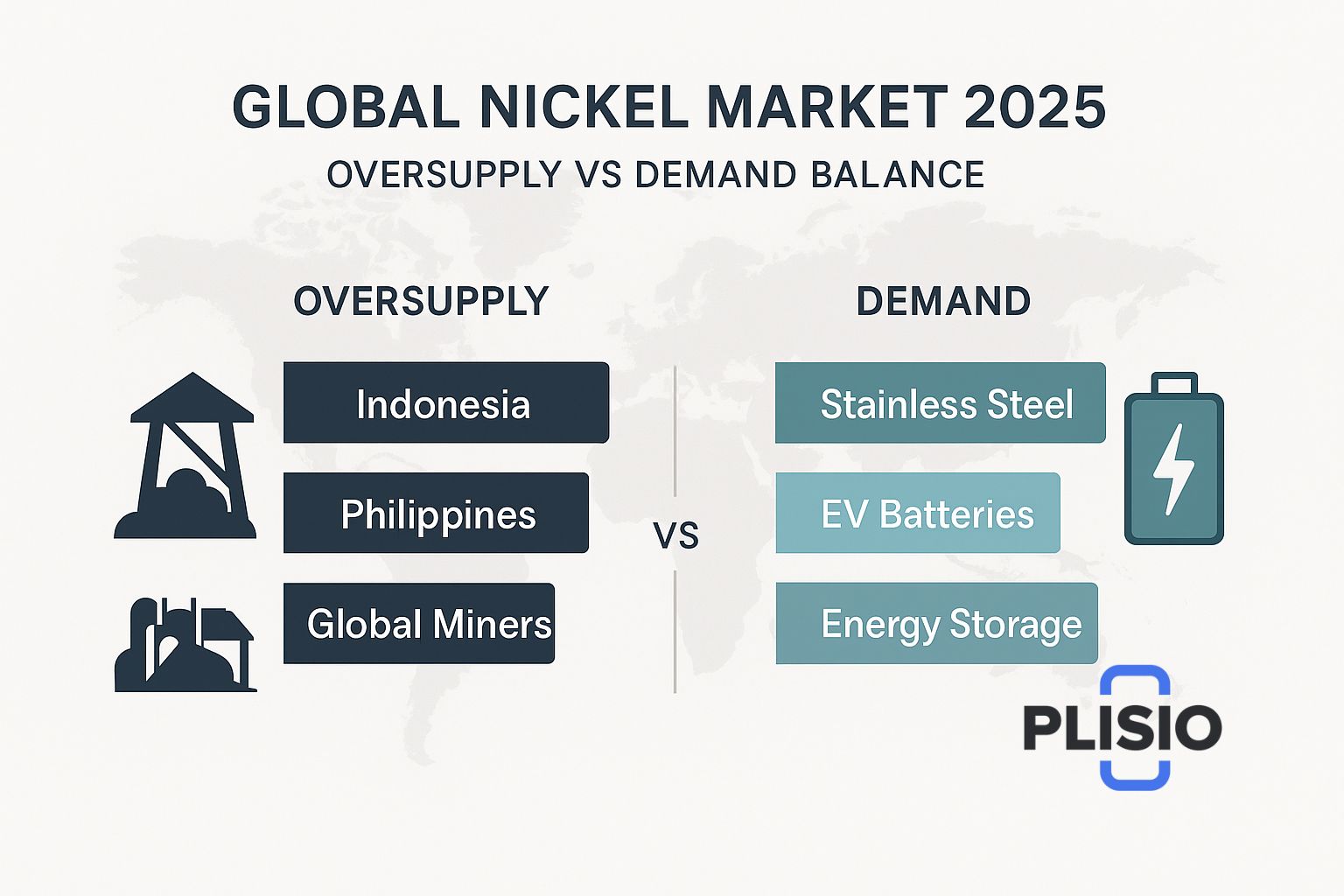
Nickel refining expansion, particularly in Indonesia, has accelerated the entry of refined nickel into the market. This has caused production growth to outpace consumption growth, challenging pricing stability.
Core Market Forces Affecting Nickel in 2025
|
Market Driver |
Influence on Price |
Direction of Impact |
|
Indonesia production growth |
Increased export and refining volumes |
Downward pressure |
|
Nickel stockpile accumulation |
Rising inventories weaken pricing momentum |
Downward pressure |
|
EV battery chemistry shifts |
Reduced reliance on nickel-heavy cathodes |
Neutral to downward |
|
Stainless steel consumption |
Stable but not accelerating demand |
Neutral |
Stainless Steel and EV Demand
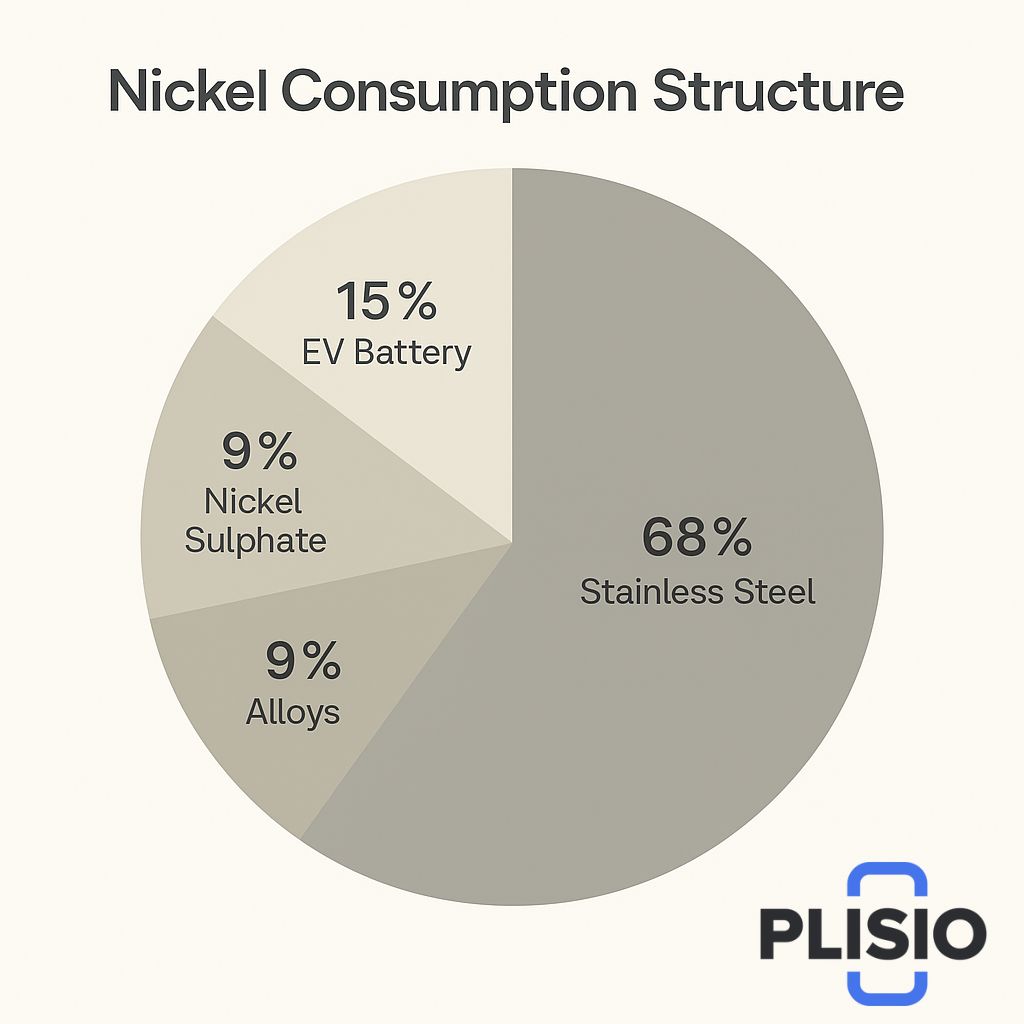
Stainless steel continues to lead global nickel consumption, accounting for the majority of industrial use. Although the electric vehicle battery market represents the most discussed growth segment, reductions in high-nickel battery formulations and alternative chemistries have slowed expectations.
The real story for nickel remains rooted not only in rising demand forecasts, but in the pace at which mining continues to deliver metal into an already saturated supply landscape.
Nickel Price Forecast and 2030 Outlook
Forward projections suggest moderate price stabilization rather than immediate recovery. Oversupply may remain intact until 2030, unless meaningful production cuts occur. Nickel price to improve projections remain conditional and hinge on whether the mining industry slows its current output trajectory.
Nickel Price Expectations Versus Market Conditions
|
Year |
Expected Price Range (USD/t) |
Key Assumption |
|
2025 |
$15,000–$16,000 |
Persistent oversupply and muted stainless steel demand |
|
2026 |
$15,500–$17,000 |
Gradual reduction in stockpiles |
|
2030 |
$17,000–$20,000 |
Structural correction and EV stabilization |
Nickel Supply Chain and Future Considerations
If nickel miners continue operating at loss-making levels, controlled shutdowns or output reductions may tighten supply. In that scenario, price may recover. However, if the structurally oversupplied market remains unchanged, price movement may stay limited.
The nickel market is not weak in terms of long-term demand potential, but it faces unavoidable short-term correction cycles. High production, nickel entering the market at accelerated volumes, and evolving battery chemistry remain the chief issues facing the nickel market.
Nickel Global Supply Dynamics, Output Trends and Stockpile Signals
Nickel output remains at multiyear highs, with Indonesia continuing to lead refined nickel and nickel ore volumes. Industry reports show that Indonesia’s nickel production is set to expand again in the first half of 2025, even as prices evened out in Q3 amid widespread profit compression and lower international benchmark futures activity. The Philippines, as the second key ore supplier, has also played a central role in supply shifts. When the country slashed nickel ore output earlier in the decade and then slashed nickel ore output earlier once again in 2024, price reactions temporarily spiked, but the impact was muted by Indonesia’s nickel capacity and refined nickel acceleration.
Nickel stockpiles remain high compared to pre‑2020 levels. Rising stock levels continue to signal structurally oversupplied market conditions, even amid price fluctuations and attempts at production discipline. LME nickel inventories and off‑exchange stock positions both suggest that nickel entering the market continues to outpace refinery and EV battery absorption rates.
Nickel Industrial Consumption, Stainless Steel Cycles and Long‑Term Nickel Use
Stainless steel remains the largest nickel consumer globally and the largest nickel demand anchor across metallurgical segments. Despite cyclical slowdowns in construction and heavy fabrication, demand is growing in specialized alloys, heat‑resistant industrial steel and long‑term nickel applications for critical infrastructure. Although stainless steel growth is steady rather than rapid, it provides a baseline floor for nickel consumption and nickel production planning.
Nickel and cobalt combinations remain relevant in advanced cathode construction, even as alternative chemistries reduce reliance on high‑nickel blends. Nickel sulphate, refined nickel and nickel recycling technologies continue to expand, offering both environmental and market stabilization benefits. These processes may reduce future nickel stockpiles by reintroducing processed nickel into the supply chain and lowering long‑run ore extraction requirements.
EV Battery Market, Power‑Density Requirements and the Real Story for Nickel
The EV battery market remains the most closely watched demand driver. Good news for EVs arrives in the form of rising vehicle electrification policies, but the real story for nickel in 2025 is more nuanced than a straightforward EV growth surge. Although demand is growing, the market has also faced considerable headwinds tied to evolving chemistry standards.
Some automotive groups now emphasize lithium iron phosphate cathodes, reducing reliance on nickel‑heavy cells. Despite those adjustments, high‑range EV models still require power‑dense cathodes including nickel, and nickel demand remains resilient within premium EV segments. EV battery engineering still relies on energy‑dense nickel structures to meet range‑per‑charge expectations.
Nickel Price Update and Market Sentiment
Nickel rose during brief rallies in mid‑2025, but nickel prices were volatile and lacked durable upward continuation. Price data shows that the price of the base metal remains firmly capped by oversupply. Analysts note that market sentiment is cautious rather than pessimistic, and the nickel market is not weak demand on a structural basis; instead, market is not weak demand but operates within an oversupply cycle that may take multiple years to unwind.
Nickel futures and nickel futures price indicators continue to reflect forward uncertainty. The long‑term nickel outlook remains tied to consumption momentum, input cost moderation, and stabilization within the EV battery market.
Conclusion
The long‑term forecast for nickel remains moderately constructive, despite short‑term imbalances. Oversupply, refining expansion and continued production growth have defined 2024 and 2025, creating an extended correction cycle. However, rising demand from stainless steel, strategic electrification policies, advanced alloy development and the EV battery sector continue to support the foundation of future nickel valuation.
If production growth moderates and stockpiles begin to draw down, nickel price to improve scenarios become more plausible. While the structurally oversupplied market continues to influence price movements, the future direction depends on whether nickel consumers, refining investments and mining industry discipline collectively stabilize the global nickel landscape.