MissAV: What It Is, the 2025 $4.5M Lawsuit, and Safer Alternatives

On January 17, 2025, the US District Court for the Western District of Washington entered a default judgment against MissAV's operator. The order: $4.5 million in copyright damages, plus seizure of the missav.com and thisav.com domains. The plaintiff was Will Co., Ltd., a Japanese AV maker. The defendant was named in case C20-5802 BHS. Ka Yeung Lee, a Hong Kong permanent resident, along with his Hong Kong-registered company Youhaha Marketing & Promotion Limited.
At its peak that month, the site was drawing more than 300 million monthly visits. That placed it inside the global top 60 of all websites and the top 15 in Japan, per TorrentFreak's January 2025 reporting. Within twenty-four hours of the seizure, operators redirected to a new domain (missav.ws, then missav.ai). The legal action was largely cosmetic.
This article is a defensive guide. It walks through what MissAV is. It covers the January 2025 lawsuit. It maps the legal status across major countries. It looks at how Japan's CODA fights piracy. It walks through the malware on lookalike clones. It surveys the legitimate licensed JAV options. And it covers the card-network pressure that pushes adult merchants to crypto rails. There are no links to MissAV mirrors anywhere in this guide. The defensive frame is the point.
What MissAV is and how it became the largest JAV piracy site
MissAV is an aggregator of pirated Japanese Adult Video (JAV) content. It indexes by actress, by genre, by maker (the Japanese term for a studio), and by monthly ranking. That is the standard JAV browsing taxonomy used on legitimate platforms too. Its differentiators against other JAV piracy hubs were three. A very large collection of mainstream studio releases. SOD, S1 No.1 Style, Faleno, Kawaii, Madonna. English subtitles on a substantial share of titles — atypical for JAV piracy. And HD streaming with low friction. The operation was hosted behind Cloudflare and used aggressive infrastructure rotation to resist takedowns.
Reported scale at its peak in late 2024 to early 2025: roughly 300 million monthly visits, per TorrentFreak. That is a lot. That figure placed the site inside the global top 60 of all websites at the time. And inside the top 15 in Japan.
The structural reason for the surge is worth naming. DMM's English-language site R18.com closed on May 12, 2023, after ending sales on January 31. On May 20, 2024, FANZA — DMM's flagship Japanese platform — geofenced the catalogue to Japanese residents only. Those two changes together vacated the legitimate English-language JAV market outside Japan. Pirate aggregators including MissAV directly filled the gap. Viewers browsed by their favorite actress. They watched online without any account barrier.
Operator names came out of US discovery in the Will Co. case. The Hong Kong shell, Youhaha Marketing & Promotion Limited, was named alongside Ka Yeung Lee. Beyond that shell, no further operators are public. The site uses anonymized registration, Cloudflare proxying, and rapid domain rotation. That pattern points to bulletproof hosting and serial mirror operations. Not to a single jurisdictional footprint.
The Will Co. lawsuit and the January 2025 seizures
Will Co., Ltd. v. Ka Yeung Lee et al. (W.D. Washington, case C20-5802 BHS) is the legal vehicle that produced the January 2025 outcome. The suit named 300 individual works and asked for statutory damages under the US Copyright Act. Defendants did not appear. The court entered default judgment on January 17, 2025: $4.5 million in damages. The math: 300 works × $15,000 each, the statutory midpoint. The order also seized the missav.com and thisav.com domains via registrar order. FANZA banners briefly appeared on the seized domains, signaling the studio coalition's involvement.
The remedy is real. But it is limited. Operators rotated to missav.ws within hours, and to missav.ai shortly after. The pattern shows a structural fact about copyright enforcement. Registrar-level domain seizures reach the brand. They do not reach the infrastructure. Without a criminal arrest in a cooperating country, seized domains tend to be replaced within days. The model that does work is Bato.to. A joint Japan-China complaint on November 19, 2025 led to the operator's arrest. About 60 affiliated sites were taken down with him.
That said, the judgment matters for two reasons. It sets a US legal precedent against a named Hong Kong operator. Other studios can cite the case in future actions. And it gave FANZA a documented basis for parallel domain takedowns. That meant registrar-level pressure on the network of mirror sites that proliferated after January 2025.
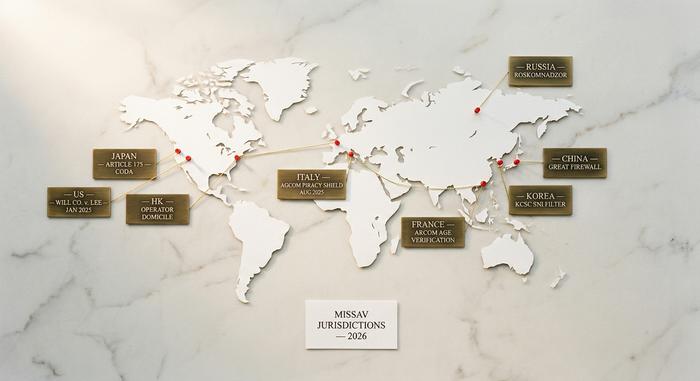
Legal status by jurisdiction in 2026
The legal frame for streaming JAV varies by country. The headline summary fits in one table.
| Jurisdiction | Position on JAV streaming sites | Key 2024-2026 actions |
|---|---|---|
| Japan | Pirated AV violates Copyright Act; Article 175 penal code requires mosaic on uncensored content (max 2 years prison or ¥2.5M fine) | CODA enforcement; Will Co. Hong Kong-targeted US case |
| United States | Copyright infringement actionable; end-user access not criminalized | Will Co. v. Lee judgment, $4.5M, January 17, 2025 |
| Hong Kong | Where Lee is based; civil enforcement not used directly | Will Co. went US route to obtain extraterritorial domain seizure |
| Italy | AGCOM's Piracy Shield blocks copyright-infringing streaming sites | Launched February 2024; expanded to all live audiovisual content August 2025; 140+ sites blocked |
| France | ARCOM blocks adult sites that fail age verification | Final standard published October 11, 2024; five major sites blocked October 17, 2024; Pornhub/RedTube/YouPorn pulled out June 4, 2025 |
| South Korea | KCSC SNI filtering since 2019; Cloudflare cooperation since September 2025 | From May 2026, system auto-blocks copyright-infringing adult content |
| China | Blocked entirely by the Great Firewall | Continuous since 2002 |
| Russia | Roskomnadzor maintains general adult-content blocklist | Specific MissAV listing not publicly verified |
Article 175 of Japan's Penal Code is the rule Japanese consumers cite when they talk about the mosaic. The article was first enacted in 1907. It was updated in 2011 to cover electronic media. Production of uncensored content for Japanese consumption is illegal at the distribution stage. Some studios produce mosaic-free content from offshore servers — Caribbeancom, Heyzo, 1Pondo. They operate in a legality gap that Japanese courts have not yet closed.
For end users, US/EU/Japan all stop short of criminalizing access to copyright-infringing video. Civil exposure is real for uploaders and rebroadcasters — much less so for viewers. Mainland China, several Gulf states, and Iran criminalize explicit-content access generally. That is a separate axis of risk from copyright. Taiwan sits in a separate regime that allows licensed adult sales but blocks unlicensed streaming on judicial complaint.
How Japan's CODA fights JAV piracy in 2026
Japan's main anti-piracy body for overseas work is the Content Overseas Distribution Association, or CODA. Its 2024-2025 record is impressive in volume. More than 677,000 takedown notices were filed across the period. The average compliance rate ran around 81%. Major-platform compliance is much higher. Facebook 93.97%. YouTube 97.84%. BiliBili and TikTok 99% or higher. CODA has four enforcement modes. Criminal prosecution. Civil litigation. Administrative action (used in China and Vietnam). And direct negotiation with operators ("knock-and-talk").
Two recent CODA-led results are worth flagging. The November 19, 2025 arrest of the Bato.to manga piracy operator was executed via joint Japan-China criminal complaint. It also took down approximately 60 affiliated sites. In December 2024, Brazil knock-and-talk operations shuttered 15 anime piracy sites, including bakashi.tv, without litigation.
The studio coalition behind copyright enforcement against MissAV-class sites is largely the same group of major Japanese AV makers. SOD (Soft On Demand) anchors the group. It is Japan's largest AV publisher with more than 30 subsidiaries. S1 No.1 Style has produced more than 5,100 titles in catalogue. Faleno, a 2019 spin-off recruiting from S1, rounds out the senior tier. So do Kawaii, Madonna, MOODYZ, Idea Pocket, and Prestige. Will Co. itself is not in that top tier. But its registered-work catalogue was sufficient to underwrite the US statutory-damages math that produced the January 2025 judgment.
The malware ecosystem on MissAV clones
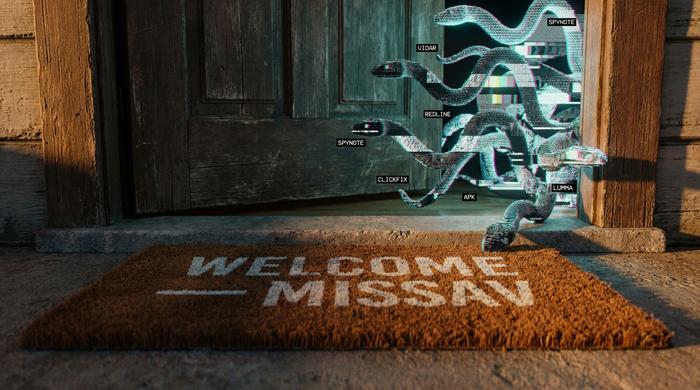
For end users, the most concrete harm from MissAV in 2025-2026 is not legal exposure. It is malware on the lookalike clones that proliferated after the January seizures. Six attack patterns are well-documented in current threat-intelligence telemetry.
First: a SpyNote Android trojan campaign distributed via typosquatted MissAV lookalike domains. Symantec and Broadcom documented it in protection bulletins after the January 2025 seizures. SpyNote's capability set is typical of advanced Android RATs. SMS interception (it captures 2FA codes). Call recording. Contact theft. GPS tracking. Screen capture. And banking-app overlay phishing.
Second: fake "MissAV downloader" tools for Windows and macOS. These bundle infostealers like Vidar, RedLine, and Lumma variants. Help Net Security and VMRay reports tracked them widely across 2024-2025 phishing telemetry.
Third: crypto-mining drive-by JavaScript on clone sites. Successor scripts to the original Coinhive, throttled to avoid detection but cumulatively meaningful at scale.
Fourth: fake CAPTCHA campaigns ("ClickFix" lures) that redirect to PowerShell payload execution. This has been a mainstream phishing technique throughout 2025; adult-niche clones are heavily used as bait.
Fifth: phishing login pages on missav-* typosquats. The legitimate site has no login wall, so any "log in to continue" page is a clear tell.
Sixth: malicious Android APKs distributed off-store. ScamAdviser flags multiple missav.* variants with mixed trust scores. The variability itself is the warning sign. There is no canonical, trustworthy MissAV domain. Domain rotation means no consistent SSL or identity reference. That fact alone makes the baseline phishing risk high regardless of legal views.
Licensed JAV alternatives in 2026
The licensed alternative ecosystem outside Japan is thin in 2026. The table below covers the main legitimate options.
| Platform | Operator | Geography | Status | Notes |
|---|---|---|---|---|
| FANZA | DMM Group affiliate | Japan-only since May 20, 2024 | Fully licensed | Largest legal JAV catalogue; rebranded from DMM.R18 in August 2018 |
| DMM TV / FANZA Premium | DMM Group | Japan-only | Licensed subscription | Geo-strict; requires Japanese payment method |
| R18.com | DMM (international arm) | Closed May 12, 2023 | Discontinued | Was the main legal English-language gateway |
| SOD Prime | SOD | Japan, partial international | Licensed studio-direct | Studio's own subscription tier |
| Caribbeancom | Offshore servers | International | Mosaic-free; legality contested in Japan | Studio-direct production; ~300,000 members; ~4,300 films |
| Heyzo | Offshore | International | Mosaic-free; same legal ambiguity | Studio-direct |
| 1Pondo | Offshore | International | Mosaic-free studio | Same model as Caribbeancom |
The structural fact is straightforward. The closure of R18.com plus the FANZA Japan-only geofence created a vacuum for English-language licensed JAV outside Japan. That is what enabled MissAV's traffic dominance through 2023-2024. The licensed offshore studios — Caribbeancom, Heyzo, 1Pondo — sit in their own legal grey zone in Japan because of the mosaic rule. But they produce their own content rather than redistributing pirated material. That is a different category of risk from clone-site malware.
Card-network pressure, debanking, and crypto context
The other macro context worth flagging is payment-processor pressure on licensed adult merchants. Mastercard Rule 5.12.7 lets the network delist merchants that "damage the goodwill" of the brand. Valve cited that rule when it delisted hundreds of adult titles from Steam in 2025. Visa's VAMP framework, effective in 2025, sets a 1.5% fraud threshold above which acquirers face suspension. Adult merchants run higher chargeback rates almost by category. That makes VAMP a real tightening.
In March 2026, FTC Chairman Andrew Ferguson sent a formal warning to PayPal, Stripe, Visa, and Mastercard. The warning targeted debanking practices aimed at legal-but-controversial industries. The warning frames debanking as a competition concern, not just a free-speech one.
The combined effect on licensed Japanese AV studios has been a slow shift toward crypto-payment options. SOD has tested crypto acceptance. Smaller offshore mosaic-free studios have moved further. Crypto payment gateways like Plisio provide the alternative path. They are non-custodial. They support BTC, ETH, USDT, USDC, LTC, DOGE, TRX and roughly twenty other assets. There is no merchant KYC for receivers and no MCC-based category restriction. None of this applies to MissAV itself, which monetizes through ad networks rather than direct payments. It applies to the licensed alternatives that benefit when piracy traffic returns to legal channels.
End-user risks and the honest verdict
For an end user, the practical risk order is the inverse of what most coverage suggests. Legal exposure for watching copyright-infringing video is low in the US, EU, and Japan. It varies sharply elsewhere. Malware exposure on typosquatted MissAV clones is high. So is phishing on lookalike login walls. Tracking and ad-network logging is hard to avoid on piracy sites running low-tier adtech. Workplace and device-policy risk is high regardless of legal frame. Cloudflare SNI and DNS records still log even under TLS.
The honest verdict. MissAV is a piracy aggregator that drew enormous traffic. It did so by filling a vacuum left by the closure of legal English-language JAV access. The January 2025 lawsuit dented the brand, not the operation. The malware ecosystem around the lookalikes is the real day-to-day risk for users. The licensed alternatives are limited, but they exist. And the macro picture for licensed adult merchants is one of card-network friction increasing, not easing, with crypto rails as the relief valve.