What is Immutable X? The NFT infrastructure powering 680+ blockchain games
Minting an NFT on Ethereum costs $5 to $50 in gas depending on the day. Minting on Immutable costs zero. Not "almost zero." Zero. No gas fees. No carbon footprint. The NFT hits the blockchain instantly, backed by Ethereum's security through zero-knowledge proofs.
That gas-free model is why 680+ games chose to build on Immutable instead of mainnet Ethereum or competing L2s. Gods Unchained, Illuvium, Guild of Guardians, and hundreds of other titles run their NFT infrastructure through Immutable. Six million users signed up for Immutable Passport in under two years. The ecosystem grew faster than any other gaming blockchain in 2024, and the growth continued into 2026 with the chain merge that unified Immutable X and Immutable zkEVM into a single network.
This article covers how Immutable works under the hood, why zero gas matters for NFTs and gaming, what the chain merge changed, and where the IMX token fits into all of it.
How Immutable works: zero gas NFTs on Ethereum
Immutable is a Layer 2 scaling solution built specifically for NFTs and gaming. It sits on top of Ethereum, inherits its security, and processes transactions at a fraction of the cost. The original Immutable X used StarkEx, a Validium built by StarkWare. The newer Immutable zkEVM uses Polygon CDK for full EVM compatibility. In February 2026, the two merged into one unified chain.
Here is how the zero-gas model works. When you mint or trade an NFT on Immutable, the transaction does not hit Ethereum directly. It gets processed off-chain in a batch with thousands of other transactions. A zero-knowledge proof (specifically a ZK-STARK) is generated to cryptographically prove that every transaction in the batch is valid. That single proof gets submitted to Ethereum L1. The gas cost of one Ethereum transaction gets split across thousands of Immutable transactions. Per-user cost: effectively zero.
The security is not theoretical. Ethereum verifies every proof. A Data Availability Committee means you can recover your assets even if Immutable goes offline tomorrow. Your NFTs sit behind Ethereum's security model. The proofs are on L1.
Carbon neutral from day one. Every NFT minted on Immutable has zero environmental impact. That used to matter more when "NFTs are killing the planet" was the hot take. It still matters for game studios that care about ESG optics.
The chain merge: Immutable X + zkEVM becomes one
For years, Immutable had a split personality. Immutable X handled NFTs with StarkEx. Immutable zkEVM handled smart contracts with Polygon CDK. Two chains. Two sets of liquidity. Games picked one and missed the other. It was messy.
February 2026 fixed that. They merged. Immutable X went read-only on the 11th. Funds migrated by the 25th. One chain now. They call it Immutable Chain. Write Solidity, get zero-gas NFT minting, access DeFi. All in one place. ZK proofs still settle on Ethereum L1. Security did not change. The user experience got a lot simpler.
The numbers from Q1 2025 give a snapshot of the zkEVM side: 498,000 average daily transactions, 150 million total transactions since launch, 87,000 new smart contracts deployed in one quarter (up 83.3%), and about 1.9 million total contracts. After the merge, all Immutable X activity flows through this infrastructure too.
The gaming ecosystem: 680+ titles and growing
Immutable's game count grew from 300 at the end of 2023 to 680+ by early 2026. In 2024 alone, they signed 250 new games, more than all previous years combined. Game7 named Immutable the fastest-growing gaming ecosystem of 2024.
The catch: only about 10% of signed games are actually live. Most are in development. The pipeline is massive but the playable catalog is still thin. That ratio is improving as games ship, but it means the 680+ number represents potential more than current reality.
The games that are live and generating activity:
Gods Unchained is the longest-running title. A free-to-play trading card game that has been on Immutable since the platform launched. Cards are NFTs that you actually own. You can sell them on the marketplace, trade them with other players, or hold them as collectibles. It is what Hearthstone would be if Blizzard let you own your cards.
Illuvium bills itself as the first AAA blockchain game. An open-world RPG where creatures (Illuvials) are NFTs. Still in early access as of 2026 but has significant community interest and investor backing.
Guild of Guardians accounted for 99% of Immutable's NFT sales volume in Q1 2025. A mobile action RPG where heroes and items are tradeable NFTs. The mobile-first approach helps reach the 55% of blockchain gamers who play on phones.
Other titles in the ecosystem include MetalCore, Shardbound, Space Nation, and hundreds of indie games at various stages of development.
Immutable Passport: 6 million users without seed phrases
Immutable Passport is the onboarding tool that solved crypto's worst user experience problem for gamers. You sign up with an email address. No seed phrase. No MetaMask. No wallet jargon. You get a wallet automatically, linked to your email, protected by standard web authentication.
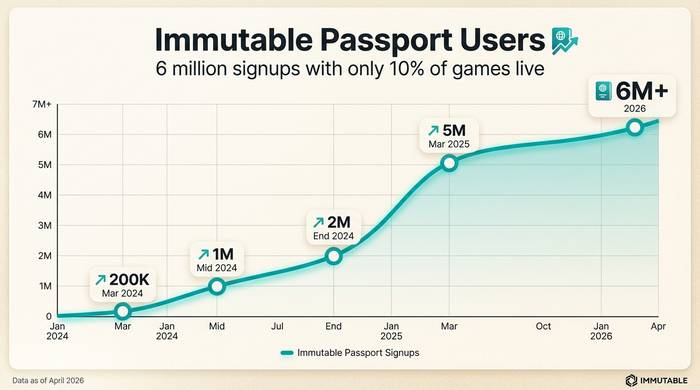
The growth has been steep. Launched January 2024. Hit 200,000 users by March. One million by mid-2024. Two million by end of 2024. Five million by March 2025. Over six million verified users as of 2026, with 1,000+ connected apps.
Here is the context that makes those numbers impressive: only about 10% of signed games are live. Passport reached 6 million users with a fraction of the ecosystem's content actually playable. As more games ship, the user base should grow with them.
This is what blockchain gaming needed all along. Nobody who plays Fortnite wants to set up MetaMask. Immutable figured that out and built an email-to-wallet system that hides the crypto from people who do not care about crypto. The NFT ownership still works under the hood. Players just do not have to think about it.
The IMX token
IMX is the native utility token of the Immutable ecosystem. Total supply: 2 billion. About 842 million circulating (42%). Fully unlocked as of 2025, meaning there is no future vesting pressure.
The token trades at about $0.14 in April 2026. That is 98.5% below its all-time high of $9.52 from November 2021. Market cap: roughly $120 million. The token is near its all-time low.
IMX has three functions: fees (20% of all protocol fees must be paid in IMX), staking (holders earn a share of network fees distributed every 14 days), and governance (token-weighted voting on protocol decisions).
Token allocation: 51.72% to ecosystem development, 25% to project development, 13.86% to private sales, 5.42% to public sales, 4% to the foundation.
| IMX token snapshot | Value |
|---|---|
| Price (Apr 2026) | ~$0.14 |
| Market cap | ~$120 million |
| All-time high | $9.52 (Nov 2021) |
| Total supply | 2 billion |
| Circulating | ~842 million (42%) |
| Vesting | Fully unlocked (2025) |
| Fee share paid in IMX | 20% |
| Staking distribution | Every 14 days |
Here is the disconnect. The ecosystem is the biggest it has ever been. 680 games. 6 million users. Chain merge done. The token is at $0.14, 98.5% below its high. The market does not care about game counts and Passport signups. It cares about revenue and NFT trading volume. Until the hundreds of games in development actually ship and generate real economic activity, IMX price is a bet on potential, not performance.
Funding and team
Immutable was founded in 2018 in Sydney, Australia by brothers James and Robbie Ferguson along with Alex Connolly. James Ferguson was 23 at the time.
The company raised over $300 million across multiple rounds. Notable investors include Temasek (Singapore sovereign wealth fund), ParaFi Capital, Lightspeed Venture Partners, and Tencent. The valuation peaked at $2.5 billion during the 2021-2022 NFT boom.
Immutable also created a $100 million fund in IMX tokens to support NFT gaming creators building on the platform. Partnerships include GameStop (NFT marketplace built on Immutable X), Razer (gaming hardware), and Polygon (zkEVM collaboration).