Tom Cruise Net Worth in 2026: The Backend Genius
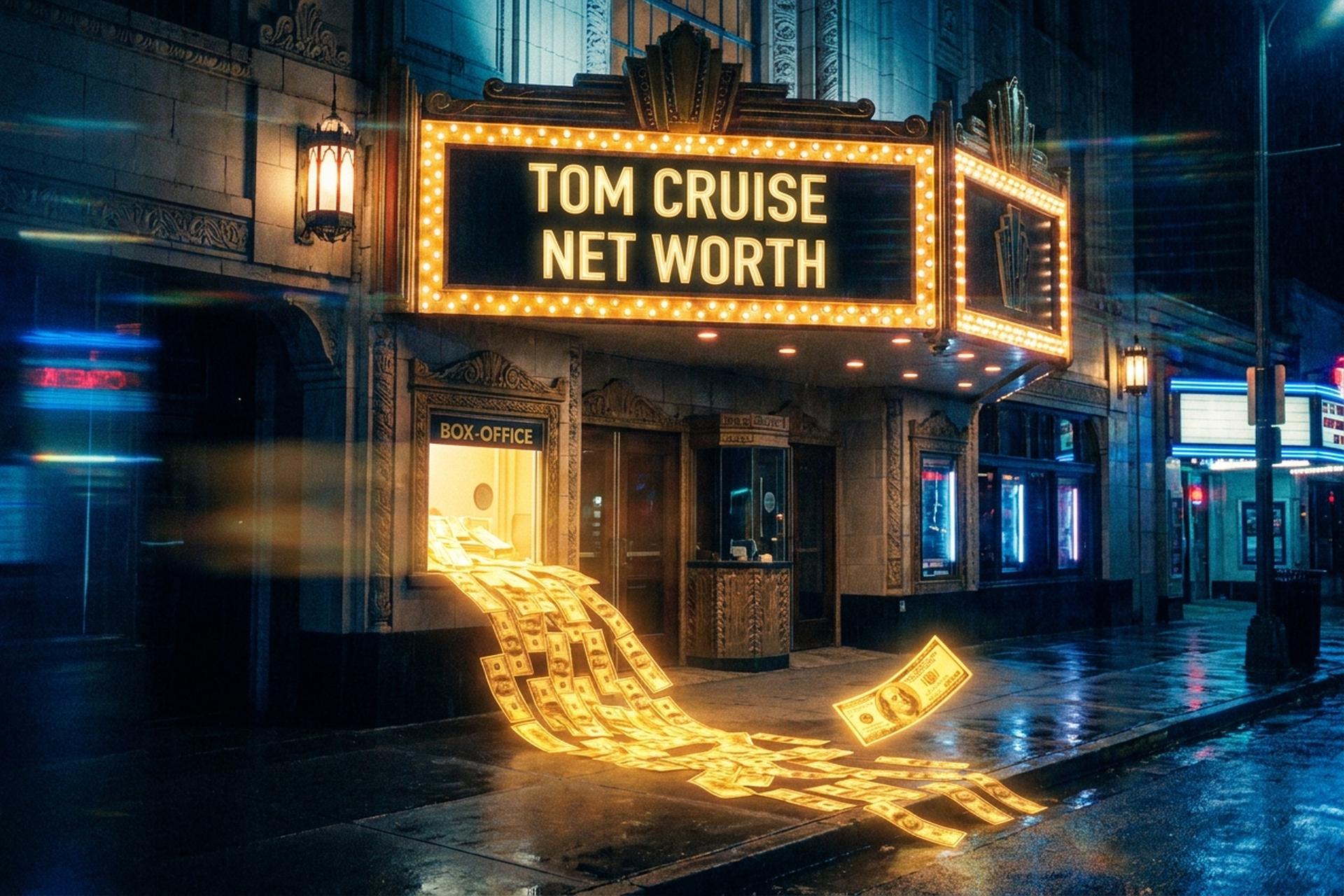
Tom Cruise is worth about $600 million. The films he has starred in have grossed nearly $13 billion. Sit with that gap for a second. He kept roughly a nickel of every dollar his movies pulled at the box office, and that nickel is the most sophisticated deal in Hollywood.
So what is the real Tom Cruise net worth in 2026, and how was it built? Not the way you think. It was not built on giant salaries, though those came too. It was built on a single idea that Cruise pushed harder than any actor before him: get paid off the ticket, not off the studio's accounting. Understand that one move and the whole fortune snaps into focus.
What Tom Cruise's net worth is in 2026
Most trackers put it at $600 million. Celebrity Net Worth lists exactly that. A few outliers stretch to $891 million, but the $600 million figure is the one nearly everyone uses, and the one that holds up best.
$600 million, with one big asterisk
Here is the asterisk. There are no public filings for Tom Cruise. No audited accounts, no salary disclosures. Every figure is an estimate built from reported deals, box-office math, and property records. What we can say with confidence is the scale of what he generated. In a January 2024 press release announcing a new partnership, Warner Bros. put his career box office at "nearly $13 billion." So his personal $600 million is the slice he managed to keep from a near-$13 billion machine. About five cents on the dollar. For a hired actor, that retention rate is extraordinary.
Most A-list actors keep a far thinner slice, because most take a salary and walk away while the studio keeps the upside. Cruise inverted that. He treats each film like a stake, not a job. The trade-off is that his wealth swings with the box office in a way a salaried star's never does. But over a forty-year run, betting on himself has paid spectacularly.
The numbers we can actually check
| Metric | Figure | Source |
|---|---|---|
| Estimated net worth | $600M | Celebrity Net Worth, Apr 2026 |
| Career box office | ~$13B | Warner Bros. press release, Jan 2024 |
| Top Gun: Maverick gross | $1.495B | Box Office Mojo |
| Mission: Impossible (8 films) | $4.73B | The Numbers |
The point of the table is not the net worth line. It is everything below it. Cruise's fortune is small only next to the absurd revenue he created. The story is not how much he has. It is how little of an enormous number it took to get there.
And it reframes every headline you have read about his pay. A "$100 million payday" sounds like a salary, the kind of number that makes people roll their eyes. It is not a salary. It is his share of a machine that printed ten times that much, which is a different and far smarter thing. That salary-versus-stake distinction is the whole story of the Tom Cruise net worth, and it is the part I keep coming back to, because almost every profile glosses right over it.
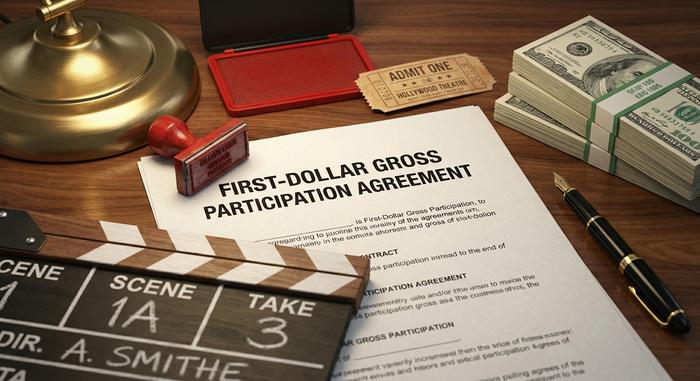
The Top Gun backend deals that built it
Now the actual engine. Most stars take a fee. Cruise takes a cut of the gross, and the difference is worth hundreds of millions.
First-dollar gross vs Hollywood accounting
There are two ways to get paid a percentage in Hollywood. You can take a slice of the "net profit," or a slice of the "gross." Almost nobody wants net. Studios are famous for "Hollywood accounting," the trick where a film that earns a billion dollars still shows a paper loss after marketing, interest, and studio fees are piled on. Net-profit participants often get nothing. The textbook horror stories are real: Hollywood has produced films that earned hundreds of millions and still, on paper, never turned a "profit," leaving anyone owed a share of net with a cheque for zero. Writers and mid-tier actors have sued over exactly this. The studios are not breaking the law; they are using contracts they wrote.
Cruise figured this out early and refused to play. He negotiates first-dollar gross, a percentage of the money as it comes through the door, before the accountants can make the profit vanish. He gets paid whether or not the studio claims the film "made" anything. That single distinction, gross instead of net, is the difference between a comfortable fee and a fortune. Very few actors have ever had the leverage to demand it. Cruise has had it for thirty years and used it without apology.
Top Gun: Maverick, the $100 million payday
The cleanest example is recent. Top Gun: Maverick, 2022. Cruise took a reported $12.5 million upfront, then roughly 10% of first-dollar gross, climbing toward 20% as the film soared. And soar it did: $1.495 billion worldwide. Deadline reported his personal cut landed "well north of $100 million" from that one film. He had run the exact play before. On War of the Worlds in 2005 he skipped a salary entirely, took about 20% of the gross, and walked off with well over $100 million on a $600 million hit. One movie. One smart contract. A nine-figure payday.
| Film | Year | Deal | Est. earnings |
|---|---|---|---|
| Top Gun: Maverick | 2022 | $12.5M + 10-20% first-dollar gross | $100M+ |
| War of the Worlds | 2005 | ~20% of gross, no upfront salary | $100M+ |
| Mission: Impossible | 1996 | actor + producer | ~$70M |
Mission: Impossible and the franchise machine
If Top Gun is the showpiece, Mission: Impossible is the foundation. The eight-film franchise has grossed about $4.73 billion worldwide, and Cruise does not just star in it. He produces it through his company, Cruise/Wagner Productions, which means he earns twice on every entry: once as the lead, once as a profit participant on the production side.
The early installments set the template for how the Tom Cruise net worth compounds across a franchise. Take the first Mission: Impossible, 1996. Once his gross points and producer share were added up, analysts credited Cruise with around $70 million. The 2000 sequel paid in the same neighborhood. Two films, a decade before Maverick, already minting him fortunes.
The recent entries kept the run alive. Dead Reckoning in 2023 and The Final Reckoning in 2025 pushed the franchise past $4.7 billion in total ticket sales, and each one carried Cruise's dual cut. The producing side matters more than people realize. A star is paid for showing up; a producer is paid on the film's performance, year after year, through home release and licensing. Cruise collects on both ledgers. Each new film compounds the last, because a franchise this reliable lets him negotiate from the strongest position in the business: the guy the whole thing cannot be made without. That is leverage no salary can buy.
How Tom Cruise ranks among the richest actors
Here is the twist. Cruise may be the most bankable movie star alive, but he is not the richest actor. Not close, at the very top.
The wealthiest names own things beyond their own films. Jerry Seinfeld sits near $1.1 billion, almost all of it from Seinfeld reruns. Tyler Perry built a studio and crossed a billion. Dwayne Johnson is around $800 million. Cruise, at $600 million, runs with them but trails them, and the reason is plain: he plows nearly everything back into the next production instead of building a media business off-screen. Compare him to Robert Downey Jr., whose Marvel deals reportedly threw off around $400 million across the Iron Man and Avengers run. Downey rode an ensemble. Cruise carries his films alone. More risk on him, and a bigger personal cut when they land.
| Actor | Est. net worth |
|---|---|
| Jerry Seinfeld | ~$1.1B |
| Tyler Perry | ~$1B |
| Dwayne Johnson | ~$800M |
| Tom Cruise | ~$600M |
| Tom Hanks | ~$400M |
He has still topped Forbes' highest-paid actors list more than once, in 1997, 2006, and 2012. In the 2025 ranking he came in second at $46 million, behind Adam Sandler. That figure is low for Cruise, but it is a base-salary year before the backend on his latest films pays out. His income arrives in lumps, not a steady wage, which is why the Tom Cruise net worth figure reflects career totals far more than any single year's earnings.

The reinvestment engine behind the stardom
Here is why Cruise has "only" $600 million instead of a billion. He spends it. Specifically, he spends it on the one asset that makes the deals possible: his own bankability. For Top Gun: Maverick he logged hundreds of hours of flight training and insisted on practical, in-cockpit footage that cost a fortune to capture. He hangs off real planes and climbs real buildings because the spectacle is what guarantees the next billion-dollar gross, which guarantees the next gross-points deal.
Other stars diversify into tequila brands, production empires, or property funds. Cruise pours the money back into being Tom Cruise, Movie Star, the single product his entire fortune depends on. It is a narrower strategy than Seinfeld's or Perry's, and on pure net worth it costs him. But it is also why, at an age when most actors coast, he is still the most reliable billion-dollar name in the business. In a strange way, the $600 million is almost a side effect. The real product is the career itself, kept alive by relentless reinvestment, and the bank balance is just what spills over the edges.
From Risky Business to global stardom
None of this was obvious in 1983, when a young actor named Thomas Cruise Mapother IV slid across a floor in his socks in Risky Business. Three years later, Top Gun made him a blockbuster phenomenon, and he was paid a flat $2 million for it. Then he learned the lesson that defined everything after.
The hits stacked up fast. Rain Man, Born on the Fourth of July, A Few Good Men, Jerry Maguire, the last earning him an Oscar nomination. Each one widened the gap between what he could demand and what a studio could afford to refuse.
Once a star is "bankable," meaning his name alone opens a film worldwide, the leverage flips. The studio needs him more than he needs any single role. Cruise used that leverage harder than anyone, trading guaranteed salary for gross points the moment he could. Hits like Jerry Maguire and the Mission: Impossible films kept proving he was worth it. Six decades in, he is one of only two actors, alongside Sylvester Stallone, with a number-one film in every decade since the 1980s. That consistency is the whole asset. A studio will hand gross points to a sure thing, and for forty years Cruise has been the surest thing in the building. The stardom was never the goal. It was the negotiating chip.
Scientology, Katie Holmes, and the money
Two questions always trail the fortune. First, Scientology: Cruise has been one of the Church's most prominent members for decades, introduced to it by his first wife, the actress Mimi Rogers. The Church does not disclose member donations, and no verified figure exists, so anyone quoting one is guessing. Second, the divorces. His 2012 split from Katie Holmes, his third wife after Rogers and Nicole Kidman, was settled privately and quickly, with reported child support that barely registered against a fortune this size. Neither his faith nor his marriages meaningfully moved the net worth needle. What moves it is the work, and the contracts attached to the work. Everything else is tabloid noise around a fortune that was built on spreadsheets.
What the Tom Cruise net worth number means
So treat the Tom Cruise net worth figure — $600 million — for what it is: the residue of a near-$13 billion career, routed through the smartest pay structure any actor ever insisted on. The headline number undersells the achievement. The real lesson is buried in the contracts. Gross, not net. Get paid before the accountants get creative. Cruise turned that single principle into one of the great fortunes in entertainment, and at 63 he is still signing deals and still doing his own stunts. The question is no longer how much he is worth. It is how much higher the number climbs before he finally sits down. Would you bet against him?