Steve Wozniak Net Worth: The Apple Co-Founder Who Walked Away
Here is a strange fact about Silicon Valley. The man who designed the machine that built a four-trillion-dollar company is, by his own choosing, one of the least wealthy people ever attached to it. Not bad luck. Not a failed bet. Steve Wozniak engineered the Apple II, watched Apple go public, and then spent the next few years quietly handing his fortune to other people. So what is the Steve Wozniak net worth figure today? Depends who you ask. The estimates run from $10 million to $140 million, a fourteen-fold spread for one man, and that gap says more than any single number could. Woz seems perfectly happy sitting at the low end of it.
What Steve Wozniak's net worth actually is
The honest answer is that nobody outside his accountant knows, and the disagreement between sources is the real story. Celebrity Net Worth lists Steve Wozniak at $10 million. A cluster of celebrity-wealth aggregators, several of them citing an older Forbes estimate, put him closer to $100–140 million. Both camps are guessing. Wozniak has never disclosed his finances, holds no public company stake large enough to file on, and has spent decades giving money away rather than reporting it.
| Source | Estimated net worth | Year | Basis |
|---|---|---|---|
| Celebrity Net Worth | $10 million | 2026 | Third-party estimate |
| Aggregator consensus (Forbes-cited) | $100–140 million | 2026 | Third-party estimate |
| Mental Floss | ~$100 million | 2017 | Third-party estimate |
Notice the column on the right. Every figure is an outside estimate, none is a disclosure, and that distinction matters when the numbers are this far apart.
Why the estimates disagree so much
Three things make Woz almost impossible to value. He sold the bulk of his Apple stock in the mid-1980s, so there is no enormous appreciating position to track the way you can with a founder who held. He gave large chunks of his early wealth directly to employees and to charity, which removes it from any ledger an estimator can see. And his later income came from private ventures and acquisitions whose payouts were never made public. An estimator is left reconstructing a number from speaking fees, book royalties, and guesswork.
What we can actually verify
A few things are documented rather than assumed. He still draws a token Apple paycheck. His original Apple-1 boards now sell at auction for hundreds of thousands of dollars, with one fetching about $375,000 in early 2025. He was chief scientist at companies that sold for real money. Everything else is inference. When a profile states his net worth as a confident single figure, treat that confidence as a writing choice, not a fact.
The Apple II that Woz built by hand
Before any of this was a fortune, it was a circuit board on a folding table. By day Wozniak designed calculators at Hewlett-Packard. By night he hung around the Homebrew Computer Club, a scrappy group of Bay Area electronics hobbyists who swapped schematics and showed off whatever they had soldered that week. That room is where the personal computer stopped being a hobby and started being an idea. Woz was the one who walked in with a working machine.
He designed the Apple I almost alone. He wrote a version of the BASIC programming language for it, laid out the circuit board by hand, and gave it the one thing most hobby boards lacked: you could plug in a keyboard and a screen and actually use it. Then came the Apple II, and that one changed the trajectory of everything. A real computer system that could display color graphics, sold as a finished product instead of a bag of parts. It carried Apple's revenue through the late 1970s, and Apple II computers kept selling, in one shape or another, for well over a decade. Hewlett-Packard, by the way, was offered the design first. They passed. More than once. The whole company swings on that rejection.
People forget there was a third founder. Apple Computer started in 1976 with Wozniak, Jobs, and Ronald Wayne, who drew the first logo and typed up the partnership agreement. Earlier still, Jobs had pulled Woz into an all-nighter to shrink the circuitry for Atari's arcade video game Breakout. It set the pattern for the next decade: Woz built, Jobs sold. None of the money that follows exists without that Apple II.
How Woz built and unwound his Apple fortune
Wozniak did have a fortune once, and a large one — the real source of every Steve Wozniak net worth figure you will read today. It just didn't last, because he didn't want it to. Apple went public on December 12, 1980, the biggest technology offering Wall Street had seen in years. The stock opened at $22 and closed near $29. By the closing bell the company was worth about $1.78 billion, and Wozniak's slice of it, somewhere near 7.9%, had become a paper fortune of $116 to $142 million. He was a multimillionaire before lunch.
The 1980 IPO that made him a millionaire
For context, Steve Jobs walked out of the same IPO with a paper fortune of around $217 million, comfortably ahead of co-founder Steve Wozniak. Both men were suddenly, absurdly rich on a Friday in December. The difference is what each did next. Jobs held and fought; Wozniak started giving.
The Woz Plan: giving stock to employees
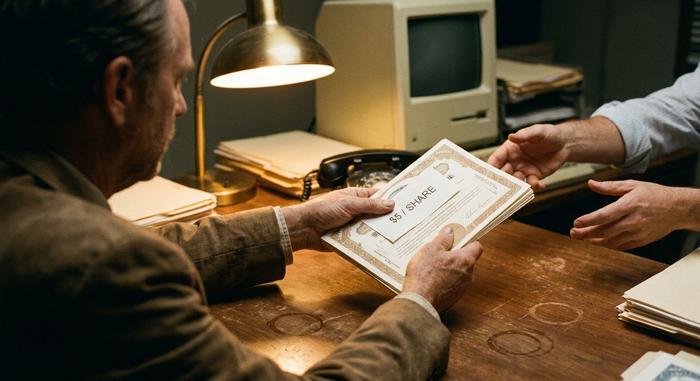
Before the IPO, Wozniak noticed that many of the early Apple engineers and staff who had built the thing alongside him held little or no equity. So he sold them roughly $10 million worth of his own pre-IPO shares at about $5 each, letting dozens of colleagues cash in when the stock hit the public market. It became known internally as the "Woz Plan." Jobs was asked to match it and declined. I keep coming back to that detail, because it is the cleanest summary of the two men you will find: one treated equity as something to share, the other as something to keep.
The $50 a week Woz still takes from Apple
Any accounting of Steve Wozniak's net worth has to reckon with what happened after 1985, when he left Apple as a full-time engineer but never fully resigned. He has stayed on the payroll ever since as a kind of permanent, ceremonial employee, which produces one of the most-quoted paychecks in technology. A 2006 estimate pegged his nominal Apple salary at about $120,000 a year. By his own account years later, what actually lands in his pocket is closer to $50 a week after taxes and deductions. The amount is the point. He has said plainly that he didn't want to be near money because being near it can corrupt your values, and a $50 weekly stub from the company he co-founded is about as far from being near money as a billionaire-adjacent engineer can arrange. He has never asked to be paid more, and he has never quit. Staying on the payroll keeps a thread tied to the thing he built, without giving him any say, any stock package, or any reason to start caring about the share price. For an engineer who left because the company had stopped being fun, that is a strangely elegant arrangement.
What Wozniak could have been worth
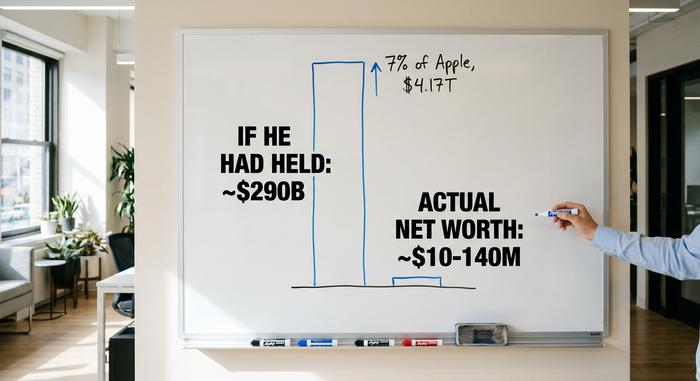
Here is the number that drives every headline about Steve Wozniak's net worth. If Wozniak had simply held his Apple stake instead of selling it, what would it be worth now? Apple's market value reached about $4.17 trillion in mid-2026, according to StockAnalysis. A 7% slice of that is roughly $290 billion, and a 7.9% slice approaches $330 billion. Numbers like those would place him near the very top of any global wealth ranking, above the founders of Amazon and Tesla.
| Wealth moment | Steve Wozniak | Steve Jobs |
|---|---|---|
| Apple IPO, Dec 1980 (paper) | ~$116–142 million | ~$217 million |
| At Jobs' death, 2011 | tens of millions (est.) | ~$10.2 billion estate |
| If 1980 stake were held to 2026 | ~$290–330 billion (illustrative) | n/a |
One caveat the viral versions skip: that counterfactual assumes he kept the same percentage of the company forever. Real shareholders get diluted as a firm issues new stock for decades of employee pay, acquisitions, and options, so a 1980 founder almost never owns the same slice in 2026. Apple has also split its stock several times along the way. The honest figure would land well below $290 billion. Even so, it would put Wozniak in the same conversation as Jeff Bezos and Elon Musk, the two men who usually trade the title of richest person alive — and he gave up the entire position on purpose.
Why Jobs ended up worth 1000x more
The Jobs comparison is the sharpest way to see it. On IPO day the two were within a factor of two of each other. By the time Jobs died in 2011, his estate was valued near $10.2 billion, most of it not even from Apple but from his Pixar stake, which converted into a large Disney holding when Disney bought the studio. Jobs also returned to Apple in 1997 and collected stock as part of that second act. Wozniak did none of those things. He left in 1985 and stayed gone, and the fortune compounded for the man who stayed.
Where Steve Wozniak makes his money now
So if not Apple stock, what funds the life of a famous Silicon Valley entrepreneur in his seventies, and accounts for whatever his net worth is today? Mostly a long string of ventures and a very busy stage. After Apple he founded CL 9 and built the first programmable universal remote control, which is a wonderfully Woz thing to have done. He started a wireless tracking outfit called Wheels of Zeus. He sat on boards. He spent years as chief scientist at Fusion-io, the flash-storage company SanDisk bought for about $1.1 billion in 2014, as CNBC reported at the time, then took a similar role at Primary Data. In 2021 he co-founded the company Privateer, which tracks satellites and orbital debris. The man has never really stopped tinkering.
The ventures are only half of it. Wozniak pulls in steady money from corporate speaking, where a single appearance runs into the tens of thousands, plus royalties from his memoir iWoz and the odd television turn. He has judged the startup show Unicorn Hunters and once gamely competed on Dancing with the Stars. And then there is the collector's market, which treats his earliest hardware like fine art. One working Apple-1, a board Woz soldered himself, sold for roughly $375,000 at auction in early 2025. None of this throws off anything close to Apple-stock money. It funds the modest, gadget-cluttered life he actually wants, which was always the only budget he cared about.
Why wealth and power were never Woz's point
It is tempting to read all of this as a cautionary tale about selling too early. Wozniak does not see it that way, and his own words make the framing clear. "I gave all my Apple wealth away because wealth and power are not what I live for," he wrote, and the record backs him up. He has funded technology museums and education programs for years, particularly around his native San Jose, including the science and technology center now known as The Tech Interactive and the Children's Discovery Museum of San Jose, which received around $1.8 million from him in the 1980s and later renamed its street 180 Woz Way in his honor. He bankrolled school computer programs out of his own pocket back then too, handing equipment and teaching time to local districts long before tech philanthropy became a public-relations strategy. The small net worth is not something that happened to him. It is something he chose, line by line.
What Woz's net worth really teaches
Steve Wozniak's net worth is the rare case where the figure is small because the person decided it should be, not because the bet went wrong. He held one of the great winning lottery tickets in business history and cashed it for a comfortable life, a stack of donated equity, and a $50 weekly paycheck he seems genuinely amused by. The interesting lesson here has little to do with Apple shares; it is about what ownership is for, and the quiet, unfashionable idea that you can look at a number, decide it is high enough, and simply stop.