Frosting AI Review 2026: Features, Pricing, and Safety
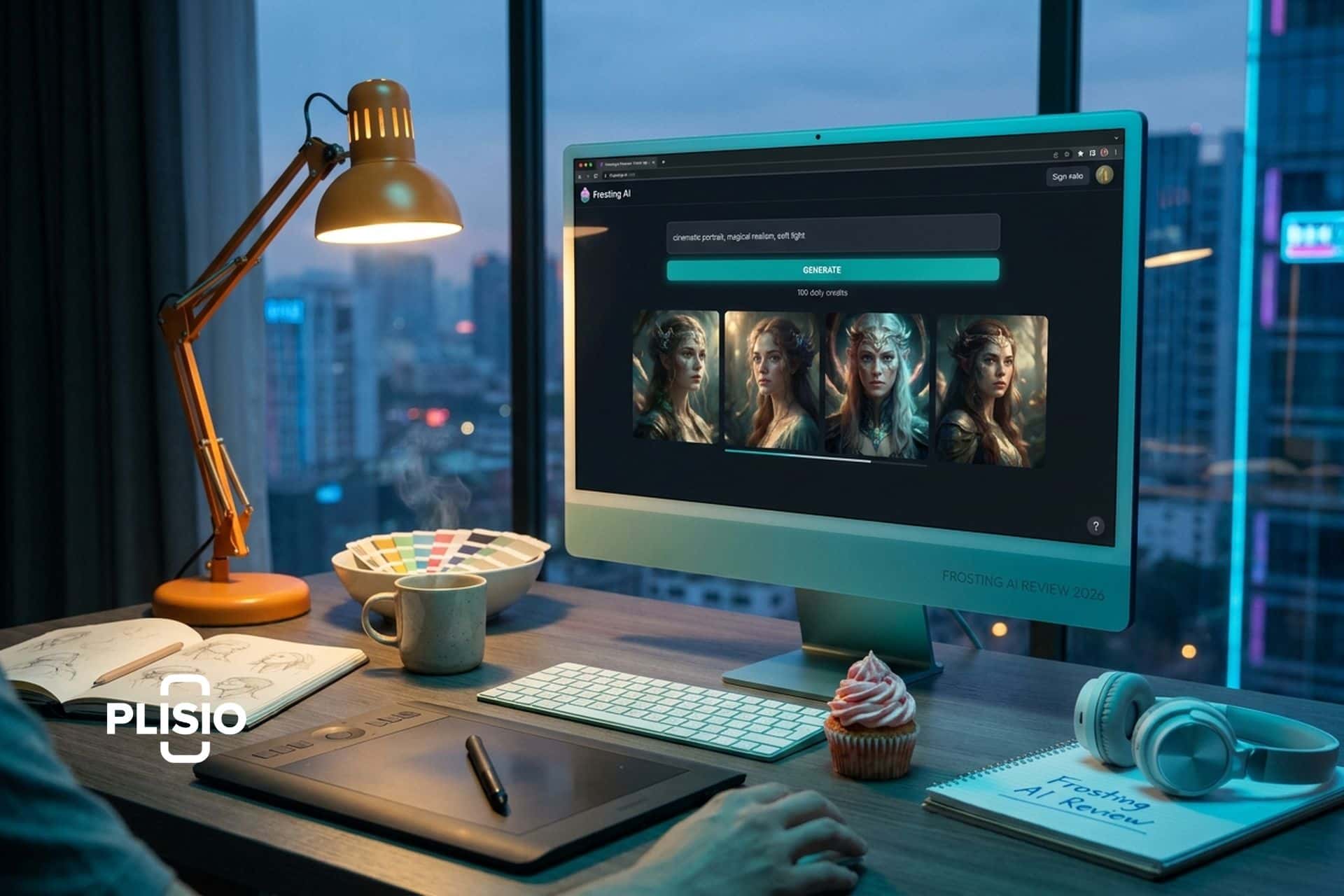
Frosting AI is a kind of AI image generator you will not see in the tech press. No Product Hunt launch. No Verge write-up. No verified founders on X. And yet it pulls hundreds of thousands of visits each month. The domain was set up on March 3, 2023. The company is trademarked as "The Frosting Company." It does not list founders or funding. What you find online splits neatly in two. Glowing paid-looking reviews on one side. User complaints about bad hands on the other. Neither is the full story.
This Frosting AI review tries to be the middle lane. What the product actually is. What it does well. Where it falls short. Who uses it. And how it stacks up against alternatives like Midjourney, Leonardo AI, and Civitai. Features, pricing, safety, NSFW policy, and a direct verdict at the end. The goal is an honest reference for anyone thinking about signing up.
What is Frosting AI? A quick overview
In one sentence: Frosting AI is a browser-based text-to-image generator built on Stable Diffusion and machine learning pipelines. Type a prompt. Pick a few options. Click generate. Images appear in 5-20 seconds. The product is ai-powered image generation aimed at hobbyists, freelance illustrators, and creators who want speed without installing anything locally. It converts text prompts into custom visuals, and lets you generate realistic images or stylized art inside the same workflow.
So what makes Frosting AI different from a generic Stable Diffusion web UI? Three things, really. First, the interface is clean and opinionated. A novice can land a usable image inside five minutes, something you cannot honestly say about ComfyUI or A1111. The user-friendly interface is a real advantage, and ease of use shows up repeatedly in Frosting AI reviews. Second, the platform runs a permissive adult-content policy with legal guardrails (more on that below), which puts it in a specific niche. Third, it supports a fairly deep stack of advanced features: batch generation, reference image input, ControlNet, inpainting, and experimental video generation. None of that is buried behind an enterprise pricing tier.
Per Similarweb, Frosting.ai pulled roughly 411,000 monthly visits in December 2025. Then 235,800 in March 2026. The audience skews heavily male (88-90%), mostly 18-24, US-led. Over two-thirds of traffic is direct. That tells you the base is loyal and returning, not discovery-driven SEO.
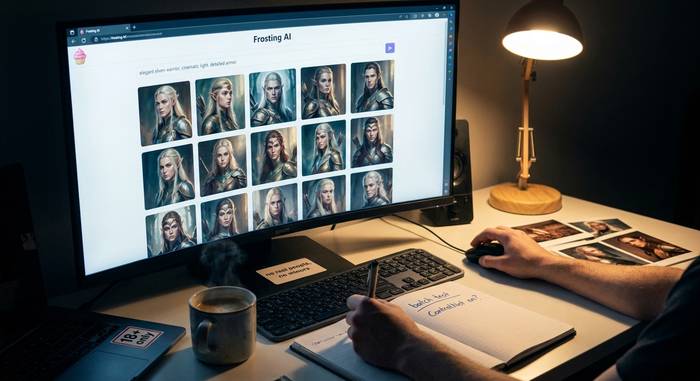
Frosting.ai features: text prompts, upscaling, and more
The core of the frosting.ai experience is text-to-image generation. Type a detailed description, or just a simple text prompt. Pick an aspect ratio and a style. Hit generate. Behind the scenes the platform routes your request to one or more Stable Diffusion checkpoints, runs the diffusion steps, and returns high-quality images you can save, upscale, or refine. The generation capabilities cover a wide range of artistic styles, cinematic photorealism, anime, painterly art creation, stylized concept work. That range gives the tool real creative flexibility for different creative needs.
Here are the features most users actually touch during a typical session:
- Positive and negative prompt fields with prompt strength controls for fine-tuning outputs.
- Aspect ratios covering square, portrait, landscape, and widescreen, plus other customization options.
- Style and mood presets that approximate common aesthetics (photorealistic, anime, cinematic, painterly).
- Image upscaling tools that push outputs to high-resolution without a full regenerate.
- Inpainting for editing specific regions of an existing image.
- Batch generation of up to 16 images simultaneously on higher tiers, useful for prompt testing.
- Reference image input that lets you upload reference images to guide the AI.
- ControlNet support for layout, pose, and composition control.
- A video generation beta on higher tiers, plus advanced options for power users.
- A character-chat experimental feature that the platform's own user feedback calls "half-baked."
Nothing here is groundbreaking in 2026. Most top-tier AI art generators offer a similar toolkit. The value is in the combination plus the low friction: no install, no API key, no ComfyUI node graph to wire together.
AI image generator quality and models in use
Frosting AI does not list which exact checkpoints it runs at any moment. That is a small frustration for prompt engineers. Third-party reviews hint at a mix of Stable Diffusion base, SDXL, and community-tuned models (Pony, Juggernaut, and similar) picked by content type. For end users, image quality sits in the "good but not great" band.
Strengths:
- Photorealism on simple scenes is solid. Portraits, still lifes, landscapes come out as visually stunning shots when prompts are precise.
- Anime and illustration styles consistently produce clean, customizable results, which matches Frosting's apparent audience skew.
- Stylistic range is broad. Switching between painterly, 3D render, or photographic styles usually works with one prompt change. The creative process feels flexible, with a gentle learning curve for beginners and good usability for returning users.
Weaknesses widely reported by users:
- Hands, especially in portrait compositions, often come out distorted with extra or missing fingers.
- Faces in small-scale or crowd scenes lose coherence.
- Text inside images is mostly unreadable.
- Highly specific prompts (named characters, branded products) often miss the mark compared to dedicated models for those niches.
These are standard Stable Diffusion failure modes rather than Frosting-specific bugs. Expect roughly the same quality ceiling you get from a mid-tier SDXL service. If pixel-perfect rendering matters, you will want FLUX-family models on platforms like Krea or direct Black Forest Labs API access.
Pricing: Frosting AI free plan and paid plans
Frosting AI runs a daily-credit freemium model. Free and paid plans sit side by side. The free version gives you 100 credits per day. That is roughly 25 to 50 generations, depending on resolution, step count, and which model you pick. Outputs are not watermarked on current tiers. (This was not always true. Some 2024 reviews reference watermarks that have since been removed.) The free trial is effectively permanent, which makes it one of the more generous entry points among AI art generators.
Paid plans stack credits, simultaneous image slots, quality steps, and premium features. The gap between free and paid plans shows up once you start batch testing or rendering at higher step counts. Paid features include batch expansion, ControlNet, video generation, and higher quality step counts.
| Plan | Price / month | Daily credits | Key add-ons |
|---|---|---|---|
| Free | $0 | 100 | Basic generation, upscaling |
| Planet | $7 | 500 | Upscaling tools, 2 simultaneous images, 25 quality steps |
| Star | $25 | 1,500 | Inpainting, 4 simultaneous images, 40 quality steps |
| Nebula | $55 | 4,000 | Reference images, 20 video generations/month, 8 simultaneous |
| Galaxy | $120 | 10,000 | Full ControlNet, character chat, 16 simultaneous, 100 steps |
Annual billing discounts everything by 20%, and the platform offers a 50% nonprofit discount for verified organizations. If you are a casual user, the free plan covers most needs. If you want batch testing, ControlNet, or video, you are looking at Nebula or Galaxy.
Worth noting: Frosting AI's pricing has shifted at least once since 2024, and some older reviews (including the Plisio base piece for this article) quote different numbers. Always check the current pricing page before committing to annual billing.
Batch generation, reference image, and ControlNet
Three advanced features deserve a closer look, because they are where Frosting AI differentiates from the cheaper "just type a prompt" generators. They also cover most image creation needs that casual users have, from designing marketing materials to building visuals for social media posts.
Batch generation lets you ask for 2, 4, 8, or 16 variations of the same prompt in one run. Useful when you have a concept but want to see how different seeds interpret it. Each batch burns credits proportionally, but the cost-per-image drops on higher tiers where batches are optimized.
Reference image input is effectively Frosting's version of image-to-image or Midjourney's sref. You upload a photo, sketch, or existing AI image, and the system uses it to guide composition, style, or color while still rendering from your text prompt. Character continuity, product consistency, and style matching are the obvious use cases.
ControlNet is the feature that puts Frosting AI on roughly equal footing with self-hosted Stable Diffusion setups. It lets you control output layout using edge maps, depth maps, or pose references. For illustrators and concept artists, ControlNet is often the single most important feature a web-based AI image generator can offer, and Frosting's implementation is functional without being best-in-class.
NSFW policy and content creation rules on Frosting AI
Frosting AI is openly tolerant of adult content. That is both its edge and the main source of discomfort around the platform. The rules are also tighter than many users think.
What is allowed:
- Adult, erotic, or explicit imagery involving clearly adult fictional characters.
- Anime, furry, photorealistic, or painterly adult-themed content.
- Private generation, with images defaulting to private and not being surfaced in any public gallery.
What is banned, per the platform's terms:
- Any depiction of minors in sexual or suggestive contexts. Zero tolerance, and this is enforced.
- Non-consensual deepfakes of real people. Generating sexual images of real individuals without consent is prohibited.
- Copyrighted characters in contexts likely to trigger IP complaints. Enforcement is uneven but present.
- Content violating US federal law or the laws of the user's jurisdiction.
The platform ages users through a verification step at sign-up. Standard threshold is 18+. In five US states (Alabama, Mississippi, Nebraska, Utah, and Wyoming), state-level laws about adult online content raise the bar to 21+. Violating these rules, according to the ToS, results in account termination and possible legal referral.
This Frosting AI content creation policy is stricter than casual observers assume, but more permissive than Midjourney or DALL-E. For serious SFW creative work the policy is irrelevant; for adult art, it is the reason the platform exists.
Privacy, age checks, and artificial intelligence ethics
AI tools sit at a messy line between free speech and real harm. Frosting AI's answer is layered, though not fully public. Images and chats are private by default. Nothing you make shows up on a public feed unless you share it. Got a complaint, say, someone using your face without your OK? There is a stated 7-day response window.
What the platform does not say out loud is more telling. How long are your images kept on their servers? Does your prompt data feed the model? Is moderation human, bot, or both? No clear answer. Rivals like Leonardo AI and Civitai publish tighter data retention terms.
On the ethics side, the standard AI art critiques still apply. Where did the training data come from? Are artists paid? What about lost illustration jobs? Frosting AI has not made a public opt-out plan or any artist pay scheme. If you care about those things, the open question is whether using the tool fits your own view.
Traffic and who uses Frosting.ai in 2026
Here is where the story gets interesting. Similarweb's April 2026 snapshot shows Frosting.ai in a measurable but contracting position. Traffic fell from around 411,000 monthly visits in December 2025 to 235,800 by March 2026. That is a 43% drop in one quarter. Why? Part of a broader pattern. NSFW-tolerant AI tools surged through late 2024 and 2025. Then they plateaued, or declined, as Midjourney, Leonardo, and mainstream generators captured more attention with better image quality.
Who is still using it? Similarweb's audience breakdown is blunt. Heavily male, 88-90%. Young, with a modal age of 18-24. Concentrated in the US, with secondary traffic from the UK, Germany, and Brazil. And 67-72% of visits are direct, meaning people type the URL or pull it from a bookmark, rather than coming from Google. That direct ratio is high. It signals a loyal returning base, not a platform living on SEO or paid acquisition.
The community numbers are small. Discord membership sits around 6,744 as of April 2026. No active subreddit with meaningful membership has emerged. Product Hunt and G2 profiles are either missing or unclaimed. So third-party review data is thin compared to mainstream AI art generators. Make of that what you will.
User reviews and sentiment about Frosting AI
Aggregated sentiment, based on scattered Reddit posts, YouTube reviews, and third-party review sites, lands around 7.8/10. Common praise and complaints cluster around predictable themes.
Praise:
- Fast generation, usually 5-20 seconds per image.
- Clean, usable interface that does not require a manual.
- Genuinely useful free plan that produces watermark-free outputs.
- A specific niche (adult content with legal guardrails) that competitors either avoid or handle worse.
Complaints:
- Hands, faces in crowds, and in-image text are unreliable (generic Stable Diffusion limits).
- Occasional billing friction; users report delays in resolving failed charges or refund requests.
- The video generation beta and character chat features feel unfinished.
- Server lag and prompt caps during peak hours.
No review cluster suggests outright scams or data misuse, which separates Frosting AI from a long tail of sketchy AI art generators. It is a functional product with predictable weaknesses.
Alternatives to Frosting AI: Midjourney, Leonardo, DALL-E
If Frosting AI does not fit your use case, here is how the alternative landscape looks in April 2026.
| Alternative | Strength | NSFW policy | Pricing |
|---|---|---|---|
| Midjourney v7 | Best aesthetic output for illustration | Strict no-NSFW | $10-$60/month |
| Leonardo AI | Great all-around, excellent model library | Moderate SFW only | Free / $12-$48/mo |
| Civitai | Open model hub, self-hosted feel | Permissive with verification | Free / credits |
| DALL-E 4 (via ChatGPT) | Best conversational prompt flow | Strict no-NSFW | Bundled with ChatGPT |
| NovelAI | Anime and storytelling focus | Permissive | $10-$25/mo |
| Krea AI | Real-time, 40+ models | SFW default | Free / $9-$70+/mo |
| Promptchan AI | Direct NSFW competitor | Permissive | ~$4.49/mo |
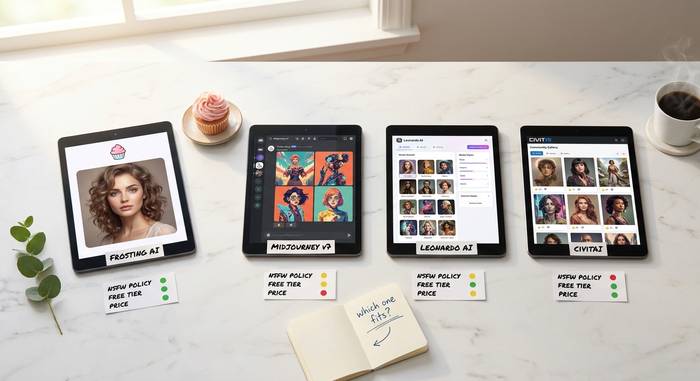
Pick Midjourney if image quality is your only axis. Pick Leonardo if you want a balanced SFW toolkit with a strong model library. Pick Civitai if you want to self-host or plug into the open ecosystem. Pick Krea for real-time generation and the widest model selection. Pick Frosting AI or Promptchan if adult content with legal guardrails is a specific requirement.
Frosting AI review: pros and cons from real use
The shortest possible summary after looking at product features, pricing, user sentiment, and traffic data.
Pros:
- Low-friction browser workflow, no install.
- Generous free plan without watermarks.
- Advanced features (ControlNet, batch generation, reference images) that rival self-hosted Stable Diffusion.
- A clearly defined adult-content policy that enforces legal limits while being permissive.
- Fast generation times and reasonable image quality for mainstream use cases.
Cons:
- Quality ceiling is mid-tier SDXL, not FLUX or Midjourney v7.
- Declining traffic suggests users are drifting to competitors.
- Thin public documentation on model selection, data retention, and training data.
- Beta features (video, character chat) are unreliable.
- No mainstream media coverage, which means limited third-party accountability.
Final verdict on the Frosting AI image generator
Frosting AI is competent, fast, and specifically positioned. It delivers what most of its target users actually want. Is it the best AI image generator on the market? No. Is it trying to be? Also no. For casual users, hobbyists, and adult-content creators who want SDXL-level quality without installing anything, it hits a reasonable balance of ease, features, and policy.
Where it falls short is in broader ambition. Frosting AI has not broken into the mainstream AI art conversation. Public transparency is limited. And it is losing traffic share as general-purpose tools like Krea, Leonardo, and Midjourney absorb more of the creative AI market. The niche is defensible but not expanding. If you want a single AI art generator to commit to, a mainstream option is probably better. If you want a lightweight second tool for specific use cases, the free plan is a reasonable place to experiment.
A 7 out of 10 product, with the seventh point earned entirely by what it does not try to do.