How Much Is Obsidian Worth? Value, Types and Pricing

So how much is obsidian worth? For the common black stuff, not much. Figure $2 to $30 a pound for raw rock, and a dollar or two for a tumbled piece off a shop shelf. Then there's the other end. Fire obsidian and the good iridescent pieces sell for many times what a plain black chunk brings. Type, cut, polish, rarity: that's the whole story of why one stone costs more than another.
What Is Obsidian and Where It Comes From
Obsidian is volcanic glass. Silica-heavy lava meets cold air, cools before its atoms can line up into crystals, and locks in place as glass. Break a piece and the fresh edge will out-cut a steel scalpel.
It turns up near rhyolitic volcanoes and lava domes. Plenty of it across the western US. Mexico too, plus Iceland, Turkey, parts of East Africa. Volcanoes churn it out by the ton, so raw obsidian has always been cheap. The supply side is not where the money is.
Here is the catch, though. Obsidian ages badly. Give it a few million years and it devitrifies, going milky as crystals creep through the glass. Anything worth cutting is fairly young rock, and a large, clear block in a colour buyers actually want is the hard thing to lay hands on.
A quick look at its physical properties:
- Composition: roughly 70% or more silica, plus magnesium and iron
- Hardness: about 5 to 5.5 on the Mohs scale, softer than quartz
- Fracture: conchoidal, breaking in smooth curved shells
- Luster: vitreous, close to manufactured glass
- Common colors: deep black, brown, mottled grey, sometimes with an iridescent sheen
How Much Is Obsidian Worth on the Market Today
Form matters more than weight here. Rough rock, tumbled stones and finished jewelry are really three markets, and they do not price the same way. Raw black obsidian? Somewhere around $2 to $30 a pound. Landscape-grade rock in bulk can fall to $5 a kilo. A tumbled stone off a shop tray costs a dollar or two. Cut and polish that same plain black obsidian into a cabochon and you are still looking at a few dollars.
The rare varieties break that pattern. Raw rainbow obsidian can pull $0.50 to $2 a gram. Gold and silver sheen tend to sell per carat once cut. Fire obsidian is the top of the market at $50-plus per carat, and a finished piece runs into the hundreds.
The table below shows the per-unit gap between plain black obsidian and the rare types.
| Unit | Common black obsidian | Rare varieties (fire, fine rainbow) |
|---|---|---|
| Per gram | $0.05 – $1 | $2 – $50+ |
| Per ounce | $1 – $10 | $50 – $1,500+ |
| Per pound | $2 – $30 | $200 – $5,000+ |
| Per kilogram | $5 – $60 | $500 – $10,000+ |
| Per carat (cut) | $0.02 – $2 | $10 – $50+ |
These are wide on purpose. Sellers price obsidian by eye and by what their buyers will pay, so two stones that look alike can carry very different tags.
Is Obsidian Traded as a Commodity?
No. Obsidian is not traded on any exchange the way gold, silver or oil are. There is no spot price, no futures contract and no daily quote you can look up. Nobody hedges an obsidian position.
Its market value is set entirely at retail. Rock shops, lapidary sellers, gem shows and online marketplaces each price their stock based on quality, processing and what buyers in their niche will pay. That is a sharp contrast with assets like precious metals or cryptocurrency, where a transparent, continuously updated market value exists at all times. With obsidian, the "market" is a patchwork of individual listings.
This matters when you are trying to value a piece you already own. There is no reference rate to check, so the practical method is to compare recent sold listings for the same variety, size and finish. Auction results and completed marketplace sales tell you far more than asking prices, which sellers often set optimistically. For anything unusual, a gemologist or lapidary dealer can give a grounded estimate.
Types of Obsidian and What Each One Costs
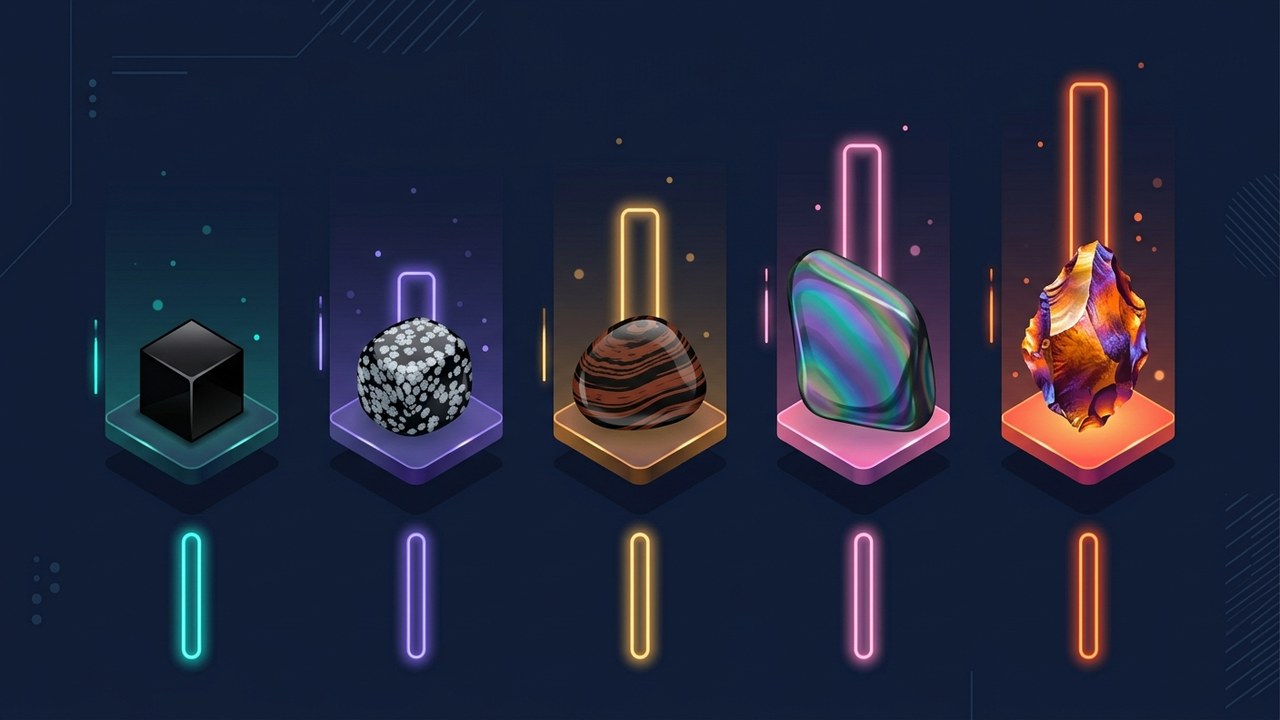
Type tells you most of what you need to know about price. Every variety looks the way it does because of some accident during cooling: trapped gas, a mineral that grew inside the melt, layers thin enough to bend light. Buyers pay for those accidents. Here is how the common types compare.
Black Obsidian
The baseline. Most common, cheapest, sold by the bucket. Raw pieces go for a few dollars a pound. A polished sphere or worry stone stays under $10 to $20 unless it is a large one.
Snowflake Obsidian
Those white flecks are cristobalite, a mineral that crystallized inside the black glass. Price sits low to mid: $8 to $25 for a tumbled stone or a small carving, a little more when the pieces get bigger and the polish gets better.
Mahogany Obsidian
Iron oxide streaks it reddish-brown against the black. Cheap material, mostly $3 to $9 a piece for tumbled stones and plain cabochons.
Rainbow and Sheen Obsidian
Tilt a rainbow obsidian piece and curved bands of purple, green and gold roll across it, thanks to nanoparticle layers bending the light. Sheen obsidian pulls the same trick in a single colour. A good cabochon is roughly $20 to $50. Every bit of that value hangs on cutting: line the stone up wrong and the colour vanishes.
Gold Sheen and Silver Sheen Obsidian
Metallic gold or silver glow right across the face. Cut into cabochons or beads, these sell per carat as a rule, about $10 to $20, because the cutter's orientation and polish decide almost everything.
Fire Obsidian
The piece collectors chase. Magnetite layers only a few atoms thick throw off red, orange, green and blue. Nearly all of it comes from a few Oregon deposits, and a cutter has to chase the fire to the surface without grinding straight past it. Reckon on $50-plus per carat, and $150 to $400 or more for a finished pendant.
| Obsidian type | Typical raw price | Cut / polished price | Main value driver |
|---|---|---|---|
| Black | $2 – $30 / lb | $5 – $20 / piece | Size only |
| Mahogany | $3 – $9 / piece | $8 – $20 / piece | Banding contrast |
| Snowflake | $8 – $25 / piece | $15 – $40 / piece | Pattern spread |
| Rainbow / sheen | $0.50 – $2 / g | $20 – $50 / cab | Color, cut orientation |
| Gold / silver sheen | $1 – $3 / g | $10 – $20 / carat | Sheen strength, polish |
| Fire | rarely sold raw | $50+ / carat | Rarity, cutting skill |
What Determines the Value of a Piece of Obsidian
Two stones from the same dig site can sell for wildly different money. Once you know the type of obsidian in your hand, the obsidian value of that specific piece comes down to a short list a dealer runs through:
- Variety and rarity. Fire and fine rainbow obsidian are scarce. Plain black is not.
- Color and pattern. Strong, evenly distributed color or sheen beats a dull or patchy stone.
- Size. Larger clean blocks are harder to find, so they cost more per unit.
- Clarity. Gas bubbles, cracks and dull spots all lower the grade.
- Cut and polish quality. A well-oriented cabochon that shows full fire is worth many times a careless cut.
- Craftsmanship. Hand-carved figures, spheres and jewelry add labor value on top of the stone.
- Provenance. Material from a known, now-limited locality can draw collector interest.
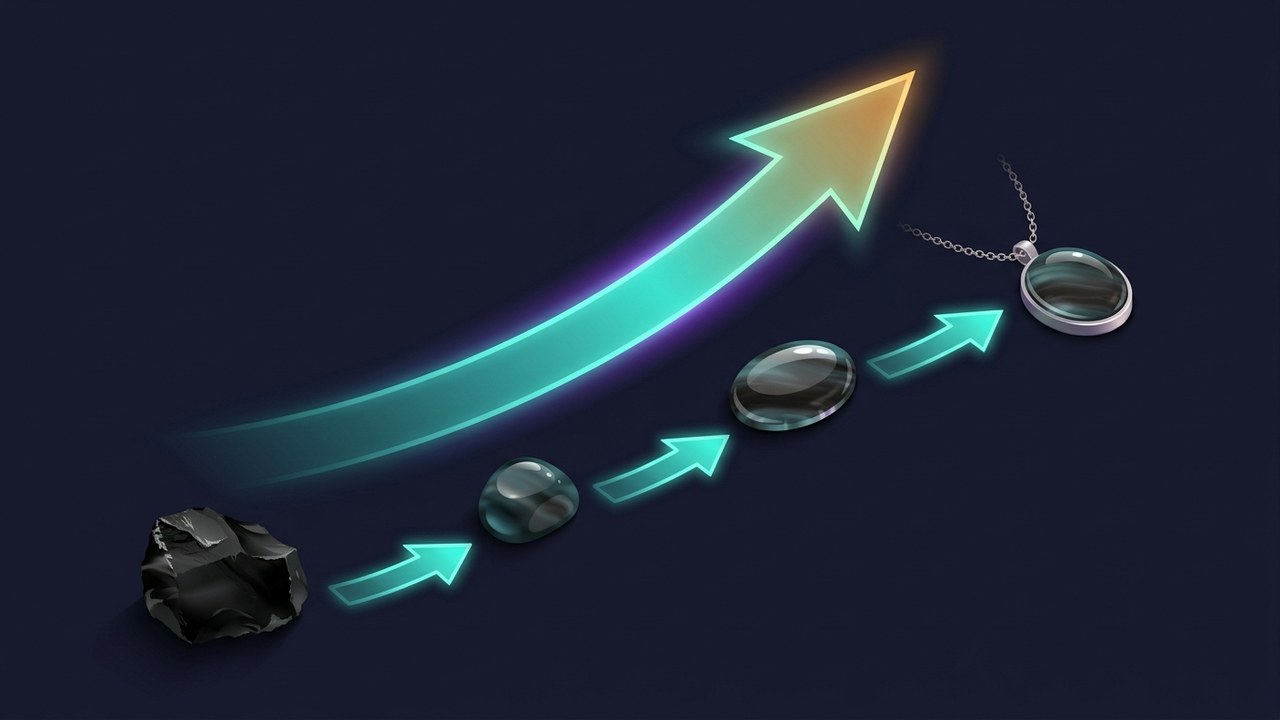
Most of the retail price is labor, not rock. Tumbling a rough stone adds maybe 200% to 300% over the raw cost. Cutting and finishing a jewelry cabochon can add 300% to 500%. The glass stays cheap. You're paying for the hours and, if it's a rare variety, the color.
Uses of Obsidian: Jewelry, Tools and Decor
People have knapped obsidian into tools for thousands of years. Blades, arrowheads, scrapers, made because a fresh fracture beats surgical steel for a cutting edge. The Aztecs polished flat slabs of it into mirrors.
Today the stone feeds a handful of markets:
- Obsidian jewelry: pendants, beads, bracelets, earrings and cabochons, mostly cut from black, snowflake or sheen material
- Carvings and decor: spheres, skulls, animal figures, bookends
- Specialty blades: a handful of surgeons still reach for obsidian scalpel edges on delicate work
- Metaphysical and spiritual practices: black and snowflake obsidian move in volume as grounding stones, and that keeps a steady floor of low-cost demand
Most of it sits between $5 and $60. Fire obsidian jewelry and the big master carvings are the exceptions that climb into the hundreds.
Buying and Selling Obsidian With Cryptocurrency
Plenty of independent rock shops, lapidary artists and crystal sellers now run online stores, and a growing number let customers pay in crypto at checkout. It suits cross-border buyers who want to skip currency conversion and card friction on a small specialty purchase.
For the shop owner, a payment gateway such as Plisio handles the technical side. It accepts Bitcoin, Ethereum, USDT and other coins, then settles the sale so the merchant is not left holding a volatile balance. For a niche seller shipping stones worldwide, that keeps checkout simple without adding financial risk.
Bottom Line on Obsidian's Value
Obsidian is cheap to start with and can get expensive fast. As plain black rock it's one of the most affordable gemstone materials going, a few dollars a pound. The real obsidian value lives in the rare varieties and the workmanship: fire obsidian, good rainbow and sheen pieces, careful carving and cutting. Work out the type, look hard at the cut, and you'll have a fair idea what a piece is worth.