UXLINK Price, Token, and the 2025 Hack Explained

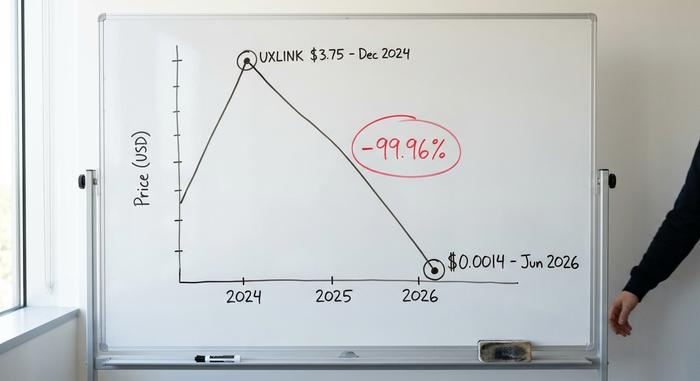
UXLINK spent two years selling one of the more believable pitches in crypto: that the fastest way to get normal people on-chain is through the contacts they already have. Then, over a single weekend in September 2025, an attacker reached into the project's own admin wallet and minted fresh tokens out of thin air. The pitch was about mass adoption. The chart now reads like a warning label. A token that touched $3.75 trades for less than a fifth of a cent today.
That gap, between the story and the price, is the whole reason UXLINK is worth a closer look. So here is the full picture: what the platform actually does, how the token and its tokenomics work, where the UXLINK price sits now, and the hack that nearly killed it. Then the question hiding under all of it. Is any of this worth your attention in 2026?
What is UXLINK? Inside this Web3 social platform
UXLINK is a Web3 social platform that tries to turn ordinary social relationships into on-chain social infrastructure. Most crypto apps ask you to start from zero: new wallet, new username, no friends. UXLINK's bet is the opposite. It pulls in the people you already talk to on Telegram, X, and similar networks, and treats that web of connections as the on-ramp. The team calls it a "group-based" or two-way social model, as opposed to the one-way broadcast feeds of traditional social platforms.
It launched around April 2023 on Arbitrum and spread fast inside Telegram, where mini-apps and referral campaigns do most of the growth work. UXLINK claims more than 54 million registered users and 500-plus ecosystem partners. Take a breath before you trust those numbers. They are self-reported, sign-ups cost nothing, and airdrop farmers inflate user counts across the entire industry. Even so, a fraction of 54 million would still make this one of the bigger social-infrastructure experiments in crypto. The money is easier to verify than the users: backers include OKX Ventures, HongShan, SevenX Ventures, and HashKey Capital, with more than $15 million raised across two rounds in 2024, as reported by Decrypt.
It helps to place UXLINK against its peers. Where Lens Protocol and Farcaster set out to rebuild the social feed itself, and the now-faded Friend.tech monetized access to creators, UXLINK aims at the layer underneath all of them: the graph of who knows whom. That focus on relationships rather than content is the clearest thing separating it from other Web3 social platforms, and it explains why so much of the product lives inside messaging apps instead of a standalone feed. Whether that is a smarter wedge or just a harder one to monetize is still an open question.
From your contacts to an on-chain social graph
At the core is UXLINK's social graph, and it lives partly on-chain. You sign in with an account you already have, join or spin up groups, and your relationships become data you own instead of data a platform rents back to you. Layered on top are the usual SocialFi mechanics: link-to-earn rewards, group quests, Soulbound Tokens that mark reputation. The pitch is simple. A verified web of real contacts is harder to fake than a wall of anonymous wallets, which makes it more useful for everything from airdrop targeting to group payments.
Account abstraction and the dual-token setup
To hide the hard parts, UXLINK leans on account abstraction. Its MPC-AA wallet lets you create and control an on-chain account with a social login, so there is no seed phrase to write down before you can do anything. That is the whole trick: make a crypto wallet feel like signing into an app. The economy then runs on two separate tokens, which is exactly where most newcomers get lost, so it is worth its own section.

How the UXLINK token and UXUY rewards work
Two tokens. This trips up almost everyone, so let me be blunt about which is which. UXLINK is the one that matters to traders. It has a market price, a fixed supply, and a slot in your exchange account, and it carries the governance votes and the gas fees. After the 2025 migration it lives as an ERC-20 token on Ethereum, having started life on Arbitrum to decentralize and scale cheaply.
UXUY is the other one, and it is not really an investment. You earn it by doing things in the app: quests, referrals, daily activity. Then you spend it inside the ecosystem. It is meant to be plentiful. Projects split their economies like this on purpose, to keep everyday rewards from diluting the asset people actually buy and sell. The downside? It splits attention, and beginners conflate the two constantly. So here is the simple version. When a headline quotes "the UXLINK price," it means the governance token. Never UXUY. If you are placing a bet, you are betting on UXLINK; UXUY is just the loyalty points you pick up on the way.
UXLINK tokenomics and token allocation
The supply is capped at 1 billion tokens, and on paper the allocation looks community-friendly. Most of it is earmarked for users and ecosystem builders; investors, the team, and liquidity split what is left. Sounds great. But "allocated to the community" is not the same as "in circulation," and the line item that actually moves the price is the unlock schedule. Tokens drip into the market for years. Each unlock is fresh sell pressure on a coin that is already on the floor.
| Allocation | Share of 1B max supply |
|---|---|
| Community (users + builders/partners) | ~65% |
| Private sale / strategic partners | ~21.25% |
| Team | ~8.75% |
| Liquidity / management | ~5% |
One honest caveat. These percentages vary between sources, and some exchange pages still show pre-migration splits. The token generation event ran on July 18, 2024, with simultaneous listings on eight centralized exchanges. Treat the numbers above as a guide, not gospel, and check the live circulating total yourself before you assume anything about scarcity.
UXLINK price today and price history
Here the review writes itself, because the number is the review. As of June 2026, UXLINK trades around $0.0014, with a market cap near $1.22 million and a circulating supply of about 856.98 million out of the 1 billion maximum, according to CoinGecko. Daily trading volume sits around $139,000, which is thin enough that a single motivated seller can move the price. This is, by any honest measure, a micro-cap.
| Metric | Value (as of June 2026) |
|---|---|
| Price | ~$0.0014 |
| All-time high | ~$3.75 (Dec 25, 2024) |
| Change from ATH | about -99.96% |
| Market cap | ~$1.22M |
| Circulating supply | 856.98M / 1B max |
| 24h trading volume | ~$139K |
From the December 2024 high to a sub-cent token
The story behind that table is a near-total round trip. UXLINK listed in July 2024, ran with the broader market into the winter, and printed its all-time high around $3.75 on December 25, 2024. From there it was all downhill, first with the market, then on its own. The September 2025 hack turned a bad year into a collapse. A token that once carried a billion-dollar fully diluted valuation now clears barely seven figures in market cap.
What actually moves the UXLINK price now
Three things drive UXLINK today, and none of them is product news. The first is liquidity, or the lack of it; with so little daily volume, the price swings on small orders. The second is supply: scheduled unlocks and the doubled token count from the hack hang over every rally. The third is sentiment toward the project's survival. Until trust rebuilds, the UXLINK price will behave less like a growth asset and more like a distressed lottery ticket.
The 2025 UXLINK hack and Ethereum migration
Most write-ups mention that UXLINK "migrated to Ethereum" and leave it there, as if it were a routine upgrade. It was not. The migration happened because the project was robbed, and understanding why is the single most important part of any UXLINK review.
How the multisig was drained
It happened over the weekend of September 22–23, 2025. An attacker took control of UXLINK's administrative multisig, a Gnosis Safe smart contract, through a delegatecall manipulation that unlocked privileged functions. The direct theft was bad enough: security firm Cyvers pegged it at roughly $11.3 million, with broader on-chain estimates running closer to $28 million once dumped tokens are counted. But the structural damage was worse. The attacker had minting rights, and used them to print around 1 billion new UXLINK tokens, doubling the supply in a single afternoon. (Audit firm Hacken cited an even larger figure tied to a separate contract; the exact totals are still disputed.) The market did not wait for clarity. The token shed more than 70% of its value that day.
There is a strange coda to the theft. Within days, the attacker reportedly lost 542 million of the stolen tokens, worth tens of millions of dollars at the time, to an Inferno Drainer phishing kit. A thief, phished. It changed nothing for victims, but it is a fitting illustration of how dangerous on-chain life is even for the people doing the stealing.
The token swap and user compensation
So that "migration to Ethereum" everyone mentions in passing? This is it. The team froze what it could, spun up a fresh ERC-20 contract on Ethereum, and ran a 1:1 token swap, so legitimate holders kept their balances while the attacker's minted tokens were left stranded. A community governance vote in early October 2025 backed the plan almost unanimously, and a buyback and compensation effort followed weeks later. The recovery was real. It kept the project alive. It did not, and could not, bring the price back.
The UXLINK ecosystem, community, and dapps
Strip away the marketing and there is a real ecosystem here. How deep it runs is the harder question. UXLINK lists hundreds of integrations and partners across multiple chains, and its foothold inside Telegram and the wider TON world is a genuine edge that most Web3 social platforms simply do not have. The roadmap adds more: a social-native rollup called UXLINK ONE, and a payments app, FujiPay, pitched as the WeChat Pay of Web3.
Here is the catch. A long partner list and a giant user count tell you a team is good at deals and distribution. They tell you nothing about how many people open the dapps on a Tuesday, or how much money actually flows through them. Active users beat registered users every time. And that number? It is the one UXLINK, like most SocialFi projects, never seems to lead with.
How to buy and use UXLINK crypto safely
If you still want exposure after all that, you can buy UXLINK on major centralized exchanges. Like most cryptocurrencies, it trades on venues including OKX, Bybit, Gate.io, Bitget, and KuCoin, priced in USD and major stablecoins. Two cautions matter more than usual here. First, the migration means you must confirm you are dealing with the current Ethereum ERC-20 contract; old Arbitrum-era addresses and any tokens linked to the hack are worthless. Second, the thin trading volume means real slippage on anything but small orders, so size your position for a volatile micro-cap and use limit orders rather than market buys.
Is UXLINK a good crypto investment now?
Here is my honest take. UXLINK is one of the more frustrating cases in crypto because the underlying idea is sound and the execution failure was severe. The product is real, the user base and VC backing are real, and social-graph infrastructure is a credible bet on mass adoption. Against that sit a catastrophic security failure, a chart down 99.96% from its high, a doubled supply, and liquidity so thin the price is barely a market at all.
That makes UXLINK a speculative turnaround story — nothing more. The bull case is that its Telegram-native distribution survives, trust slowly rebuilds, and a future cycle rewards the project for shipping. The bear case is simpler: a hacked micro-cap with a broken chart and an overhang of unlocked supply rarely comes back, and most don't. If you buy, treat it as a high-risk bet with money you can afford to lose entirely, not as a core holding. The story is interesting. The risk is real.