Pyth Network: How the Real-Time Price Feed Oracle Works
Some of the biggest trading firms on Wall Street, names like Jane Street, Cboe, and Virtu, quietly publish their price data onto more than a hundred blockchains hundreds of times a second. The pipe that carries it is the Pyth Network. Most people outside of trading have never heard of it, yet it feeds the prices that decide whether a loan gets liquidated or a perpetual trade pays out across much of decentralized finance.
This guide explains what Pyth Network is, how its pull oracle actually works, what it is used for, how it compares to Chainlink, what the PYTH token does, and the risks worth knowing, including a real shift the project is going through in 2026. No finance degree required.
What is Pyth Network? A first-party oracle
A blockchain is sealed off from the outside world by design. A smart contract cannot simply look up the price of Bitcoin, because it has no way to reach a website or an exchange. An oracle is the bridge that carries outside data, like prices, onto the chain so contracts can use it.
Pyth Network is an oracle, but with a specific twist that defines everything about it. It is a first-party oracle. Instead of paying anonymous node operators to fetch prices from public APIs and relay them, Pyth gets the data straight from the firms that create it: exchanges, trading houses, and market makers publishing their own numbers directly. Fewer hands touch the data, so there is less to break and less to fake.
Why does that matter? Picture the older approach. A network of independent node operators each call some exchange's public API, then report back what they saw. Every one of those hops is a place where data can lag, get rate-limited, or be quietly gamed. Pyth removes the relay entirely — the firm that already knows the price, because it is the one making the market, signs and submits it directly. The number has one author instead of a line of messengers passing it along.
It launched in 2021 on Solana, incubated by the trading firm Jump, and has grown into one of the largest providers of on-chain market data.
| Pyth Network by the numbers | Figure |
|---|---|
| Price feeds | 3,059+ |
| First-party data publishers | 138+ |
| Blockchains supported | 114 |
| dApps integrated | 711 |
| Cumulative traded volume powered | ~$2.3 trillion |
How Pyth works: the pull oracle model
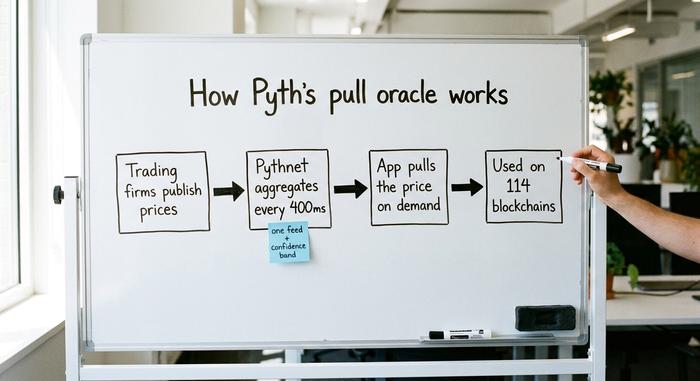
The mechanics sound complicated and are not. Three steps: data goes in, the network combines it, apps pull it out.
First-party data publishers
More than 138 institutions submit prices to Pyth, according to its own network data. Each publisher sends not just a price but a confidence interval, a small range saying how sure it is. Because dozens of firms publish the same feed, no single source can yank the price around. If one publisher's number drifts far from the rest, the aggregation simply weights it down. That confidence interval is not decoration. When a fast-moving asset has publishers disagreeing, the band widens, and an app reading the feed can see for itself that now is a risky moment to act.
Pythnet and price aggregation
The submitted prices land on Pythnet, a dedicated Solana-based appchain built just for this job. Roughly every 400 milliseconds, Pythnet blends all the publishers' inputs for a given asset into one aggregate price plus a single confidence band. That band is genuinely useful information. A tight band means the market agrees; a wide one means prices are volatile or thin, and a careful protocol can choose to pause rather than act on a shaky number.
Pull vs push: prices on demand
Here is the part that makes Pyth different. Older oracles "push" updates, writing fresh prices on-chain on a fixed schedule whether anyone needs them or not, which is slow and expensive. Pyth flips it. The latest price sits ready off-chain, and an app "pulls" it onto its blockchain only at the exact moment it needs it, paying a tiny fee for that single update. It is the difference between a newspaper delivered on a timer and a live quote you request the instant you trade. Wormhole, a cross-chain messaging system, carries those updates to all 114 supported chains, and a newer service called Lazer pushes latency toward a single millisecond for the fastest trading apps.
A quick example shows the savings. A lending protocol that only checks a price when someone borrows or gets liquidated does not need a fresh on-chain update every few seconds around the clock. With a pull oracle it pays for exactly the updates it consumes and nothing more, which is why dozens of small apps can afford feeds that would have been far too costly under the old always-on push model.
What the Pyth Network oracle is used for
Speed is the selling point, so Pyth gravitates to the fastest-moving corners of crypto. Perpetual futures exchanges and derivatives platforms lean on it heavily, because a stale price on a leveraged trade is how people get liquidated unfairly. Lending markets use it to value collateral, and decentralized exchanges use it to price swaps. And it is not only crypto prices. Pyth feeds span equities, FX pairs, commodities, and even ETFs, the same financial-market data classes that traditional finance runs on, which is what lets a single smart contract reference a stock and a stablecoin in the same real-time market data call.
The footprint is large. Pyth powers around 711 applications and has underpinned roughly $2.3 trillion in cumulative trading volume, by its own reporting. Total value secured sat near $6.14 billion at the end of the third quarter of 2025, per Messari's State of Pyth report. The reach now extends past crypto, too. In August 2025 the US Department of Commerce selected Pyth to publish official economic data, including GDP figures, directly on-chain.
The pattern is consistent: wherever a wrong or slow price costs real money, Pyth tends to show up. A derivatives exchange settling trades every second simply cannot run on a feed that refreshes once a minute, and that mismatch is most of the reason Pyth grew up inside the perpetuals market rather than the slower lending corner of DeFi.
Pyth Network vs Chainlink: pull vs push
You cannot discuss oracles without Chainlink, the incumbent that defined the category. The honest summary is that Chainlink is bigger and broader, while Pyth is faster and owns derivatives.
By total value secured, Chainlink held roughly 75% of the oracle market against Pyth's 7% in the third quarter of 2025, according to the same Messari data. But market share is not the whole story. Pyth supports more blockchains, updates faster, and has become the default oracle for perpetuals precisely because its pull model suits high-frequency trading. Chainlink wins on maturity, the sheer amount of value it secures, and a wider menu of services beyond price feeds.
The deeper difference is philosophical. Chainlink trusts a decentralized crowd of node operators to go and fetch data; Pyth trusts the original sources to publish it themselves. Neither is automatically safer. A first-party model is only as honest as the firms behind it, while a node-operator model adds independence at the cost of an extra layer between you and the truth. Pick your trust assumption and the rest follows.
| Pyth | Chainlink | |
|---|---|---|
| Oracle model | Pull (on demand) | Push (scheduled) |
| Data source | First-party firms | Node operators |
| Update speed | ~400ms, sub-ms via Lazer | Slower, periodic |
| Blockchains | 114 | 30+ |
| Oracle TVS share (Q3 2025) | ~7% | ~75% |
| Best at | Perps, derivatives, breadth | Total value secured, maturity |
The PYTH token, tokenomics and supply
PYTH is the network's governance token. Holders can vote on parameters like which feeds exist and how fees work through the Pyth DAO. It is not a fee you pay to read a price; it is the steering wheel for the protocol.
Supply, unlocks and market cap
PYTH has a fixed maximum supply of 10 billion tokens. About 7.87 billion are in circulation, for a market capitalization near $311 million as of mid-2026, per CoinGecko. Supply is the number to watch. A large unlock of roughly 2.13 billion PYTH, equal to about 37% of the circulating supply, landed in May 2026, tracked by Tokenomist. Unlocks of that size can weigh heavily on price, regardless of how the technology is doing. For a newcomer the takeaway is simple: a meaningful slice of the maximum supply is still locked and scheduled to enter circulation over the coming years, so even steady demand has to soak up a steady stream of new tokens before the price can climb.
| PYTH tokenomics | Figure |
|---|---|
| Max supply | 10 billion |
| Circulating supply | ~7.87 billion |
| Market cap (mid-2026) | ~$311 million |
| All-time high | $1.20 (Mar 2024) |
| Token type | Governance |
Staking, OIS and the revenue model
Pyth ran a program called Oracle Integrity Staking, where holders staked PYTH behind specific publishers to back the accuracy of feeds and earn rewards, with penalties if a feed went wrong. Worth knowing in 2026: those staking rewards ended in April 2026. The project is pivoting toward selling its data to institutions through a paid tier called Pyth Pro, and routing that revenue back to the token through a reserve-and-buyback model rather than simple staking emissions. If you read an older guide promising a staking yield, it is out of date.
The logic behind the switch is worth understanding. Instead of printing new rewards to pay stakers, which adds selling pressure, Pyth wants paying institutional customers to fund the network, then to use part of that revenue to buy PYTH off the open market. In theory that ties the token's value to real adoption rather than to emissions. In practice it only works if enough institutions actually pay for the data, which is the open question hanging over the entire plan.

Risks and the 2026 Pyth Network transition
No oracle is risk-free, and Pyth carries a few worth naming plainly. The core one is data risk: if a feed is wrong, contracts act on bad numbers and people can be liquidated, which is exactly why the confidence interval and multi-publisher design exist. Token holders face dilution from the large unlock schedule. And competition from Chainlink is not going anywhere.
The biggest open question is the transition itself. Pyth is rebuilding its economics in real time, sunsetting old infrastructure, ending staking rewards, and betting on institutional subscription revenue that is still mostly a projection rather than a proven, audited number. That bet might pay off handsomely or it might underdeliver. None of this is financial advice; it is the context you would want before forming a view.
It also helps to remember how young all of this is. Pyth has existed for only a handful of years, the oracle category itself is barely older, and the rules for how these networks earn money are still being written. That is not a reason to dismiss it, because early infrastructure often turns out to matter most, but it is a reason to size any exposure with clear eyes.
Where Pyth Network goes from here
Pyth Network solved a real problem: getting fast, trustworthy prices onto blockchains straight from the firms that make markets, and it won the derivatives corner of DeFi doing it. The next chapter is harder. It has to turn institutional demand for its data into durable value for the token, not just headline integrations. The honest thing to watch is not the price chart but the revenue. If real subscription income shows up before the next wave of unlocks, the model works. If it does not, what is the token actually worth?