Lionel Messi Net Worth in 2026: A Billionaire Now
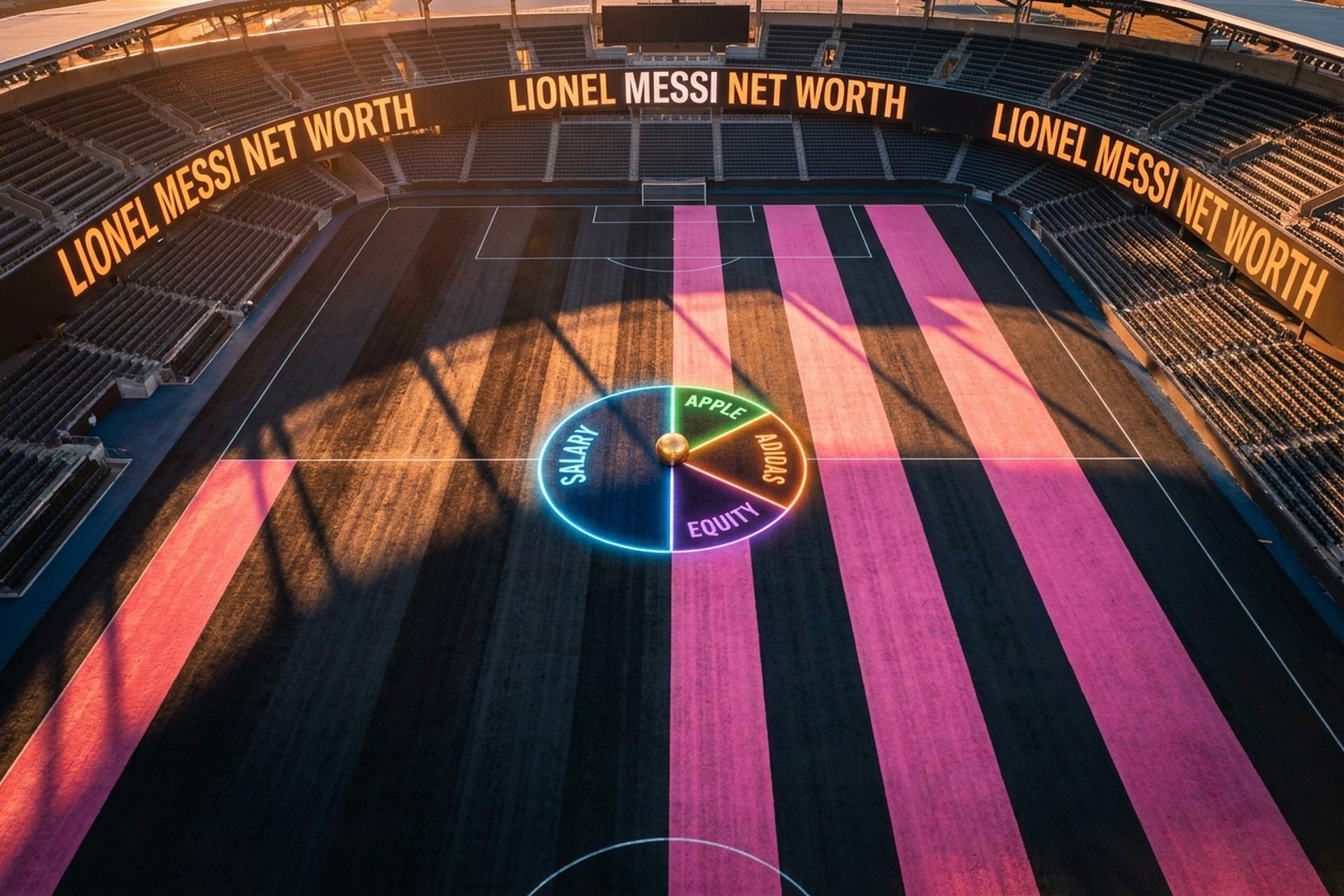
Lionel Messi is, officially, a billionaire. Forbes made it official in June 2026, adding him to its billionaires list at roughly $1.1 billion. Yet search his name that same week and half the celebrity sites still say $600 million. Both numbers are defensible. That gap is the whole story.
So what is the real Lionel Messi net worth in 2026? It depends on what you count, and on which clock you read. The headline says billionaire. The aggregators lag behind. And the deal that tipped him over the line is the most interesting part, because it is barely a salary at all. When Messi moved to Miami, he stopped just collecting wages and started taking a cut of the league he was about to grow.
What Lionel Messi's net worth is in 2026
Forbes is the number that matters here, and in June 2026 it crossed a line. Hank Tucker's piece, "How Lionel Messi Became A Billionaire," pegged his fortune at about $1.1 billion. Celebrity Net Worth still lists him near $600 million. Other trackers land in between, around $850 million to $1 billion. Nobody is exactly wrong.
Think of it as two different questions. "What has Messi earned, and what is he attached to?" is the Forbes question, and the answer is a billion-plus. "What could he liquidate tomorrow?" is the aggregator question, and that answer is naturally lower and slower to move. Neither is lying. They are measuring different things and calling both "net worth."
Why the estimates run from $600M to $1.1B
The spread comes from method, not mystery. Forbes adds up career earnings plus the live value of his assets and active deals, then prints a billionaire headline. Aggregators do something narrower. They estimate money in the bank, and they update it slowly, so they trail the news by months. There are no audited filings to settle it. What nobody disputes is the trajectory. Across his career, Messi has banked somewhere between $1.28 billion and $1.6 billion in gross earnings. In 2026 alone, Forbes clocked his income at $140 million. The split is almost even: $70 million on the field, $70 million off it. Third among all athletes that year.
The numbers we can actually check
| Metric | Figure | Source |
|---|---|---|
| Net worth (Forbes) | ~$1.1B | Forbes, Jun 2026 |
| Net worth (aggregators) | ~$600M | Celebrity Net Worth |
| 2026 annual earnings | $140M ($70M on / $70M off) | Forbes |
| Career gross earnings | $1.28B–$1.6B | Forbes / industry estimates |
The table is the honest version of the answer. Pick the billionaire figure if you trust Forbes' method, the $600 million if you want only liquid wealth. The truth lives in the band between them.
And the band keeps drifting upward. Every season Messi plays, every subscriber Apple adds, every shirt Adidas sells nudges the Forbes figure higher and drags the aggregators slowly after it. A net worth this size is not a fixed fact. It is a moving estimate of a fortune that has not finished growing.
Inside the Inter Miami equity deal
Here is the move that changed the math. Most football transfers are about a salary. Messi's 2023 jump to Inter Miami was about ownership — and it is the single deal that explains why his net worth crossed the billion-dollar line.
Salary, plus a slice of Apple and Adidas
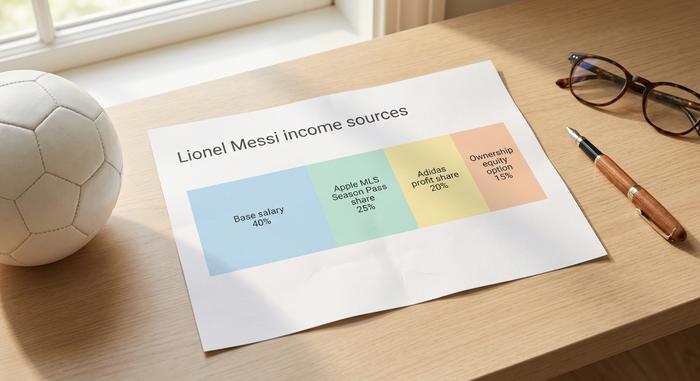
On paper, the deal looked big but not record-breaking. Sportico reported a base of $50 to $60 million a year, climbing toward $150 million in total once signing bonuses and equity were folded in. His disclosed MLS guaranteed compensation later hit $28.3 million for the 2025-26 season, the highest in the league. But the salary was never the point. The deal stapled Messi to the businesses around the league. He takes a cut of new subscribers to Apple's MLS Season Pass, the streaming bundle Apple sells worldwide. The MLS commissioner confirmed as much in public. He also takes a profit share from Adidas on the jersey and apparel sales his arrival lifts, a setup people likened to the old Nike-Jordan model. More subscribers, more shirts, more money for Messi. He is not an employee. He is a partner in the upside.
This is the part that makes the deal historic rather than merely expensive. For a century, athletes sold their labor by the season while the club kept the franchise value. Messi flipped that. By tying his pay to Apple subscriptions and Adidas sales, he turned himself into a shareholder in the league's growth, not just its highest-paid worker. And the growth was real. MLS Season Pass signups jumped after he arrived, and Inter Miami went from an afterthought to one of the most valuable clubs in the league. He did not just join MLS. He repriced it, then wrote himself a slice of the new number.
The ownership option, and the Beckham myth
There is one more piece, and most write-ups get it wrong. Messi's contract reportedly includes an option to convert into an ownership stake in Inter Miami itself after he retires. That is not the same as the David Beckham deal from 2007, which gave Beckham the right to buy a brand-new expansion franchise at a fixed price. Messi's option is in the club he already plays for. The distinction matters, because owning a slice of a team you made famous is a very different bet than buying a discount expansion slot. In October 2025 he signed an extension through 2028, keeping the whole arrangement alive for years more.
It is a template now. Other leagues and franchises have started dangling equity at marquee names, because Messi proved a star will trade guaranteed cash for a share of what he helps build. The richest athletes of the next generation may negotiate like founders, not employees.
From Barcelona to PSG: the contract years
Messi's story did not start with mega-deals. Born in Rosario, Argentina, in 1987, he was diagnosed with a growth hormone deficiency as a boy, and his family could not afford the treatment. Barcelona could. The club signed a 13-year-old, paid for his medical care, and famously sealed the first agreement on a paper napkin. That bet built both of them.
Before the equity era came the wage era, and the wages were staggering. In 2021 the Spanish paper El Mundo leaked his final Barcelona contract. The number: a maximum of about 555 million euros, roughly $674 million, over four years. Reportedly the richest contract in sports history at the time. When he left for Paris Saint-Germain that summer, the money stayed enormous, a reported $30 to $40 million a year plus bonuses, with part of his signing paid in club fan tokens.
Those years built the base. Eight Ballon d'Or awards, a 2022 World Cup that finally completed his résumé, and a global fame that turned every contract negotiation into a formality. By the time he reached Miami, the wages almost mattered less than what they had already made him: a global icon whose net worth was already in the hundreds of millions before the equity era began. Two decades of trophies had done the hard part. The brand was built, and all that was left was to decide who got to monetize it. Increasingly, that person was Messi himself.
Messi or Ronaldo: who is richer?
The eternal question now has a cleaner answer than ever, because in 2026 both men are billionaires for the first time at once. Cristiano Ronaldo got there first, declared a billionaire by Forbes back in 2020. He is still ahead.
| Player | Net worth | 2026 annual | Club |
|---|---|---|---|
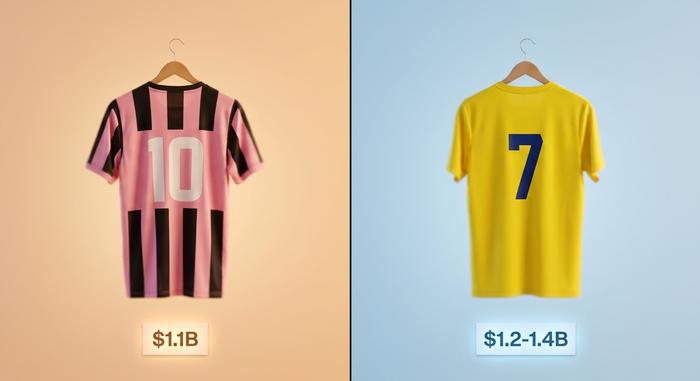
| Cristiano Ronaldo | ~$1.2B–$1.4B | ~$300M | Al-Nassr |
| Lionel Messi | ~$1.1B | ~$140M | Inter Miami |
The gap, roughly $250 to $300 million, is almost entirely one paycheck. Ronaldo's move to Al-Nassr in the Saudi Pro League reportedly pays north of $200 million a year, the largest salary in the history of team sports. Messi chose a smaller wage in Miami for a bigger stake in the business. Whether that was the richer choice will not be clear until the equity pays out. I would not call a winner yet. Ask again in ten years.
There is a personality split buried in those numbers, too. Ronaldo chased the biggest possible paycheck into a new market. Messi took less cash to plant roots in one and own a piece of it. Both are billionaires now. Only one of them holds a stake that could keep compounding long after he stops playing.
Endorsements, Adidas, and the business empire
Roughly half of Messi's income now comes from off the pitch, and that half does not retire when he does. Adidas has backed him since 2006, with a widely cited lifetime boot deal worth around $25 million a year, though the company has never officially confirmed the terms. Around it sit Pepsi, Mastercard, Apple, Budweiser, Hard Rock, and Lays, adding up to roughly $65 million a year in endorsement income.
Then there are the things he owns outright. A boutique hotel chain, MiM Hotels. Real estate across Barcelona, Miami, and Ibiza. The Messi Store apparel line. Underneath all of it sits the real asset: an audience of more than 595 million social media followers, including some 480 million on Instagram alone. Brands are not paying for a soccer player. They are renting the largest personal audience in sports.
The 2022 World Cup poured fuel on all of it. Winning the one trophy that had escaped him turned a beloved player into a global icon, and the brands paid accordingly. Apple even built a documentary series around him. The lesson for any modern star is plain: the trophy is the marketing, and the marketing is most of the money. A title Messi chased for a decade also happened to be the single best business deal of his career. It is why his off-field income has held steady even as his on-field wage settled into MLS numbers: the icon is now worth more than the player.
Lionel Messi's crypto and fan-token deals
A corner of the empire runs through crypto, which is worth knowing if you follow the space. In March 2022, Reuters reported Messi signed a global ambassador deal with Socios.com worth more than $20 million over three years, promoting fan tokens built on the Chiliz blockchain. That October he added a partnership with the crypto exchange Bitget, and he has also lent his name to an Ethernity NFT collection. These were promotional and ambassador arrangements, not disclosures of personal investment, and they arrived during the last crypto boom. Still, they show how a modern superstar's brand now reaches into digital assets the same way it reaches into soft drinks and sneakers.
It was not all smooth. The fan-token and exchange boom Messi rode in 2022 cooled sharply afterward, and several athlete crypto deals from that period aged badly. His were promotional, time-boxed, and paid upfront, which is the safer side of that trade. The episode is a small but telling window into how fast a superstar's name can be bolted onto a new asset class, for better or worse.
What the Lionel Messi net worth number means
So treat the billion-dollar headline as a milestone, not the real news. The real news is the shift underneath it. For twenty years Messi was paid wages, the richest in the game, but still wages. In Miami he started trading some of that guaranteed money for a piece of what he builds: a share of Apple, a share of Adidas, an option on a club. The next chapter of the Lionel Messi net worth story will not be written on a contract. It will be written on a cap table. The question is no longer how much he earns. It is how much he ends up owning. Where do you think that lands him by 2030?