DexTools: the DeFi trading dashboard that every DEX trader needs to know
A token launches on Uniswap at 8 AM. By 8:05 the liquidity pool has $200,000. By 8:15 it has $2 million. By 8:30 the developer wallet dumps everything and the chart goes vertical, straight down. If you were watching the pool on DexTools, you saw the warning signs before the rug pull happened. If you were not, you found out on Twitter 20 minutes after you lost your money.
That scenario plays out dozens of times a day across Ethereum, BSC, Solana, Base, and every other chain where DEX trading happens. The raw DEX trading experience gives you nothing: no charts, no holder data, no audit scores, no whale tracking. Just a swap button and a prayer. DexTools fills that information gap. It is the most used DeFi analytics platform in crypto, and for good reason.
This article walks through what DexTools is, how each feature works, how to use it to avoid scams and find real opportunities, what the DEXT token does, and how the platform compares to competitors like DEXScreener and Birdeye.
What DexTools is and why DEX traders use it
DexTools is a real-time analytics and charting platform for decentralized exchange trading. It pulls data from every major DEX across multiple blockchains and presents it in a format that actual traders can use: live price charts, liquidity pool data, token audits, holder distributions, whale transaction tracking, and price alerts.
The platform launched in 2020 during the early DeFi boom when Uniswap and SushiSwap were exploding with new token launches. Back then, trading on a DEX meant you had zero information about what you were buying. No chart. No volume data. No way to know if the developer could drain the liquidity pool. DexTools built the analytical layer that DeFi was missing.
Today DexTools tracks tokens across more than 80 blockchains including Ethereum, BNB Chain, Polygon, Arbitrum, Solana, Base, Avalanche, and dozens more. Dextools is the world's leading DeFi analytics platform by user traffic, processing millions of page views daily from traders trying to make sense of the chaotic decentralized market.
The platform offers both free and premium tiers. Free users get basic charts, pool explorer, pair explorer, ten favorite pairs, price alerts, and the top 10 hot pairs list. Premium users unlock Big Swap Explorer, Multi Swap windows, unlimited favorites, Trade Analytics, Wallet Tracker, an ad-free experience, limit orders, and a trading bot. Premium access comes either through holding the native DEXT token or paying a monthly subscription fee.
The core DexTools features every trader should know
Let me walk through the tools that matter most, because DexTools has a lot of features and the interface can be overwhelming for beginners.
Pair Explorer. This is the heart of the platform. Search for any token, and DexTools shows you every trading pair it has on every supported DEX. You get live price charts with customizable timeframes, volume data, liquidity depth, and the list of recent transactions. The chart is a real TradingView integration, so you get proper candlesticks, indicators, and drawing tools. Not a simplified crypto-only chart, the actual trading interface that stock traders use.
Pool Explorer. When a new token launches, it creates a liquidity pool on a DEX. The Pool Explorer shows every new pool across supported chains in real time. This is where sniper traders watch for new launches. The feed moves fast. During busy periods, a new pool appears every few seconds. Each entry shows the token pair, the chain, the initial liquidity, and how long ago it was created.
DextScore. DexTools runs an automated audit on tokens and assigns a score from 0 to 99. The score considers: is the contract verified? Is the liquidity locked? Can the developer mint more tokens? Is there a sell tax? Are the top holders too concentrated? A DextScore of 80+ generally means the token has passed basic safety checks. Below 30, you should be extremely cautious. This is not a guarantee. Scammers get creative. But it catches the obvious rug pulls that take money from people who did not check.
Big Swap Explorer. Whale watching. This tool shows large transactions on any token, filterable by size. If a wallet that holds $500,000 worth of a token starts selling in chunks, you want to know about that before the rest of the market reacts. Premium feature, worth the cost for active traders.
Hot Pairs and Trending. The Hot Pairs list ranks tokens by a combination of volume, price action, social activity, and transaction count. It is the pulse of the DeFi market at any given moment. When a token suddenly appears in the top 10 Hot Pairs, something is happening: a whale bought in, a news event dropped, or a coordinated pump is underway. Reading the Hot Pairs list with context separates informed traders from gambling.
Multiswap. Trade up to ten tokens at once from within the DexTools interface. It aggregates prices across DEXs to find the best rate. You do not need to leave the analytics dashboard to execute trades. The swap routes through the cheapest path automatically.
Price Alerts. Set alerts for specific prices on any tracked token. Notifications go to desktop or Telegram. If you are watching 30 tokens but can only stare at charts for 4 hours a day, alerts cover the other 20 hours.
Trading Bot. Automated trading through Telegram with DexTools data feeding the decisions. Set buy/sell triggers based on price, volume, or wallet activity. Premium only.
How to use DexTools to spot scams and avoid rug pulls
The DeFi market has a scam problem. In 2025, rug pulls and token scams still drained hundreds of millions from retail traders. DexTools will not make you immune, but it gives you the data to make smarter decisions.
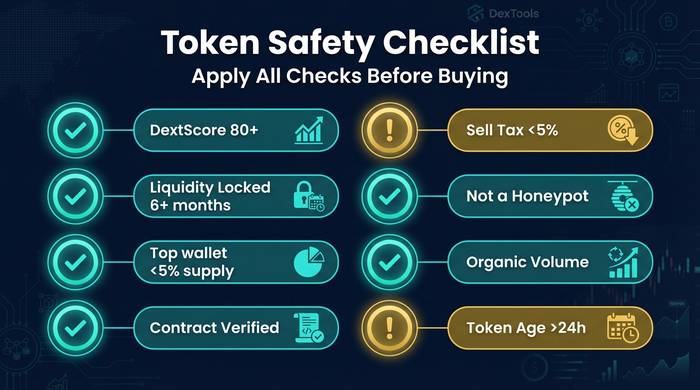
Here is a practical checklist for evaluating any new token on DexTools:
| Check | What to look for | Red flag |
|---|---|---|
| DextScore | Score above 60 (ideally 80+) | Below 30, no verified contract |
| Liquidity locked | Lock period of 6+ months | Unlocked liquidity or lock expiring soon |
| Holder distribution | Top wallet holds <5% (excluding contract) | One wallet holds 20%+ of supply |
| Contract verified | Source code published on block explorer | Unverified contract |
| Sell tax | 0-5% is normal | 10%+ sell tax or changing tax rates |
| Honeypot check | Selling is possible | Cannot sell after buying |
| Volume vs liquidity | Healthy ratio, organic trades | Wash trading (same wallets buying and selling) |
| Age of token | Older tokens have track record | Launched minutes ago with hype but no product |
None of these checks guarantees safety. A scammer can lock liquidity, get a high DextScore, and still coordinate a dump once enough retail money flows in. But a token that fails three or four of these checks? Walk away. The risk is not worth it.
For deeper analysis, use the Wallet Tracker to see what known profitable wallets are buying. If three wallets with 90%+ win rates all entered a token in the last hour, that is more signal than any chart pattern.
The DEXT token: utility, staking, and premium access
DEXT is the native token that powers the DexTools ecosystem. It is not just a governance token. Holding DEXT unlocks premium features on the platform.
The tier system works like this: hold a certain amount of DEXT in your connected wallet, and premium features activate automatically. More DEXT means higher tier access. Alternatively, you can pay a monthly subscription fee denominated in DEXT (calculated at fiat equivalent).
Staking DEXT provides additional benefits. Stakers earn rewards from platform revenue and get access to exclusive features. The token runs on Ethereum (ERC-20) and has a relatively small market cap compared to major DeFi protocols.
The DEXT token also powers the DexTools airdrop system and various community incentive programs. New feature launches sometimes come with DEXT holder benefits or early access.
Whether DEXT is a good investment depends on whether DexTools continues to grow its user base. The platform is already the market leader in DEX analytics. If DEX trading volume keeps growing (and the trend since 2020 suggests it will), the demand for DEXT should grow with it. If CEXs recapture market share from DEXs, the thesis weakens.
DexTools vs the competition: DEXScreener, Birdeye, and GeckoTerminal
DexTools is not the only game in town. Several competitors have gained ground, especially on newer chains.
| Platform | Best for | Free features | Chains supported | Unique strength |
|---|---|---|---|---|
| DexTools | Multi-chain DEX analytics | Charts, pools, audits, alerts | 80+ chains | DextScore, deepest feature set |
| DEXScreener | Speed and simplicity | Nearly everything free | 80+ chains | Faster interface, no token needed |
| Birdeye | Solana ecosystem | Charts, portfolio | Solana-focused | Best Solana analytics |
| GeckoTerminal | CoinGecko integration | Full free access | 100+ chains | Backed by CoinGecko data |
| Defined.fi | Developer APIs | Basic charts | 40+ chains | GraphQL API for builders |
DEXScreener is DexTools' most direct competitor. It offers similar functionality with a cleaner, faster interface and makes almost everything free. No token required, no premium tiers for basic features. The trade-off: DEXScreener lacks the depth of DextScore audits and the Big Swap Explorer that serious traders rely on.
Birdeye owns the Solana market. If you trade primarily on Solana DEXs like Raydium or Jupiter, Birdeye provides better Solana-specific data than DexTools. For multi-chain traders, DexTools covers more ground.
GeckoTerminal is CoinGecko's answer to on-chain analytics. It benefits from CoinGecko's massive cryptocurrency database and is completely free. The data is solid but the tooling is less advanced than DexTools for active trading.
My take: if you trade on multiple chains and want the deepest analytical toolkit, DexTools wins. If you want fast, free, no-friction access, DEXScreener is hard to beat. If you live on Solana, Birdeye. Use the right tool for the chain you trade on.
Getting started with DexTools: the practical walkthrough
Getting set up takes about five minutes.
You need a crypto wallet. MetaMask works for EVM chains (Ethereum, BSC, Polygon, Arbitrum, Base). Phantom works for Solana. Install the browser extension, fund it with some tokens for gas fees.
Go to dextools.io. Click "Connect App" and then "Connect Wallet." Approve the connection in your wallet. You are now logged in with basic (free) access to all core features.
Start with the Pair Explorer. Type a token name or contract address into the search bar. The contract address is always safer because token names can be spoofed. DexTools shows you every pair that token has across every supported chain. Click a pair to see the full chart, transaction history, holder info, and DextScore.
For new token hunting, switch to the Pool Explorer tab. Set your preferred chain. Watch new pools appear in real time. Click any pool to evaluate it using the scam checklist from the previous section.
Set up price alerts for tokens you are watching. Go to the pair page, click the bell icon, set your target price and notification method (desktop or Telegram bot). The dextools app allows you to follow thousands of cryptocurrencies in real time through your mobile device on iOS or Android.
For premium access, either buy and hold DEXT tokens in your wallet, or subscribe through the monthly plan. The DEXT holding approach has the advantage of appreciating if the platform grows, but it ties up capital in a single asset.
The role of DEX analytics in DeFi trading
DEX trading volume hit record levels in 2025. Monthly volumes on Uniswap, PancakeSwap, Raydium, and other major DEXs regularly exceeded $100 billion. That volume attracts both legitimate traders and scammers. Analytics tools like DexTools serve as the market's immune system: they surface the data that helps honest traders avoid traps and find genuine opportunities.
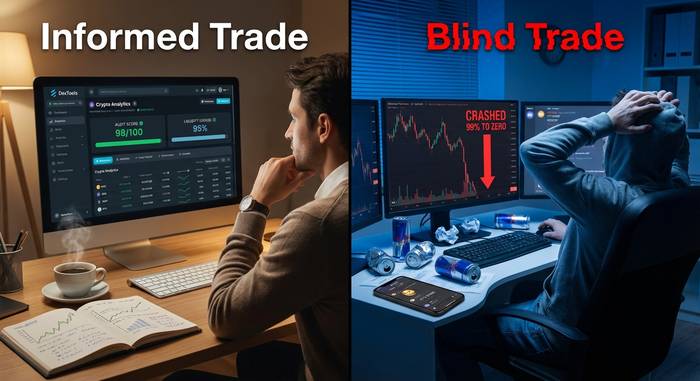
The shift from centralized to decentralized trading continues. After FTX collapsed in 2022, billions of dollars moved from CEXs to DEXs. Users who learned the hard way that "not your keys, not your crypto" is more than a slogan started trading where they controlled their own funds. But DEX trading without analytics is like stock trading without a Bloomberg terminal. You can do it. You probably should not.
DexTools and its competitors fill that gap. They turn raw blockchain statistics and DeFi market data into something you can act on.
The numbers back this up. According to multiple industry reports, DEX trading now accounts for roughly 15-20% of all crypto spot trading volume, up from under 5% in 2020. That percentage climbs every time a centralized exchange gets hacked or freezes withdrawals. The infrastructure for decentralized trading improves every year: better liquidity, tighter spreads, faster execution. But the analytics layer is what makes it usable for anyone who takes trading seriously.
I have talked to traders who run six-figure portfolios entirely through DEXs. Every single one of them uses some combination of DexTools, DEXScreener, and chain-specific tools like Birdeye. None of them trade blind. The edge in DeFi trading is not speed anymore. Bots handle that. The edge is information quality: knowing which pools have locked liquidity, which wallets are accumulating, which tokens fail basic security audits. That is what DexTools provides, and that is why it processes millions of visits per day from people who could easily use any of the free alternatives but choose to pay for DEXT premium access instead.