
DEX Screener: Real-Time Analytics for Decentralized Exchanges
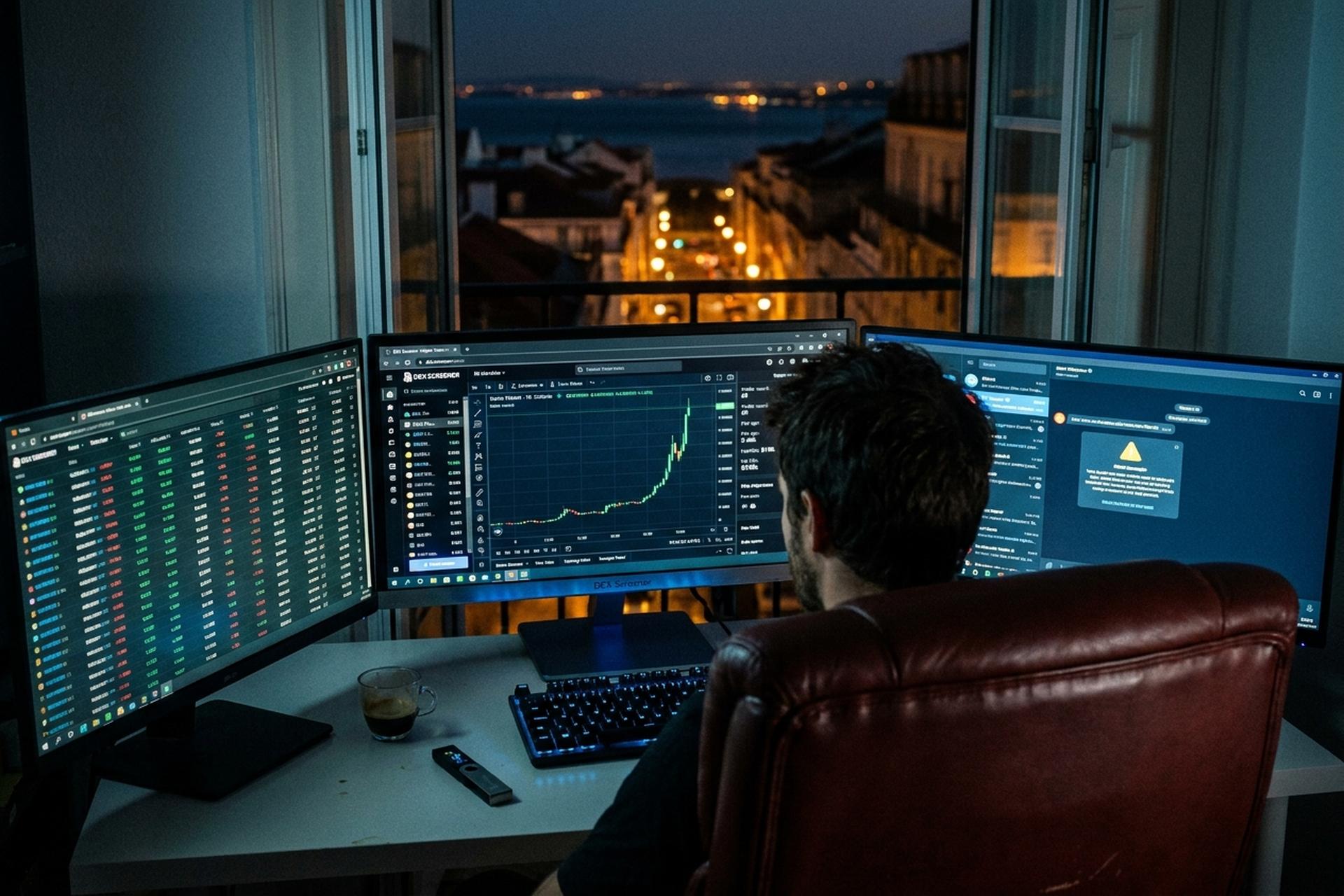
It is 4 a.m. somewhere in Lisbon. A trader is staring at the New Pairs feed on dexscreener.com, watching a fresh Solana token cross 100k in pooled liquidity within ninety seconds of its launch. Pair age: two minutes. Holder count: 47. He has thirty seconds to decide whether to ape in before the chart turns vertical or whether the same liquidity is about to vanish in a rug pull. That single window is what DEX Screener is for. Tens of thousands of traders open it every minute, and during the March 2024 memecoin run, Solana's top twenty pairs cleared $178 million in 24-hour volume on this one site, ahead of Ethereum's $138 million, per DL News.
This guide walks through what DEX Screener actually is, how to read a token pair page, the filters that separate active traders from spectators, how it stacks up against DexTools, Birdeye, and GeckoTerminal, and what changed in 2026 once paid boosts and Enhanced Token Info became part of the discovery layer.
What is DEX Screener? A 2026 DeFi analytics primer
DEX Screener is a free, real-time DEX analytics dashboard for DeFi tokens trading on multiple decentralized exchanges. It is not a wallet, not a DEX itself, and not a custody product. It is a read-only window into web3 markets. The site reads block data directly from supported blockchains and surfaces every active trading pair across dozens of blockchains, with a customizable chart, liquidity, volume, and transaction count attached. Every metric on the page comes straight from on-chain state, which is why DEX Screener charts update faster here than on most centralized platforms or CEX-style aggregators. Real-time crypto data from multiple decentralized exchanges is the entire product, and it is what helps traders and investors make informed decisions before a price move has fully played out.
The company was founded in 2021 by Andreas Diegues, Alexandre Bini, and Robert Smart, a small remote-first team based in the United States. The product positions itself as a real-time blockchain analytics app used by more than 1.5 million traders monthly across dozens of blockchains, a claim corroborated by SimilarWeb traffic at 15.62 million visits in October 2025, cooling to 8.96 million by December as the memecoin cycle softened. The official site, dexscreener.com, ranks number three on SimilarWeb in the Crypto Trading & Wallets category as of January 2026, and 82.3 percent of desktop traffic arrives directly, which is the audience signature of a bookmark, not a search result. Mobile users can grab the app on Google Play or the App Store, but most getting-started traffic still flows through the desktop interface.
How to read a DEX Screener token pair: key features
Every pair page on the site is built from the same six modules. Once you can read them at a glance, triaging a token takes about thirty seconds.
Price and price change. The big number at the top, with 5-minute, 1-hour, 6-hour, and 24-hour deltas. Useful for entry timing. Useless on tokens younger than an hour.
Liquidity and FDV. Liquidity is how much money can leave the pool before slippage swallows your order. Fully Diluted Valuation is what the project would be worth if every token in the supply were issued at the current price. A token with a $50 million FDV and only $40k of liquidity is mathematically a trap.
24-hour volume and transactions. Volume tells you whether anyone else is interested. Transactions split by buys versus sells tell you whether they are interested for the right reasons. A 70/30 buy/sell split with rising volume is healthy. A 50/50 split with declining volume is exit liquidity for somebody else.
Pair age and creation block. Newer than six hours and the chart is a coin-flip. Older than two weeks and the easy money is gone.
Holder count and top traders. Concentrated holdings are a red flag. If the top ten wallets hold over 30 percent of token supply, expect a coordinated dump. Compare this against liquidity and market cap to see if the float is too tight to absorb their exit.
Security checks. DEX Screener now flags mintability, freeze authority on Solana, owner balance percentage, and sometimes a Blockaid rug-pull score. Blockaid's integration, announced as a case study in 2024, brought mean time-to-detection on malicious tokens under ten minutes and removed roughly 160 hours of manual review per month from the company's internal queue.
A pair page does not tell you the project is real. It tells you whether a market is real. The first is your job. The second is the dashboard's job. One quick rule of thumb: if any single metric on the page would embarrass the project on its own — say, ten holders, $4k of liquidity, or a 95-percent owner balance — that one number outweighs everything else.
Filters and watchlists: how DeFi traders really use DEX Screener
Most casual users park on Trending, scroll, and never touch the filters. That is fine for entertainment. It is not how anyone makes consistent decisions on this site.
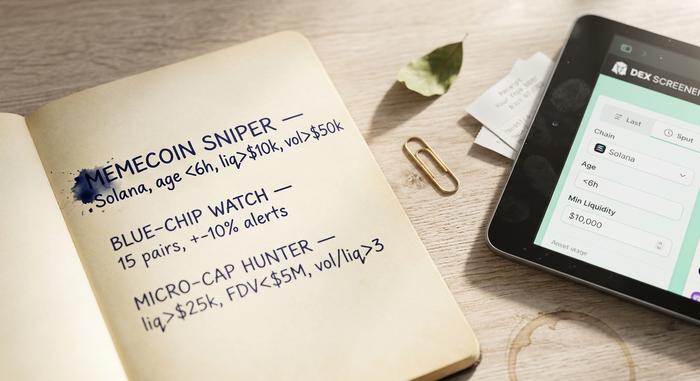
The combination that earns DEX Screener its place is New Pairs + filters + alerts. The New Pairs feed shows every freshly created liquidity pool across every supported chain in near real time. Without filtering, it is unreadable noise. With filtering, it becomes a search engine for new tokens that match a thesis. The customizable screeners with several metrics, including liquidity, vol/liq ratio, FDV, age, and holder count, turn live token data into a research tool you can actually trust for DEX trading.
Three filter recipes cover most use cases:
| Recipe | Purpose | Filter combo |
|---|---|---|
| Memecoin sniper | Catch tokens within an hour of launch on Solana | Chain: Solana, Age: under 6h, Min liquidity: $10k, Min 24h vol: $50k, Sort: vol desc |
| Blue-chip watch | Track established tokens you already own | Watchlist of 10-20 specific pairs, alerts on ±10% moves and unusual volume |
| Micro-cap volume hunter | Find low-FDV pairs catching unusual flow | Min liquidity: $25k, Max FDV: $5M, Min vol/liquidity ratio: 3, Age: 24h-30d |
Watchlists are unlimited. Price alerts trigger by absolute price, percentage move, or new pair appearing on a specific chain. Alerts deliver to the in-app notification panel, the Discord bot, or the Telegram bot, depending on what you wire up. The MultiCharts layout displays up to sixteen pair charts on one screen, which is the closest thing on-chain has to a Bloomberg Terminal.
A practical workflow looks like this. Set one filter for new pairs on Solana under two hours old with at least $25k of liquidity. Set a second watchlist for the ten or fifteen tokens you already own. Set price alerts only on the watchlist, never on the new-pairs filter, or your phone will buzz every fifteen seconds. Let the new-pairs feed run quietly in a tab. Open a chart only when something interesting hits the filter twice in a row, which usually means the volume is not a single whale's market order.
The mistake most traders make is treating the Trending tab as a discovery feed. Trending is influenced by paid Boosts, which means it is partly an advertising surface. Filters are not. Filters answer the question you asked. Trending answers the question someone paid to put in front of you.
DEX Screener vs DexTools, Birdeye, GeckoTerminal analytics tools
Four tools, four niches. None of them does everything well, and the right answer is usually two of them open at once.
| Tool | Chains supported | Free tier | Paid tier | Best at |
|---|---|---|---|---|
| DEX Screener | 80+ (no official counter) | Full charts, filters, alerts, public API | Boosts ~$99-$3,999, Enhanced Token Info $299-$499 | Memecoin discovery, speed, breadth |
| GeckoTerminal | 263 networks, 1,864 DEXes | Full data, free API | CoinGecko Pro API tiers | Widest chain coverage, CoinGecko brand |
| DexTools | 80+ chains, 10,000+ pairs | Live pairs, multichart, basic alerts | Standard $100/month or 1,000 DEXT held | Long-tenure charting, social signal |
| Birdeye | Solana plus 10+ EVM chains | Real-time data, wallet PnL | Tiered BDS API pricing | Solana wallet analytics, PnL tracking |
GeckoTerminal wins on raw chain count. It indexes 263 networks against the 80-plus DEX Screener publicly references, and the CoinGecko backing gives it the safest data provenance for journalism or research. The interface is plainer, the alerts are weaker, and the chain rotation is slower than DEX Screener's. It is the tool you use when you need a number you can quote.
DexTools has been around since 2020 and has the longest memory in the space. Its Standard plan runs $100 a month or 1,000 DEXT held, and it offers an "Influencer score" and social signal layer that DEX Screener does not. It is also slower to add new chains, and the free tier is more restrictive than DEX Screener's.
Birdeye is a Solana-first tool that has expanded to ten or so EVM chains, including Sui, Base, and the newer HyperEVM. Its strength is per-wallet PnL and "smart money" tracking that DEX Screener does not match. If you trade Solana actively, Birdeye complements DEX Screener rather than replacing it.
DEX Screener wins on memecoin discovery and on raw speed of the new-pairs feed. It loses on chain count to GeckoTerminal, on social-signal layering to DexTools, and on Solana wallet depth to Birdeye. Pick by use case, not by brand loyalty. For most active DeFi market participants, DEX Screener provides the cleanest user experience for tracking decentralized exchange activity in real time, but it works best as one tab in a stack of three.
Boost and Trending: the dexscreener.com paid layer in 2026
The free layer of DEX Screener has not changed much. The discovery layer has been monetized.
Boosts are the visibility currency. A project pays for a pack of Boosts that elevate its position on Trending and add a flame icon to the listing for 12 to 24 hours. Public secondary sources, including dexrockets.com and a tactical Medium guide, cite tier prices around $99 for 10 Boosts, $249 for 30, $399 for higher counts, and roughly $3,999 for 500 Boosts, which unlocks the Golden Ticker. The 500-Boost threshold is officially documented in `docs.dexscreener.com/boosting`. The dollar values are not officially listed by DEX Screener and should be treated as directional, not gospel.
Enhanced Token Info is the legitimization layer. The marketplace lists it at $499 with a discounted $299 promo, and what it buys is a structured profile on the pair page: project logo, social links, a short vision statement, the team, the roadmap, and locked-supply wallets. Crypto and card payments are accepted, and the page populates within minutes for fast turnaround.
A reasonable read of all this: DEX Screener is monetizing attention, not data. Charts, filters, and the API stay free. What costs money is being seen.

Risks: when the DEX Screener analytics platform amplifies scams
The same speed that helps real traders also helps the people scamming them. Boosts and Trending placement have been used to manufacture fear-of-missing-out around tokens with no community, no audit, and no plan beyond the first 24 hours.
Independent traders on X have documented coins spending $40,000 to $80,000 in 24-hour Boost campaigns, almost always followed by a sharp pump and a slower bleed back to zero. Solidus Labs published research suggesting roughly 98 percent of Pump.fun tokens and around 99 percent of Solana memecoin launches show patterns consistent with manipulation, rug pulls, or wash trading. That is not DEX Screener's data, but it is the universe DEX Screener indexes.
The Blockaid integration helps on the worst category of malicious smart contracts: honeypots, mintable supply, freeze-authority traps. It does not help on the broader category of "the chart is real, the team is fake, and you are exit liquidity." Visibility on this site is not validation. A boosted listing is an ad, and a trending position can be either organic or rented. Treat both with the same skepticism you would apply to a sponsored post on any other platform, and never let a flame icon do due diligence for you.
Wallet connection and trading on the dex screener platform
The Trade button on a DEX Screener pair page does not move funds itself. It routes you to the underlying decentralized exchange, with DEX Screener as the broker UI on top. Connect MetaMask, Phantom, or another non-custodial wallet, set slippage and gas, and the swap happens on Uniswap, Raydium, or whichever DEX hosts the pair. Funds never touch DEX Screener. This is one of the cleaner sides of the product. Most users open DEX Screener for analytics and execute somewhere else anyway.
API access: blockchain data and core features for devs
A free public API exposes most of what the site shows. The endpoints at `api.dexscreener.com` cover token search, pair lookup, and trending; rate limits are generous for hobby integrations and tighter for production scrapers. Common calls: `/latest/dex/tokens/{address}`, `/latest/dex/pairs/{chain}/{pair}`, `/latest/dex/search?q=`. Output is JSON, no API key required for the public endpoints, and the on-chain data feeds the same indexer that drives the website.
Bookmark dexscreener.com and set one alert
DEX Screener is the closest thing on-chain has to a Bloomberg Terminal that anyone can open in a browser. It tells you what is moving across hundreds of DEXs in real time. It cannot tell you why, and it cannot tell you whether the move will reverse before your transaction confirms. Bookmark dexscreener.com, set one watchlist, set one alert, learn to read a pair page in under a minute, and treat anything Trending as advertising until proven otherwise.



