Jannik Sinner Net Worth in 2026: Earnings Breakdown
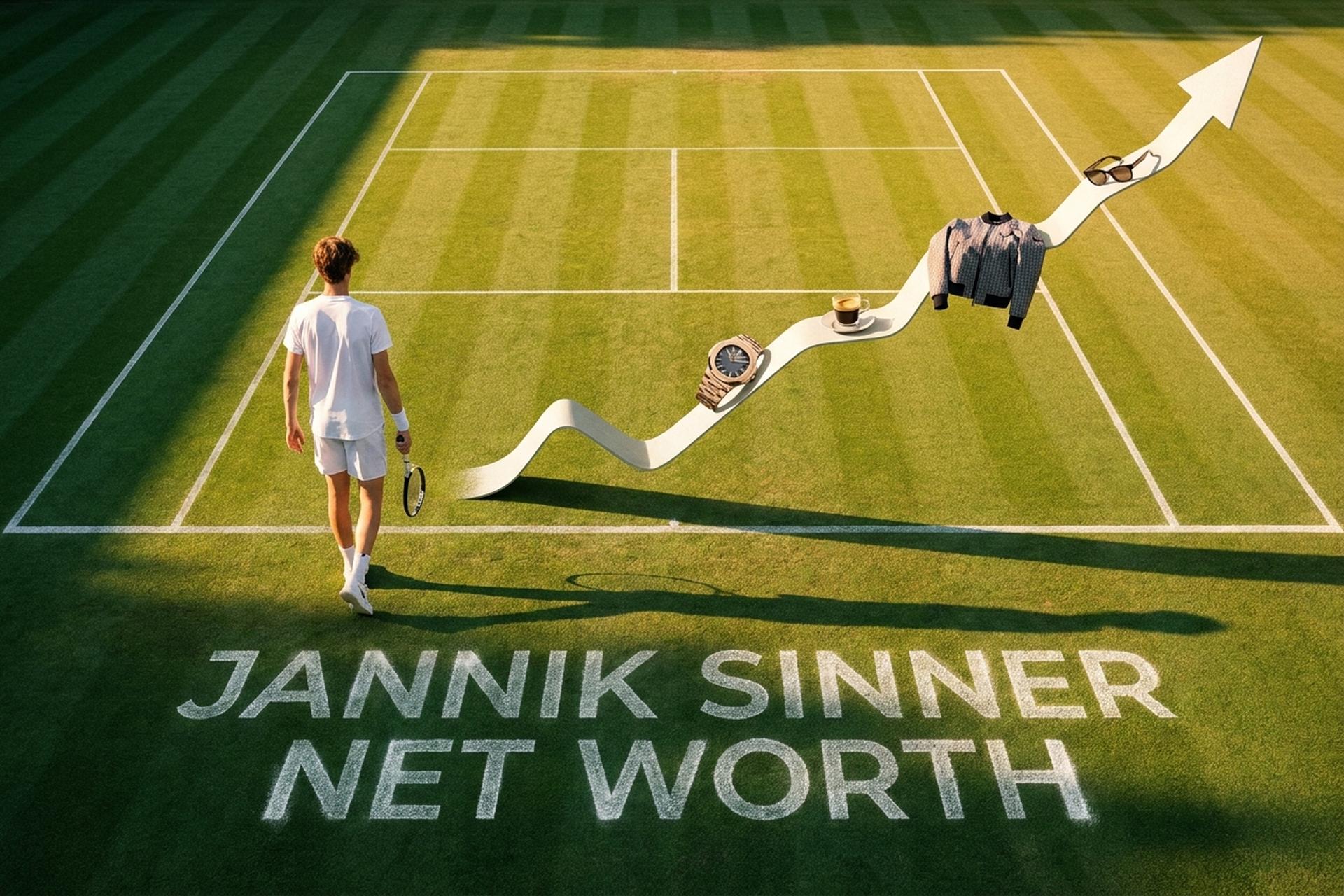
Ask ten outlets what Jannik Sinner is worth and you will get ten different answers. One says $30 million, another $40 million, a third stretches to $55 million. So what is the real Jannik Sinner net worth in 2026? The honest reply is a range, not a single figure, and the reason it is a range tells you more about modern tennis money than any tidy number could.
Here is the part most write-ups skip. Neither Forbes nor Sportico publishes a "net worth" total for an active 24-year-old. What they publish is his annual earnings, and those numbers are huge. In the year to August 2025 Sinner pulled in more money than any other tennis player on the planet. Strip out the prize money and something stranger appears: the deals he signs off the court now bring in as much as the trophies he wins on it.
What Jannik Sinner's net worth is in 2026
Start with the number everyone quotes: about $40 million, the figure Celebrity Net Worth runs with. Other trackers stretch the band to $35-45 million. Are they wrong? Not exactly. They are educated guesses, built from whatever earnings happen to be public, because no major outlet audits the bank account of a player who is barely a third of the way through his career. Treat the $40 million as a marker, not a measurement.
Why the estimates disagree
A net worth is what you keep. Cash, property, investments, minus what you owe. Earnings are a different thing: the money that came through the door, before tax, before the agent's cut, before he has spent a euro. For someone this young the gap between the two is huge, and almost entirely private. Sinner has been earning serious money for only about three seasons. When Forbes first ranked him in August 2024, it put his fortune at $26.6 million. One winning year later, the guesses had jumped. See the problem? Any fixed number is a photo of a line that is still shooting upward.
That is also why the trackers fight each other. Celebrity Net Worth is trying to total a lifetime of accumulated wealth. Forbes and Sportico measure a single twelve-month haul. Different questions, different answers, and not one of them claims to be an audit.
The numbers we can actually verify
So forget the lump sum for a moment. Here is what reliable sources have actually put on the record.
| Metric | Figure | Source | Date |
|---|---|---|---|
| Annual earnings (on + off court) | $52.3M | Sportico | Aug 2025 |
| Of which, prize money + on-court | $27.3M | Sportico | Aug 2025 |
| Of which, endorsements (off-court) | $25M | Sportico | Aug 2025 |
| Forbes annual total | $47.3M | Forbes | Aug 2025 |
| Career prize money (milestone) | $60.0M | ATP / Tennis.com | Mar 2026 |
| Career prize money (7th all-time) | $64.8M | Sportico | Jun 2026 |
That Sportico haul made Sinner the highest-paid tennis player on earth for the year, ahead of Carlos Alcaraz and Novak Djokovic. Forbes counted only sanctioned prize money, left the exhibitions out, and still ranked him second behind Alcaraz. Strip away the methodology and both land in the same spot: a bit more than half from the sport, a bit less than half from brands.
Jannik Sinner's rise from the slopes to number one
Sinner did not start out as a tennis prodigy. He started out as a skier. Born on August 16, 2001, in San Candido, a German-speaking town in South Tyrol near the Austrian border, he was a national-level junior on the slopes, and he only picked tennis over skiing around age 13. Then he left home. He moved to the Piatti Tennis Center in Bordighera, down on the Italian Riviera, to train under the veteran coach Riccardo Piatti. Big gamble for a kid. It paid off fast.
He turned pro in 2018. ATP Newcomer of the Year in 2019. Top ten by 2021. Then the breakthrough: the 2024 Australian Open, his first Grand Slam title, and by June 2024 he was world number one in the ATP rankings, the first Italian man ever to get there. That climb is why the sponsors came calling. Nobody pays $15 million a year for a promising junior. You pay it for a global number one with a decade of marketability still ahead. The tennis came first. The money followed.
Inside Sinner's endorsement and sponsorship deals
Want to understand the money? Follow the endorsements, not the trophies. In 2024 his off-court income was around $15 million, the bulk of what he earned that year. By 2025 it sat between $25 million (Sportico) and $27 million (Forbes). For most of tennis history that ratio ran the other way: prizes paid the bills, sponsors were gravy. With Sinner it has flipped.
The Nike deal that set the floor
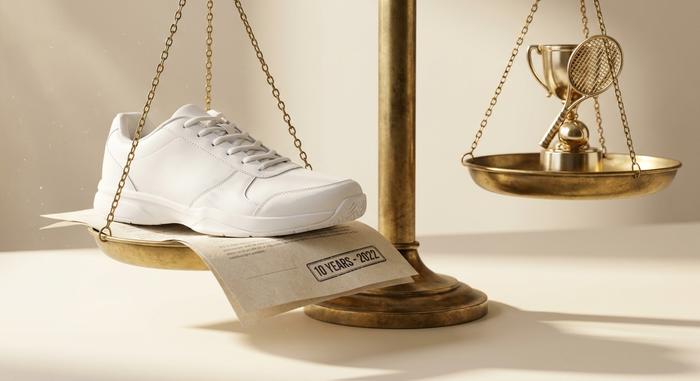
It starts with Nike. Sinner signed a ten-year apparel deal reported near €150 million, call it $158 million, or roughly $15 million a year. The smart part is the date. He signed in May 2022, before he had won a single Grand Slam. Nike was paying for a top-ten prospect, not a four-time major champion. That contract set an income floor that does not care whether he wins on Tuesday. Every title since has been profit stacked on a base that was already banked. Most athletes never get that kind of leverage. He got it at 20.
Why luxury brands, not just sportswear
The rest of the roster reads more like a Milan boutique than a locker room. Rolex on the wrist. Gucci for the tailoring. Head for the racket. Then Lavazza coffee, Panini, the insurer Intesa Sanpaolo Assicura, the telecom firm FastWeb, and, from 2026, Allianz. Italian heritage names sit at the heart of it, which is no accident for the first Italian man to top the rankings. These houses are not buying court time. They are buying an image, and image deals tend to be stickier, built around equity and multi-year ambassador roles instead of one-season banners. Some reportedly carry equity-style upside rather than a flat fee. That structure would matter more than the logos, as the next two years proved.
And the roster keeps growing. Allianz signed a multi-year global deal with him in January 2026, and his off-court take climbed from about $15 million in 2024 to $25-27 million a year later. Few athletes in any sport grow their endorsement income that fast. That curve, more than any one contract, is what the brands are buying: a bet that the winning, and the fame, will hold.
Career prize money and Grand Slam earnings
Prize money is the visible half of Sinner's career earnings, and it is big. It is also lumpy, capped by whatever pool a tournament puts up. He crossed $60 million in career prize money in March 2026 and sat near $64.8 million by mid-year, seventh on the all-time list. And not all of his on-court money is prize money. One exhibition, the Six Kings Slam in Riyadh, reportedly paid him about $5 million for a few nights' work. That is why Sportico's on-court figure of $27.3 million runs well ahead of the $20.3 million Forbes counts when it sticks to sanctioned events. The majors show how the cheques land.
| Event | Year | Winner's prize | Source |
|---|---|---|---|
| US Open | 2024 | $3.6M | Sportico |
| Australian Open | 2025 | $2.2M | Sportico |
| Wimbledon | 2025 | £3M (~$4.05M) | Sportico |
Big cheques, no question. But notice that one Nike year, at roughly $15 million, beats any single one of these titles. Win a major and you collect a few million plus a ranking bump that sweetens the next negotiation. The prize money is the headline. The endorsement renewal it sets off is where the compounding happens, and it is the same machinery behind the way any public-figure net worth gets estimated.
Sinner vs Djokovic, Federer and Nadal
Set Sinner next to the all-time greats and he can look almost modest. He is not. He is just early.
| Player | Est. net worth | Majors | Note |
|---|---|---|---|
| Roger Federer | $750M | 20 | Retired; Uniqlo ~$30M/yr |
| Novak Djokovic | $240M | 24 | Most men's majors |
| Rafael Nadal | $220M | 22 | Retired 2024 |
| Carlos Alcaraz | $50–85M | 4+ | Forbes' top earner |
| Jannik Sinner | $35–55M | 3+ | Age 24, still climbing |
Federer needed two decades, twenty majors, and a second career in business to reach $750 million. A big slice of that is not tennis at all. His equity stake in the Swiss shoe brand On is reportedly worth hundreds of millions, on top of the roughly $30 million a year Uniqlo pays him to wear its kit. Serena Williams, the richest woman in the sport at about $300 million, got there the same way, through investing rather than prizes. Djokovic and Nadal each stacked their fortunes over almost twenty years. Sinner is three seasons into his prime. Lining his balance up against theirs is like judging a startup's first profitable year against a blue chip. The comparison I would actually make is with Alcaraz, and on annual flow the two of them already own the top of the sport.
What the 2025 ban did to Sinner's endorsements
The real stress test of Sinner's wealth was not a loss on court. It was a doping case. Two positive tests for the banned substance clostebol surfaced in 2024. The International Tennis Integrity Agency disclosed them that August, when Sinner had at least ten endorsement partners on his books. He eventually reached a case resolution with the World Anti-Doping Agency in February 2025 and served a three-month ban. The tribunals accepted his contamination explanation. The headlines were brutal anyway. For months his off-court income looked exposed.
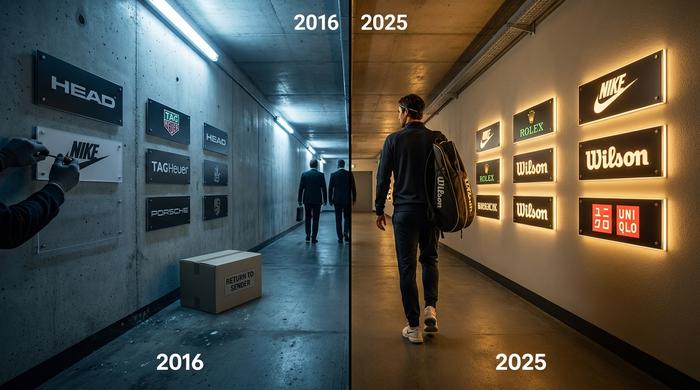
Here is what did not happen: nobody walked. Lavazza and Rolex publicly confirmed Sinner stayed on as an ambassador, and other partners quietly reaffirmed their deals. Compare that with Maria Sharapova in 2016, who lost or saw suspended her ties with Nike, Porsche and TAG Heuer within days of her own announcement. Why the different outcome? Part of it is the contamination ruling. But part is structure. Sharapova's deals leaned on performance-sportswear contracts that punish reputational risk fast. Sinner's luxury and heritage partners had built longer, image-led relationships that could absorb a bad season. A sticky portfolio is worth more than a big one.
Investments and earnings beyond the tennis court
Income is only half of wealth. The other half is what you do with it. Sinner routes his business affairs through a holding company, Foxera Holding, which manages his investments and holds real estate in Milan. And he has turned some of the money outward. In 2025 he launched the Jannik Sinner Foundation for children's education and sport, and used part of his Wimbledon winnings to help fund a free tennis academy for kids who could not otherwise afford it. He even published an illustrated tennis manual for children. He is based in Monte Carlo, Monaco, a choice that, like many top players, keeps more of those earnings working for him rather than going to Italy's top tax rate. None of it is flashy. There are no headline yacht purchases or vanity startups, just the quiet work of turning a few enormous earning years into property, a managed portfolio, and a foundation while the tax base stays light. For a 24-year-old, that is the whole difference between a big income and lasting wealth.
The real number behind Jannik Sinner's net worth
So pick your figure: the Jannik Sinner net worth estimate most analysts converge on is around $40 million, with a credible band from the mid-thirties to the mid-fifties. But the number on its own misses the point. Sinner has a guaranteed Nike floor, a luxury portfolio that survived the worst news of his career, and prize money still flowing seventh-fastest in history, all at 24. The interesting question is not what he is worth this morning. It is how fast that figure compounds over the next ten years. If you had to bet, which way is that line pointing?