Thailand Crypto Tax: What’s Tax-Free and What Isn’t
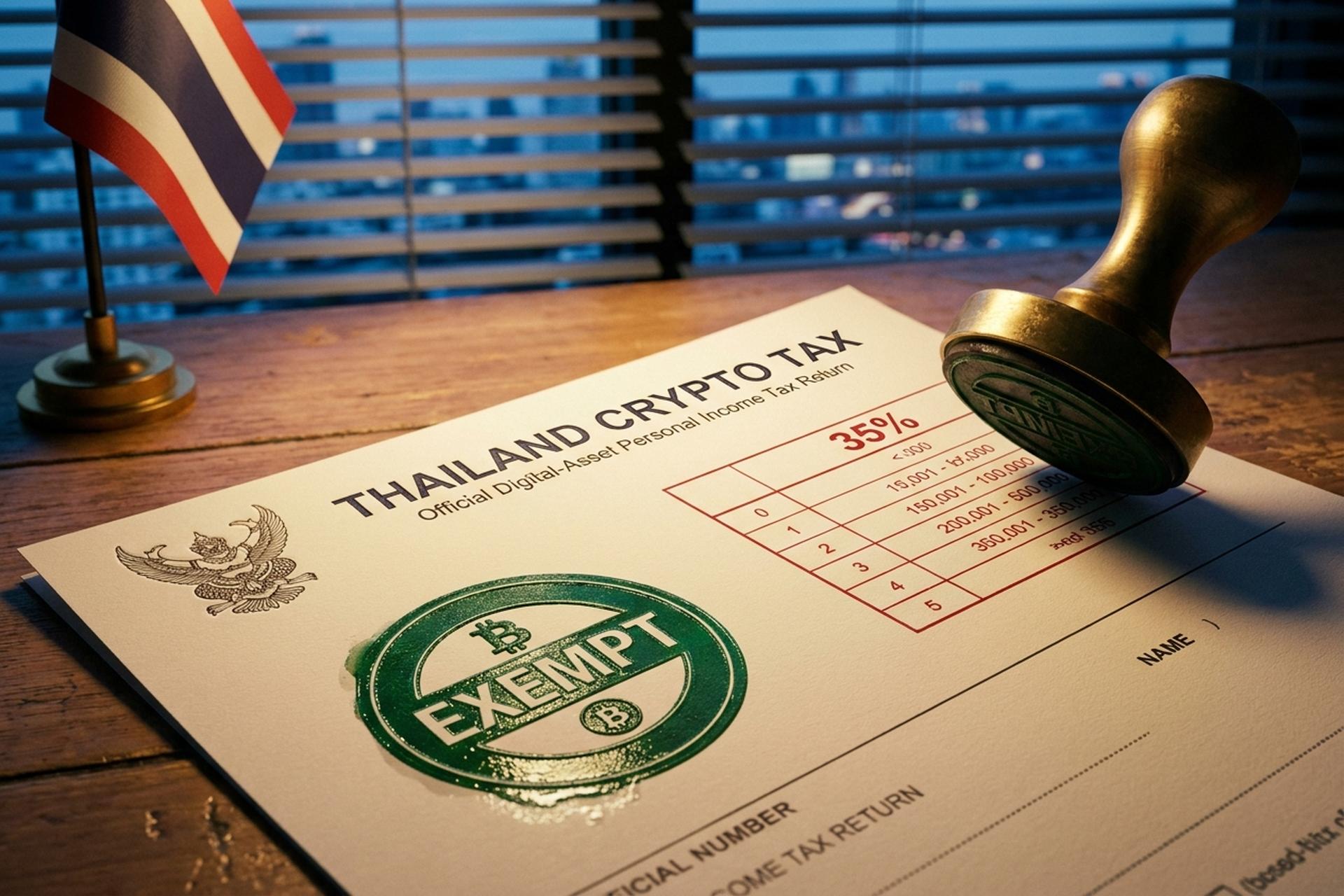
Thailand did something unusual with crypto profits: it made them tax-free, and then drew a tight fence around the word. Sell a coin at a gain on a licensed Thai exchange and the government now takes nothing. Do almost anything else with that same coin and the old rules still apply, with rates that climb to 35 percent. The headline writes itself as "Thailand scraps crypto tax." The reality is narrower and a good deal more interesting, because the exemption rewards a very specific behavior rather than the asset itself. This guide walks the exact line of that box — what Thailand's crypto tax rules actually cover, what they quietly leave out, and what a resident or expat still owes.
How Thailand Taxes Crypto: The Quick Picture
Start with the default, because the exemption only makes sense against it. Thailand's crypto tax framework begins from a single fact: it has treated cryptocurrencies as a taxable digital asset since 2018, when an Emergency Decree amended the Revenue Code and slotted crypto income into two categories: returns from holding, such as staking, under Section 40(4)(h), and gains on transfer above cost under Section 40(4)(i). In plain terms, both the yield your crypto throws off and the profit when you sell it are assessable income. A sale, a swap into another token, or using crypto to pay for goods can each be a taxable event. They get added to everything else you earn in the year and taxed on the progressive personal income tax schedule.
That is the baseline the country never repealed. What changed in 2025 was not the classification of crypto but a carve-out layered on top of it. So when someone tells you crypto is "tax-free" in Thailand, the accurate version is that one specific slice of crypto activity has been temporarily lifted out of a tax system that otherwise still works exactly as it did before.
The 2025-2029 Crypto Tax Exemption, Explained
The single most consequential thing Thailand did was remove personal income tax on capital gains from selling crypto, but only when the sale runs through a licensed Thai venue. The relief is tied to where you trade, not to what you hold. That distinction is the whole story.
What Actually Qualifies
The legal instrument is Ministerial Regulation No. 399 (B.E. 2568), published in the Royal Gazette on 5 September 2025 after the Cabinet approved the measure in June. It exempts personal income tax on capital gains from cryptocurrency and digital token sales when those sales go through exchanges, brokers, or dealers licensed by the Thai Securities and Exchange Commission. The window runs from 1 January 2025 through 31 December 2029, a clean five-year period. There is no cap on the gain. A retail investor who buys Bitcoin on a regulated Thai platform and sells it there for a profit during this window reports the gain and pays nothing on it.
The 15 Percent Withholding Tax That Vanished
Before this, crypto gains carried a 15 percent withholding tax under Section 50(2)(f) of the Revenue Code. For qualifying trades on licensed exchanges, that withholding is gone too, which matters in practice because withholding was the mechanism most likely to actually bite a casual investor. The 15 percent figure still lingers for transactions outside the licensed channel, such as private and over-the-counter deals, so the number has not disappeared from the law. It has simply stopped applying to the trades most people make.
Why Thailand Did It
The motive is not generosity. Thailand wants to be a regional digital-asset hub, and an exemption that only works on regulated domestic platforms is a deliberate way to pull trading volume onshore and into the supervised system. Thailand's Ministry of Finance has estimated the measure will generate at least 1 billion baht in additional revenue over the period, the logic being that concentrating activity on licensed venues widens the tax base elsewhere even as it zeroes out this one line.
| What you do | Tax status, 2025-2029 |
|---|---|
| Sell crypto for a gain on a licensed Thai exchange | Exempt from personal income tax |
| Same sale, 15% withholding tax | No longer applied |
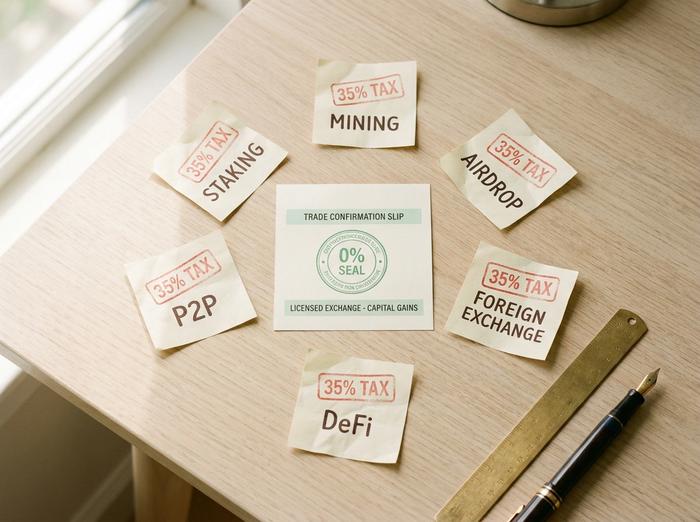
| Staking, mining, or airdrop income | Taxed as ordinary income |
| Trade on a foreign or unlicensed exchange | Taxed, up to 35% |
| VAT on licensed crypto transfers | Exempt since 1 Jan 2024 |
Capital gains are not the only relief. A second, quieter exemption covers value-added tax. Under Royal Decree No. 788, gazetted on 24 September 2024, transfers of cryptocurrency and digital tokens through licensed exchanges, brokers, and dealers would normally be subject to VAT, but are exempt from the standard 7 percent rate, effective from 1 January 2024 and, unlike the income-tax measure, with no announced end date. VAT on a trade would have been an awkward friction for everyday users, so removing it permanently for the licensed channel reinforces the same message as the capital-gains carve-out: bring your activity onshore and into the regulated system, and the tax cost drops toward zero.
What the Tax-Free Rule Leaves Out
Here is where the fence gets tight. Because the exemption attaches to a venue and to one type of income, everything that falls outside those lines stays on the normal tax ladder. The list of what is left out is longer than the list of what is covered.
Income the Exemption Doesn't Touch
The carve-out applies to capital gains on disposal. It does not touch the other ways crypto generates income. Staking rewards, mining proceeds, and airdrops remain ordinary assessable income under Section 40(4)(h), taxed at your marginal rate. So a Thai resident can sell appreciated tokens on a licensed exchange and owe nothing on the gain, yet still owe full tax on the staking yield those same tokens earned during the year, because earning crypto through staking is treated differently from selling it. The asset is identical; the tax outcome splits depending on how the money arrived.
Venues That Don't Count
The other gap is geographic and structural. Trades on foreign exchanges, unlicensed platforms, decentralized exchanges, peer-to-peer swaps, and most DeFi activity sit entirely outside Ministerial Regulation No. 399. Gains there become taxable as before, at rates reaching 35 percent. For the many Thai users who trade crypto on large offshore platforms, the celebrated exemption may not apply to a single one of their transactions. The relief is generous inside the box and absent everywhere outside it.

Crypto Tax Rates and the Progressive Brackets
When crypto gains are taxable, they are not taxed at a flat rate. They are added to your other income for the year and run up Thailand's progressive personal income tax brackets, so the rate you actually pay depends on your total income, not on the crypto in isolation. A small gain on top of a modest salary might be taxed lightly; the same gain on top of a high salary is taxed at the top.
| Net annual income (THB) | Tax rate |
|---|---|
| 0 - 150,000 | 0% |
| 150,001 - 300,000 | 5% |
| 300,001 - 500,000 | 10% |
| 500,001 - 750,000 | 15% |
| 750,001 - 1,000,000 | 20% |
| 1,000,001 - 2,000,000 | 25% |
| 2,000,001 - 5,000,000 | 30% |
| Over 5,000,000 | 35% |
One caution on the numbers: the Revenue Department's older English-language pages still show a slightly different top-bracket threshold, and current 2025 guidance from major accounting firms places the 35 percent rate on income above 5 million baht. When the exact figure matters for a real filing, confirm it against the current Revenue Code rather than a cached web page.
A quick example shows how this works. Suppose a resident earns 1.2 million baht from employment and makes a 400,000 baht taxable crypto gain on a foreign exchange in the same year. The gain does not get its own flat rate; it sits on top of the salary, so the top slice of the combined income is taxed in the 25 percent band rather than the lower bands the salary alone would have reached. That same 400,000 baht gain would have been tax-free under Thailand's crypto tax exemption, had it been realized on a licensed Thai exchange during the window. The venue, once again, decides the bill.
Tax Residency and the 180-Day Line
For tax purposes, none of this turns on your passport. It turns on residency. Thailand treats you as a tax resident if you are physically present in the country for 180 days or more in a calendar year, and tax residency is what pulls your income, including crypto income, into the Thai system. Spend less than that and your exposure is limited to Thai-sourced income. Cross the 180-day line and the full apparatus, exemption and all, applies to you the same way it applies to a Thai national. This single threshold decides whether the rest of this article is your problem or someone else's.
Foreign Residents and Crypto Tax in Thailand
Expats face an extra layer that is easy to miss. Since Departmental Instruction Por. 161/2566 took effect on 1 January 2024, foreign-sourced income that a Thai tax resident brings into the country is taxable in the year it is remitted, not just income earned that year. Crypto gains made on an overseas exchange and later moved into Thailand can therefore be caught, and the Ministerial Regulation No. 399 exemption does not rescue them, because it only covers trades on licensed Thai venues. So the expat who trades on a foreign platform sits in the worst spot: no exemption on the gain, and a remittance rule that taxes the money when it lands. The way out, for those who qualify, is to trade on a licensed Thai exchange in the first place, which is precisely the behavior the rule was designed to encourage.
How to Report and File Crypto Taxes
The mechanics follow Thailand's ordinary income tax rules. Individuals report crypto income on the standard personal income tax return, form PND 90 for mixed income or PND 91 for employment income only, and the filing deadline is 31 March of the following year, with a short extension into early April for online filers. Even exempt gains are best reported rather than ignored, since the exemption is a tax outcome, not a reason to leave the activity off the return. Keep transaction records for at least five years, including dates, amounts, wallet addresses, and cost basis, and pick a consistent costing method such as first-in-first-out or moving average. Good records are the cheapest insurance against a later question from the Thai Revenue Department. The downside of getting it wrong is not trivial: surcharges and penalties for late or incorrect filing can reach up to 200 percent of the tax due plus 1.5 percent monthly interest, which turns the five-year record-keeping habit from a formality into a genuine defense.
Thailand vs Singapore and Malaysia
It helps to see Thailand's offer in context. Its exemption is unusually generous but also temporary and conditional, where some neighbors simply never taxed personal crypto gains in the first place.
| Country | Personal crypto capital gains |
|---|---|
| Thailand | 0% on licensed-exchange trades, 2025-2029; otherwise up to 35% |
| Singapore | 0%, no capital gains tax regime; frequent trading taxed as business income |
| Malaysia | 0% for casual investors; active trading taxed as business income |
Singapore's zero is structural and permanent. Thailand's is a policy window with an expiry date and a venue requirement attached. Both reach the same headline number for an ordinary investor, but they get there by very different routes.
DeFi, NFTs and the Crypto Tax Grey Areas
Treat the edges with caution. DeFi positions, NFT sales, and similar activity sit outside the licensed-exchange exemption, so the safe assumption is that gains there are taxable on the normal schedule. As of late 2025, the Revenue Department had not issued detailed guidance on how some of these, including staking and mining calculations, should be reported in practice. Silence is not the same as a tax-free signal. Where Thailand's crypto tax rules have not spoken clearly, the conservative reading is to document the activity and treat it as assessable income until told otherwise.