What Is a Third-Party Payment Processor?

Every time a customer clicks "buy" on your site, a chain of events fires off in roughly two seconds. Banks talk to card networks. Fraud checks run in the background. Money changes hands. Most business owners never see any of it — and that's the whole point. The company making it happen is called a third-party payment processor.
You've probably used one already. Stripe, Square, PayPal — they're all third-party processors. They sit between your checkout and your customer's bank, handling the technical plumbing so you don't have to. Online retail is heading toward 22.9% of global sales by 2028, and behind almost all of it is a processor someone plugged in and forgot about. Whether you're just starting to accept payments online or reconsidering your current setup, knowing how these services actually work helps you pick the right one and avoid the expensive mistakes.
How Third-Party Payment Processors Work
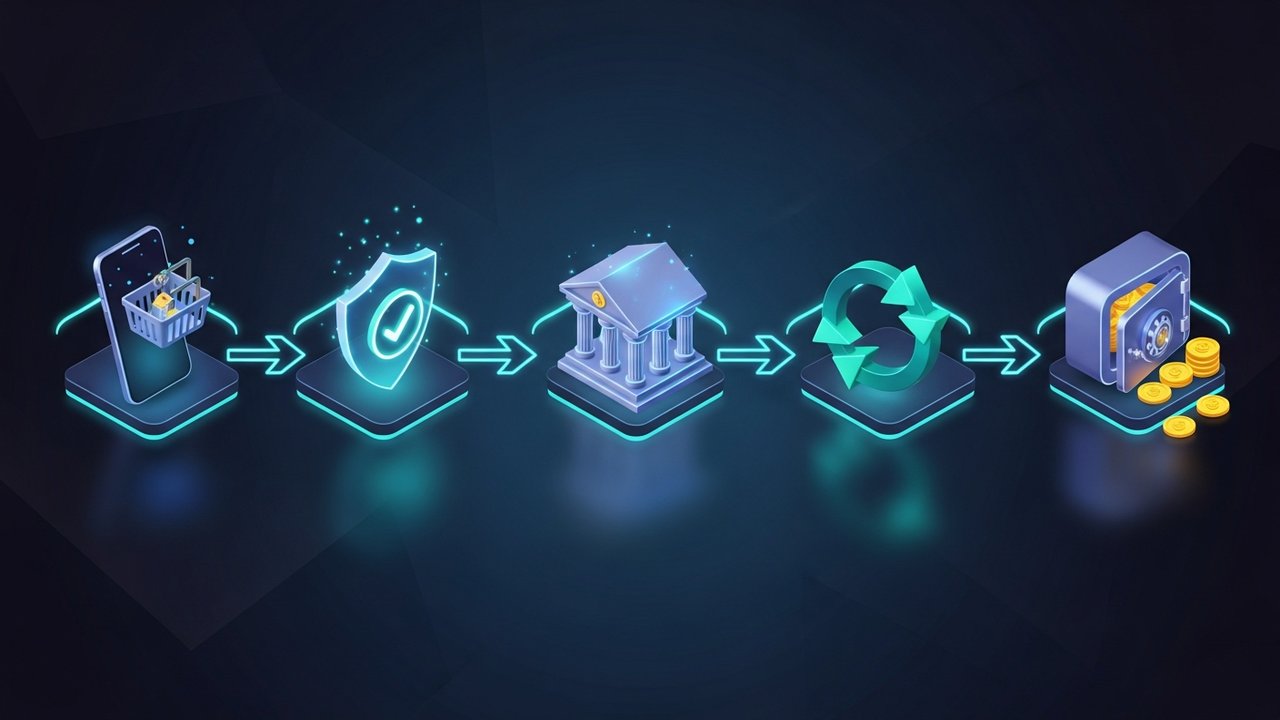
When a customer enters their card details at checkout, a multi-step process kicks off in under two seconds. Here's what happens:
- Checkout initiation. The customer submits payment on your site or in your store. Your payment gateway, which may be built into the third-party processor, encrypts the card data and sends it along.
- Authorization request. The processor forwards the transaction details to the acquiring bank and on to the relevant card network: Visa, Mastercard, or similar.
- Issuer verification. The card network routes the request to the customer's issuing bank, which checks available funds, fraud signals, and account status, then returns an approval or decline.
- Authorization response. That response travels back through the same chain in milliseconds. Your checkout displays a success or failure message.
- Capture and settlement. Once authorized, the funds are "captured." The processor batches captured transactions and initiates the money transfer from the customer's bank account to the merchant account, a process that typically takes 24 to 72 hours.
- Payout. The funds land in your business bank account, minus the processor's transaction fee.
The key word here is third-party. This processor isn't your bank, and it isn't the customer's bank. It sits between both parties and handles technical routing and compliance so you don't have to build any of that infrastructure yourself. The entire payment process, from the customer's tap at checkout to funds landing in your account, runs through the processor's systems. That's why businesses use them: you can process payments and accept payments across card networks without a direct banking relationship.
Third-Party Processor vs. Merchant Account
The most common point of confusion is the difference between a third-party processor and a dedicated merchant account. They both let you accept payments. The underlying structure, though, is very different.
A dedicated merchant account is a bank account set up specifically for your business. A merchant account provider underwrites your business individually, reviewing your revenue, industry risk, and chargeback history before granting an account. A third-party processor works differently. It pools thousands of merchants under a single large merchant account that it controls, and you get access to that shared infrastructure without any individual underwriting.
| Feature | Third-Party Processor | Dedicated Merchant Account |
|---|---|---|
| Setup time | Under 24 hours | Several days to 2 weeks |
| Setup fees | None | Often $50–$200 |
| Monthly fees | None (most providers) | $10–$30/month typical |
| Per-transaction cost | Flat rate (~2.9% + $0.30) | Interchange-plus (often lower at scale) |
| Account stability | Shared account — freeze risk | Your own account — more stable |
| Approval requirements | Minimal (basic KYC) | Full underwriting review |
| Best for transaction volume | Under $10,000/month | Over $10,000/month |
The shared account structure is what makes third-party processors fast to onboard. No individual underwriting, no waiting. It's also what creates the account stability risks covered later: one bad actor in the pool can trigger a fraud review that temporarily freezes funds across the group. The payment process itself is identical either way, with authorization, capture, and settlement following the same steps. The difference is purely in how funds are held and how risk is spread.
Third-Party Processor vs. Payment Gateway
These two terms get used interchangeably, but they describe different jobs in the payment process.
| Term | Role | Example |
|---|---|---|
| Payment gateway | Technology layer — encrypts and transmits card data | Stripe Radar, Braintree |
| Payment processor | Financial layer — routes funds between banks | Stripe Payments, Square |
| Third-party processor | Combines both functions in one service | Stripe, Square, PayPal |
A payment gateway is the secure tunnel. It captures payment details at checkout, encrypts them, and sends them to the processor. The payment processor does the actual moving of money. Most third-party processors bundle both into a single product, which is why smaller businesses rarely need to worry about the distinction. The separation starts to matter when you're building a custom checkout that needs a standalone gateway connected to a separate acquiring bank.
Benefits of Using a Third-Party Payment Processor
For most small businesses and early-stage e-commerce stores, a third-party payment processor is the fastest path to accepting online payments. Small businesses in particular benefit from the zero-setup-cost model. You get solid payment processing infrastructure without a bank contract or an underwriting review. The advantages:
- Fast onboarding. Most third-party processors approve accounts in under 24 hours. No lengthy credit checks, no months-long paperwork process.
- No setup fees or monthly minimums. You don't pay anything until you make a sale, which makes the payment solution essentially risk-free to test.
- PCI DSS compliance handled for you. Payment Card Industry Data Security Standard compliance is a real technical burden. Third-party processors absorb it entirely. Your customers' card data never touches your servers.
- Built-in fraud tools. Machine learning fraud detection, 3D Secure authentication, and velocity checks come standard with most providers.
- More payment options in a single integration. A single API connection typically unlocks credit cards, debit cards, digital wallets (Apple Pay, Google Pay), and often ACH transfers, giving customers a wider range of payment options without separate processor relationships for each.
- Multi-currency support. Most major third-party processors support 100+ currencies. That matters the moment you start selling internationally.
- No long-term contracts. You can switch providers or add a dedicated merchant account later without penalty.
This also streamlines the entire payment process for small teams. No compliance officers, no banking lawyers, no custom engineering required. For a business processing under $5,000–$10,000 per month, the flat transaction fees and zero overhead usually work out cheaper than the fixed costs of a dedicated merchant account. At $3,000/month in card sales at 2.9% + $0.30, your processing cost comes to roughly $105. A dedicated merchant account at the same volume would likely cost more once you factor in monthly fees, gateway fees, and interchange, and that's before you've processed a single transaction.
Drawbacks and Risks of Third-Party Processors
The shared-account model has real downsides. Worth understanding before you commit:
- Higher per-transaction fees at scale. The flat 2.9% + $0.30 structure gets expensive once transaction volume climbs. At $50,000/month, the gap between flat-rate and interchange-plus pricing can cost thousands of dollars per year.
- Account holds and freezes. Your funds pass through a shared merchant account. That means the processor can freeze your balance while investigating suspicious activity, including activity triggered by other merchants in the same pool. Your cash can be tied up for days or weeks with no warning.
- Limited control over chargebacks. With a dedicated merchant account, you work directly with your merchant account provider on disputes. Through a third-party processor, dispute resolution runs through the processor's own system, which is often less flexible.
- Dependency on provider uptime. If the processor goes down, your checkout goes down. Most major providers publish 99.9%+ uptime SLAs, but even brief downtime during peak sales periods costs real money.
- Customization constraints. Third-party processors are built for broad compatibility, not deep customization. If you need specific routing logic, multi-party payouts, or complex settlement structures, you'll hit limits. Marketplaces splitting payments between sellers tend to outgrow third-party processors fast.
How to Choose a Third-Party Payment Processor
Picking a payment processor isn't just about finding the lowest transaction fee. Run through this checklist before committing:
- Calculate your true cost per transaction. Map your payment process costs against your average order value. A 2.9% + $0.30 fee costs proportionally more on a $10 item than a $200 item, and that gap widens fast at scale.
- Check which payment options are supported. If your customers expect digital wallets, ACH, or Buy Now Pay Later options, confirm those are available. The wider the range of payment options, the fewer customers abandon checkout because their preferred method isn't there.
- Verify international coverage. If you sell globally, confirm the processor supports your customers' local payment methods and currencies, not just card networks. Many small businesses assume an online payment solution works globally by default. In practice, coverage varies a lot by region.
- Review integration options. Look for native plugins for your platform (Shopify, WooCommerce, Magento) and a solid API if you're building custom checkout flows.
- Understand the payout schedule. Daily, weekly, or rolling payouts affect your cash flow. Know exactly when money lands in your bank account.
- Check security certifications. At minimum: PCI DSS Level 1 certification and 3D Secure 2.0 support for card-not-present transactions.
- Evaluate customer support quality. Email-only support is a liability when payments are involved. Confirm you can reach a human when something breaks.
- Plan your growth path. If you expect to cross $10,000/month, ask whether the processor can move you to a dedicated merchant account or lower interchange-plus pricing as you scale. Understanding your payment process volume trajectory now prevents a disruptive switch later.

Third-Party Processors for Crypto Payments
Card networks aren't the only rails a third-party processor can run on. Crypto payment processors work the same way at the core — routing funds from buyer to merchant — but they use blockchain instead of Visa or Mastercard.
Here's how it works in practice. A customer pays in Bitcoin, Ethereum, or USDC. The processor verifies the blockchain transaction, converts the digital asset, and settles the amount to the merchant. That settlement can land in crypto or get auto-converted to fiat, whichever the merchant prefers. One big difference from card payments: chargebacks don't exist. Blockchain transactions are irreversible, so there's no dispute mechanism to game. Cross-border friction drops too, and processing fees tend to run lower — especially on high-ticket orders or international sales.
In markets where card decline rates are high or banking access is thin, crypto has become a real primary payment method for some e-commerce businesses, not just a bolt-on feature.
Plisio is a cryptocurrency payment gateway built for exactly this. It supports 20+ cryptocurrencies with automatic fiat conversion, connects through a single API, and charges fees starting at 0.5% per transaction. For merchants looking at crypto as an additional payment solution or a main checkout option, it's the same straightforward setup that made traditional third-party processors popular for card payments in the first place.
Choosing the right payment processor comes down to transaction volume, the payment methods your customers expect, and how much complexity you want to manage. Third-party processors handle the hard parts: security, compliance, multi-currency support, all with minimal setup. Whether you're launching your first online payment flow or adding a new checkout channel, they let you process payments from day one without a banking contract. For most businesses, that's the right place to start.
As your business grows, revisit the decision. The same flat-rate fees that made a third-party processor attractive at $2,000/month become a drag at $50,000/month. Most processors make it straightforward to upgrade your account structure or migrate to a dedicated setup when the time comes, so starting simple doesn't mean staying simple forever.